

A section of Kenyans is raising alarm after noticing unexpected deductions from their M-PESA balances, with many saying Safaricom quietly took the money to settle Fuliza balances they either didn’t know existed or believed had already been cleared.
Over the past few days, affected users have been sharing screenshots on X showing small but concerning deductions from their M-PESA accounts, often in amounts like KES 60, KES 78, KES 120, KES 213, and even KES 300. In several of the cases shared publicly, Safaricom later told customers that the deductions were tied to Fuliza loans that were not billed accurately at the time due to a system issue.
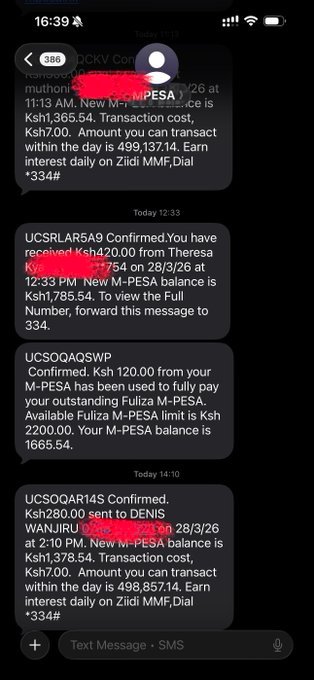
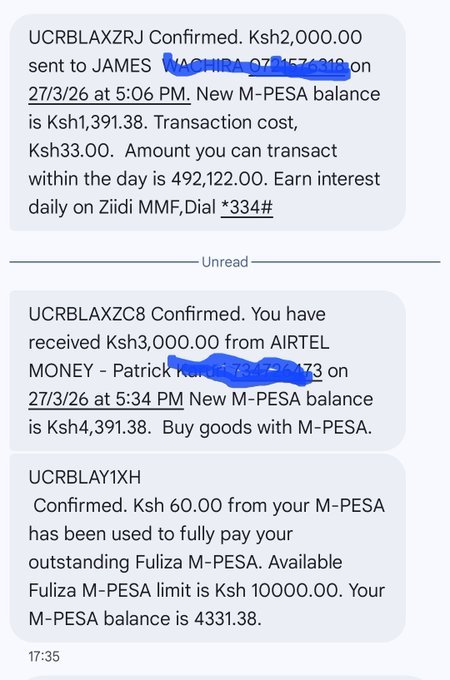
That explanation, however, is doing little to calm nerves.
From the screenshots I’ve seen, the issue is not just the money itself. It’s the manner in which it appears to be happening. Users say the deductions are being made without a prior explanation, without notice that there was an unresolved billing problem, and without a clear transaction-level breakdown showing where the supposed Fuliza debt came from in the first place.
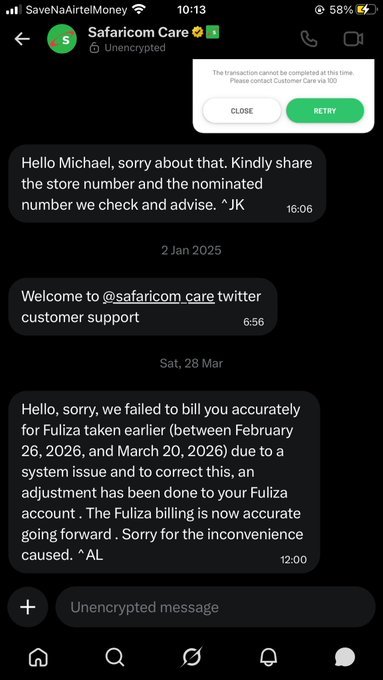
One of the responses attributed to Safaricom Care says the company “failed to bill you accurately for Fuliza taken earlier (between February 26, 2026, and March 20, 2026) due to a system issue” and that “an adjustment has been done” to the customer’s Fuliza account. The message adds that “the Fuliza billing is now accurate going forward.”
That wording has appeared in multiple complaints, which suggests this may not be a one-off mix-up affecting a single account.
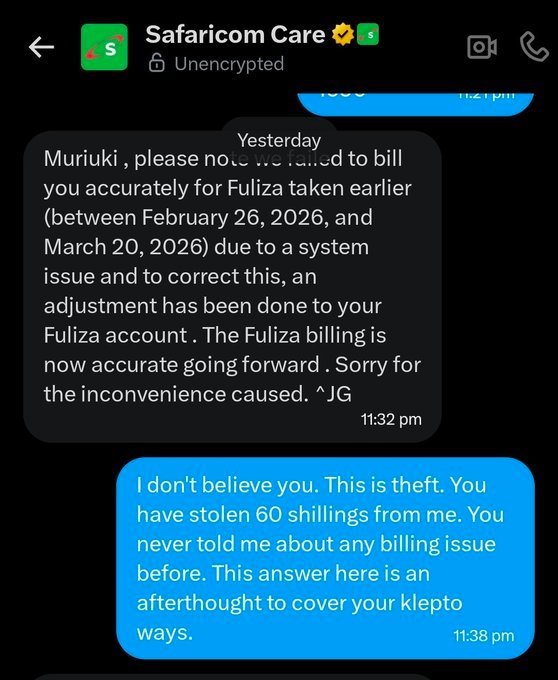
The frustration from users is easy to understand. Fuliza is not some vague loyalty points program hiding in the background. It is a credit facility tied directly to people’s mobile money, which for many Kenyans is effectively their everyday bank account. When money disappears and the explanation only comes after public pressure, trust takes a hit immediately.
A number of users insist they had not used Fuliza recently. Others say they may have used it before, but had no idea Safaricom had missed deductions earlier and was now carrying out what looks like a silent correction weeks later. One complaint that stood out argued that Safaricom could not even point to the exact transaction, date, or time that created the discrepancy, only a broad multi-week window. That vagueness is a big part of what is making this issue blow up.
And honestly, that’s the real problem here. Even if Safaricom’s explanation is accurate, people should not have to go on a detective mission through X replies and DMs to learn why their own money has been taken. A proper notice should have come first, with the amount, the relevant Fuliza transaction, the date it occurred, what went wrong, and why recovery was happening now.
From the transaction screenshots being shared, some of the deductions appear to happen immediately after money lands in an M-PESA account. That part is not unusual on its own, because Fuliza recoveries typically happen automatically when funds become available. What makes this case different is that some customers say they were unaware they even had an outstanding Fuliza balance to begin with, while others believe the balance being recovered is wrong altogether.
So at the very least, Safaricom appears to have a communication problem on its hands. At worst, it may be facing a much more serious trust issue around account transparency and billing integrity.
For a platform as central as M-PESA, that matters. A lot.
M-PESA is not just another app on a phone. It is where salaries hit, where biashara money sits, where school fees pass through, and where many households keep funds for daily use. When unexplained deductions start appearing, even in relatively small amounts, the public reaction is always going to be intense. Small deductions at scale also create the worst kind of suspicion, because people naturally start wondering whether this is an isolated billing cleanup or a wider systemic problem.
To be fair, the reports circulating online do not yet prove that every affected user was wrongly charged. Some may indeed have had legitimate Fuliza balances that were not recovered on time. But that is precisely why Safaricom needs to be much clearer than it has been so far. A generic “system issue” explanation is nowhere near enough when customers are questioning whether their money is safe.
What users seem to want is fairly straightforward. Show the exact Fuliza transaction in question. Show the amount that should have been deducted at the time. Show why it was missed. Show why the recovery was triggered now. And most importantly, notify the customer before taking the money, not after they’ve already noticed something is off.
Until that happens, the company is leaving too much room for doubt, and in financial services, doubt spreads fast.
I think Safaricom needs to address this publicly, not just one complaint at a time in private messages. If this was indeed a temporary system error affecting Fuliza billing between late February and mid-March, then the company should say so openly, explain the scope, clarify whether all deductions were valid, and tell customers how to verify any amount that has been recovered from their accounts.
Because right now, the message many users are getting is simple: money can leave your M-PESA account first, and the explanation may come later, if you complain hard enough.
That is not a reassuring message for the country’s biggest mobile money platform to be sending.