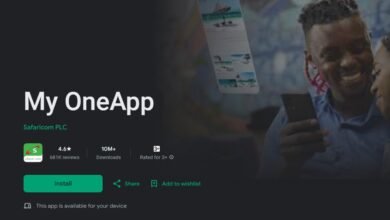


Safaricom’s new My OneApp is, in many ways, the app the company probably needed to build. It brings together services that had long been split between the M-PESA app and MySafaricom, offers a richer interface, surfaces more useful information, and generally feels like a more modern product. After using it for a few days, I can see the appeal.
But even with those gains, one thing keeps bothering me, and I think it is a much bigger deal than Safaricom may realize.
The name.
“My OneApp” might sound clean and modern inside a product meeting, but out here in the real world, it feels strangely disconnected from the two brands that gave this app its relevance in the first place: Safaricom and M-PESA. That disconnect is, for me, the biggest weakness of the new app, and it overshadows a lot of the good work Safaricom has done elsewhere.
For years, Safaricom and M-PESA have built deep recognition in Kenya. These are not just product names. They are daily language. People do not say they are going to open a fintech utility platform to initiate a peer-to-peer transfer, because thankfully normal people are not product managers. They say they are opening M-PESA. They say they are using Safaricom. That familiarity matters. It creates trust, clarity, and instant recognition.
My OneApp throws that away.
The name does not carry Safaricom’s identity. It does not carry M-PESA’s power. It does not immediately tell users what ecosystem it belongs to. In trying to sound broad and all-encompassing, Safaricom has stripped away the strongest emotional and practical cues the company had. For a business that has spent years making M-PESA one of the most recognizable financial brands in Africa, that feels like an unnecessary loss.
I honestly think adoption would have been much easier with a name that stayed closer to either Safaricom or M-PESA. Something like “Safaricom One,” “M-PESA One,” or even a more direct extension of an existing brand would have carried far more continuity. Instead, “My OneApp” sounds generic, like the kind of placeholder name that survives internal meetings and somehow ends up on the final product because nobody stopped it in time.
That branding disconnect matters even more because this is not a side app. This is supposed to become the digital front door for some of Safaricom’s most important services. When users are checking balances, buying bundles, paying bills, sending money, or managing their accounts, they want reassurance that they are inside a familiar, trusted environment. A name tied more clearly to Safaricom or M-PESA would have done that work instantly. My OneApp does not.
Beyond the branding issue, though, the app itself shows real promise.
The overall experience is more information-rich than what Safaricom offered before. There is more context, more visibility, and a stronger sense that the company is trying to give users a fuller picture of their activity. Compared to the older experience, My OneApp feels less bare and more useful. It looks and behaves like a platform meant to handle more than just one or two isolated tasks.
I also like the improved recipient identification. When sending money or paying for goods and services, the app resolves names in real time as you type. That is a genuinely useful addition. In a country where one wrong number can send money into the void and ruin your mood for the rest of the afternoon, better confirmation matters. This is one of those quality-of-life improvements that does not need flashy marketing because its value is immediately obvious in use.
At the same time, the rollout has not been clean.
Stability has been one of the app’s weakest points, especially around money transfers. I have seen bugs, and others have reported even worse experiences. The good thing is that this has notably improved over the past few days, which suggests Safaricom is actively working on fixes. So I would not say the app is fundamentally broken. It is usable, and overall it works well. But there have been enough hiccups to remind users that this is still a fresh merger of important services, and that kind of instability always hits harder when money is involved.
Then there is the migration problem.
For some users, upgrading to My OneApp appears to result in the loss of previously saved paybill numbers. That is the sort of thing that sounds minor until it happens to you. Saved paybills are part of routine behaviour. People build those lists over time because they do not want to memorize utility numbers, school fees accounts, or business tills every single time. Losing that data creates friction immediately, and worse, it makes the transition feel careless.
What frustrates me even more is that this could have been handled better with simple communication. If Safaricom knew there was a chance saved paybills would not migrate cleanly, users should have been warned before updating. A basic prompt telling people to save key numbers as Favorites beforehand would have gone a long way. Instead, some users appear to have walked into the new experience only to realize pieces of their setup did not come with them.
That feeds into another weakness: lack of user guidance.
A product like this does not just need code. It needs hand-holding, especially at launch. Safaricom is asking users to shift from familiar habits into a consolidated app that now carries more responsibility. That kind of transition should come with very clear instructions, warnings, and onboarding. When that guidance is missing, avoidable issues start feeling like product failures.
There is also the matter of access for users abroad. From the feedback I have seen, app updates appear to be restricted to Safaricom internet only in some cases, which creates unnecessary friction, especially for users outside Kenya. That is a strange limitation for a modern digital product tied to a global user base. Kenyans abroad still rely on Safaricom and M-PESA connections back home, and an app like this should make life easier for them, not more annoying.
So where does that leave My OneApp?
For me, this is not a bad app. In fact, overall, it works well. The interface is improved, the experience is richer, and some features, like smart recipient identification, are clearly steps forward. Stability is also getting better, which is encouraging.
But the app is still weighed down by rollout issues, migration gaps, and weak user communication. And above all that, it suffers from a branding decision that feels deeply unnecessary.
Safaricom had a chance to unify its digital ecosystem without abandoning the names that made that ecosystem powerful in the first place. Instead, it chose a title that sounds detached from both Safaricom and M-PESA, and in doing so, it diluted some of the trust and familiarity that should have made this transition easier.
My OneApp may eventually become the all-in-one platform Safaricom wants it to be. But right now, even as the product improves, I cannot shake the feeling that the company gave up too much in the name alone.