
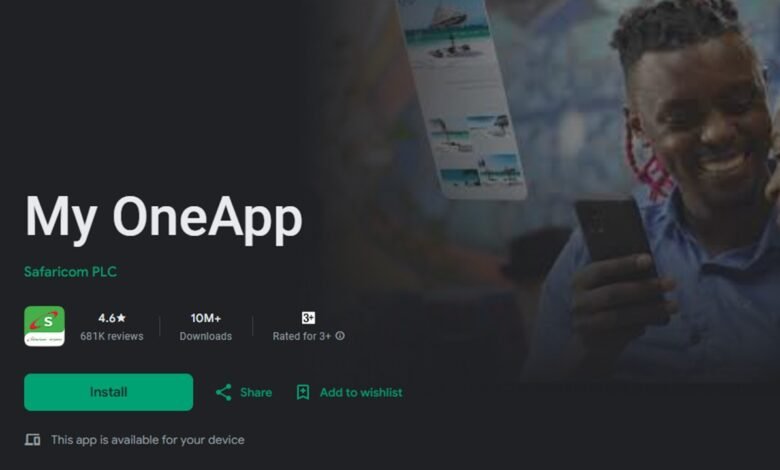

Safaricom’s new My OneApp was supposed to simplify life. Instead of juggling the M-PESA app and MySafaricom, users were promised one unified platform for payments, bundles, account management, fibre, and a growing list of mini-app services. That was the pitch when Safaricom unveiled the app during Decode 4.0 in Nairobi, positioning it as an AI-powered super app and a major step in its wider platform consolidation push.
But a few days into this rollout, the complaints are already piling up, and they touch the exact kind of features that should never feel shaky in a Safaricom app. Safaricom has publicly acknowledged that My OneApp has had login issues and that “most of the financial mini-apps services are not working,” adding that a resolution was underway. That is the sort of admission that immediately changes the tone around a launch like this. It stops being about bold vision and starts becoming about whether people can reliably access the services they depend on every day.
From what I’ve seen, this is not a case of the app being completely broken for everyone. I have My OneApp on my phone, and I am not experiencing most of the worst issues people are describing online. The app does open, major sections do load, and you can already see what Safaricom is trying to build here. But I have still bumped into a few errors here and there, enough to tell me that the rollout is not as clean as the company would have wanted. That mismatch is what makes this story interesting. The app is clearly functional for some users, yet unstable enough for others that the early public reaction has turned messy very quickly.
One of the loudest complaints has to do with access, especially for users outside Kenya or those trying to rely on Wi-Fi or another data connection. Recent Google Play Store reviews complain that the new app now expects a Safaricom SIM and Safaricom connectivity in cases where users previously had more flexibility. One reviewer called the update “a total mess,” saying the app could not be used properly over Wi-Fi while abroad, while another diaspora user complained that being forced to log in using Safaricom bundles made little sense outside the country. For a service tied so closely to money and everyday utility, that kind of friction is a serious problem.
Performance is another recurring theme. In those same public reviews, users complain about freezing during money transfers, sluggish behaviour, and the feeling that the new app is heavier than it needs to be.
One review says the app sometimes freezes when sending money and forces the user back to the SIM Toolkit. Another points to balance visibility, claiming the app does not always show the actual level of bundles clearly enough to track usage properly. That might sound like a minor annoyance in a normal consumer app. In a Safaricom app, where people are checking balances, buying bundles, and moving money in real time, it becomes a trust issue almost immediately.
That trust problem matters even more because My OneApp is not launching in a vacuum. This is not a brand-new category that users are still learning. It is replacing familiar routines. Safaricom has already started migrating M-PESA app users toward My OneApp through updates, while the older MySafaricom app remains active for now. In theory, that should reduce app juggling and bring everything under one roof. In practice, it also means Safaricom is asking people to shift critical habits toward a platform that, by the company’s own admission, is still dealing with login trouble and mini-app failures.
That is the real tension at the center of this launch. The idea behind My OneApp is easy to understand, and honestly, it is overdue. I’ve long felt that Safaricom’s digital experience had become too fragmented, with too many important services spread across too many surfaces. Merging M-PESA and MySafaricom into one place is the logical move. It gives Safaricom a better chance at surfacing the right tools, personalising the experience, and keeping users inside one cleaner ecosystem.
But that logic only holds if the basics are rock solid. The minute login becomes unreliable, payments freeze, balances feel unclear, or mini-apps fail to load, the convenience story starts to collapse under its own ambition.
So far, My OneApp looks less like a failed launch and more like a rushed one. That distinction matters. I do not think Safaricom has shipped a dead app. I think it has shipped an important app before fully earning user confidence in the merged experience. And because this app now sits so close to M-PESA, bundles, and core account access, users will naturally judge it more harshly than they would some casual lifestyle platform. That is just how it goes when your product is part of daily infrastructure.
Safaricom still has time to fix the narrative, but only if it treats these early complaints as product feedback instead of routine launch noise. The company’s vision for My OneApp is not hard to see. In my own testing, I can already see parts of it working. But a super app does not succeed because the concept is clever. It succeeds because the basics work every single time. Right now, too many users are telling Safaricom that My OneApp is not there yet.