

If you have visited Kenya as a tourist, or hosted someone visiting, you probably know the pain. You land at JKIA, excited about the Mara or the coast, but the moment you need to pay for something at a curio shop, a park gate, or a small hotel, things get awkward. Card machines are scarce. ATMs are unreliable. And carrying wads of foreign currency or freshly exchanged Kenyan shillings is neither safe nor convenient.
That is the problem TouristTap was built to solve. And now, the Kenyan government has officially recognised it as an authorised payment option across the country’s tourism ecosystem.
What just happened
Craft Silicon, the Nairobi-headquartered fintech company behind the ride-hailing app Little and core banking software used by over 300 financial institutions globally, has secured government approval for TouristTap to operate as an official payment channel at key tourism touchpoints. Think game parks, hotels, coastal resorts, and visitor attractions across the country.
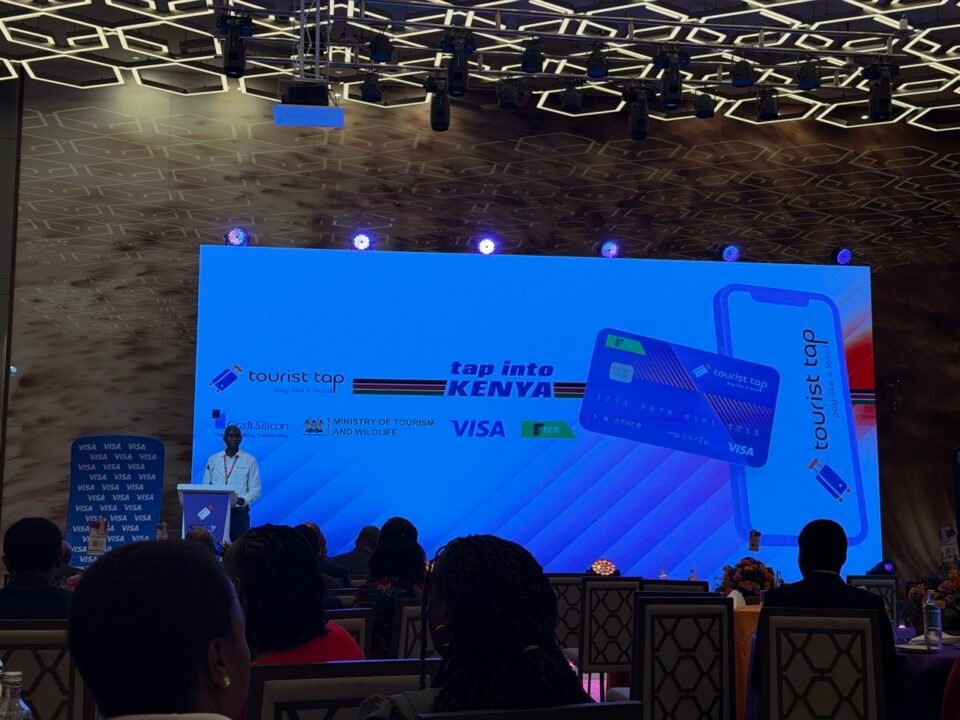
The announcement was made at the “Tap into Kenya” event, with Cabinet Secretary for Tourism and Wildlife, Hon. Rebecca Miano, presiding as chief guest. This is not just a product launch. It is a government endorsement, which is a significant distinction. It means TouristTap has been vetted and cleared to sit alongside existing payment methods at state-regulated tourism sites.

Craft Silicon CEO Kamal Budhabhatti gave a live demonstration of the platform at the event, and revealed that the company received its patent certificate for the technology just a day before the launch.
How TouristTap actually works
The app supports multiple payment channels. On the home screen, a user selects their country (Kenya is currently the only supported market) and chooses how they want to pay: M-Pesa, Airtel Money, Business Payments, or Online Payments.
From there, the app lets you send money to a Paybill number, a Till number, a mobile number, or a KES Wallet. If you are a tourist paying a lodge, you enter their till or paybill, key in the amount, and pay. The platform supports any international Visa or Mastercard, regardless of the currency on the card. So whether your card is denominated in US dollars, euros, pounds, or yen, it works. The merchant receives the payment in KES.
Craft Silicon confirmed at the launch that support for merchants to receive payments in foreign currencies is coming, but for now, all transactions settle in Kenyan shillings.
On Android devices, the NFC tap-to-pay functionality works natively. On Apple devices, the process routes through Apple Pay due to Apple’s closed NFC ecosystem. So a tourist with an iPhone tapping to pay KES 2,100 at a Nairobi restaurant, for instance, would complete the transaction via Apple Pay. This means the app works smoothly for tourists from countries where Apple Pay is already supported.
Transaction costs are clearly displayed within the app before a user confirms any payment. There are no hidden fees.
The platform is PCI-DSS certified, which is the global gold standard for card payment security. Card details are encrypted, never stored on the device, and the system uses PIN-on-Glass technology for transaction authorisation. KCB Bank processes and settles the payments, while Visa provides the card network rails through CyberSource, its payment management platform. In case anything goes wrong, Craft Silicon confirmed a 24-hour support line is available for users.
Not just for tourists
Here is where TouristTap gets more interesting than its name suggests.
The app is not limited to visitors. Any person in Kenya can use it to pay from a card to a till number, paybill, or mobile wallet. That is a meaningful capability. If you have a debit or credit card and want to pay a merchant who only accepts M-Pesa or a till number, TouristTap bridges that gap.
It also opens up a practical use case for the diaspora. A Kenyan in London or Toronto with an international Visa card can now pay directly to a Kenyan paybill or till number through the app. No intermediaries. No conversion fees through third-party remittance apps. Just card to local payment rail, directly.
There is also a referral system built into the app. Merchants who refer tourists to download and sign up for TouristTap earn a commission. This is a smart distribution play. Rather than relying solely on marketing to get tourists to adopt the app, Craft Silicon is giving merchants a financial incentive to do the onboarding themselves. A tour guide at Amboseli or a curio seller at Maasai Market becomes a distribution channel.
Why it matters for Kenya’s KES 500 billion tourism economy
The timing of this approval is not accidental. According to the Kenya Tourism Sector Performance Report 2025, released by the Ministry of Tourism in April 2026, the sector generated approximately KES 500 billion in revenue last year. That is up from KES 452 billion in 2024, a 10 per cent jump. The country welcomed 7.9 million visitors, including 2.7 million international arrivals and 5.2 million domestic travellers.
Those are strong numbers. But a significant chunk of that spending still happens in cash, particularly at smaller establishments, community conservancies, and informal tourism businesses. When payments are cash-based, revenue tracking is difficult, tax collection leaks, and the visitor experience suffers.
TouristTap’s government-backed rollout across tourism sites addresses this directly. If a visitor at Amboseli or Diani Beach can tap their phone to pay, the transaction is recorded, the merchant gets paid instantly, with a clear digital trail. CS Miano put it plainly: the platform strengthens revenue transparency and keeps Kenya’s tourism ecosystem globally competitive.
What about M-Pesa?
Kenya’s mobile money infrastructure is world-leading, and M-Pesa dominates domestic transactions. But M-Pesa was built for Kenyans. A tourist arriving from Berlin or Boston does not have an M-Pesa account and is unlikely to set one up for a two-week holiday.
TouristTap fills that gap by letting international visitors use the cards they already have, while routing payments into the local ecosystem that merchants already use. It is not a replacement for M-Pesa. It is a bridge between international card networks and Kenya’s mobile money rails.
The fact that the app lets a foreign Visa card pay directly to an M-Pesa number or a Lipa na M-Pesa till is the real technical achievement here. That interoperability between international card schemes and local mobile money is something very few platforms in Africa have managed cleanly.
What to watch next
There are several threads worth following from here.
First, the Apple Pay angle. TouristTap’s reliance on Apple Pay for iPhone users raises an interesting question: could this kind of tourism-driven demand accelerate Apple Pay’s formal rollout in Kenya? Apple has been slow to expand Apple Pay across African markets, but if a government-endorsed payment platform is routing iPhone transactions through it, the commercial case gets stronger.
Second, the multi-currency settlement question. Right now, merchants receive KES regardless of what currency the tourist pays in. When Craft Silicon enables foreign currency settlement, that changes the game for hotels and safari operators who deal in dollars and euros. It also introduces forex complexity that will need careful handling.
Third, the broader interoperability question. If TouristTap can connect international cards to M-Pesa tills and paybills this cleanly, what stops other payment solutions from doing the same? Kenya’s payment infrastructure has long been siloed. M-Pesa on one side, card networks on the other, bank transfers somewhere in between. Platforms like TouristTap that bridge these rails could push the wider ecosystem toward genuine interoperability.
Kamal Budhabhatti has been clear about the ambition: TouristTap is not a Kenya-only play. The company plans to expand to other African tourism markets where the same friction exists. For Kenya specifically, this government approval adds credibility that matters when pitching to park authorities, hotel chains, and county governments.
The real test, as always, will be adoption. Can TouristTap onboard enough merchants quickly? Will the user experience hold up during peak season in the Mara? And can the platform handle the complexity of payments across different counties, currencies, and connectivity conditions?
Those questions remain open. But with government backing, a KCB and Visa partnership, a patent in hand, and a tourism sector generating half a trillion shillings annually, TouristTap has a credible runway to prove itself.







The reviews of this app are seriously bad. Transactions are deducted but money never reaches. How can this be totally omitted. Is this not an artricle but paid advertisement?
Hi. Our article ran as a news report from the “Tap into Kenya” event, where the government approved TouristTap as a tourism payment option. It described what the app claimed to do.
We only used it limitedly and did not check the store reviews first. We can see some of those complaints were already up when we published, and we should have caught them. We are working on the follow-up now and will put questions to Craft Silicon about payments that get deducted but never delivered, and about how refunds work.
If it happened to you, email mail@tech-ish.com with the date and amount.