

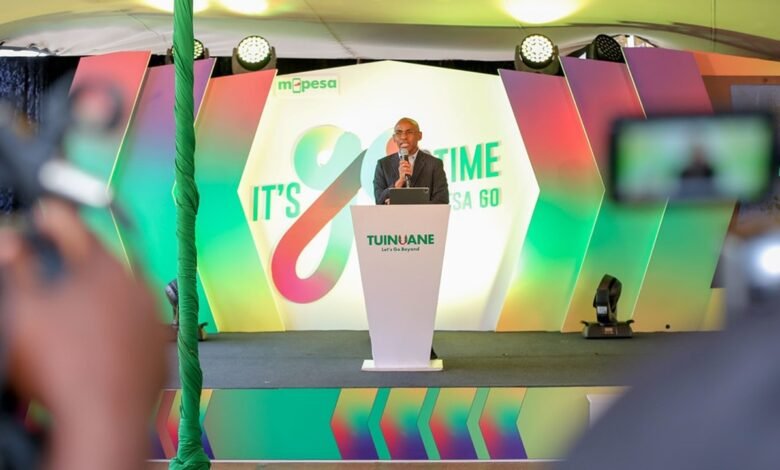
Safaricom on Wednesday issued a public apology to customers over its troubled My OneApp rollout, acknowledging that the experience has fallen short of expectations. The statement, published on the company’s social media channels and signed by Safaricom PLC, is the telco’s first formal admission of fault since the app began causing widespread problems in early April.
The apology specifically singles out roaming and diaspora customers as the most affected group. It also acknowledges that users whose phones had auto-updates enabled were migrated to My OneApp without warning. “This is not what we promised, and for that we are sorry,” the statement reads.
It took roughly two weeks to get here. My OneApp launched at Safaricom’s Decode 4.0 summit on 1 April, marketed as the long-awaited merger of the M-PESA app and MySafaricom app into a single platform. By 4 April, Safaricom was already admitting on X that login failures and broken mini-app services were widespread. By 7 April, tech publications across Kenya were documenting a full-blown user revolt.
What the apology does not say
The statement promises urgency and round-the-clock work from Safaricom’s teams. What it does not include is anything resembling a concrete plan. There is no fix timeline. There is no option to roll back to the previous M-PESA app through official channels. There is no mention of compensation for users who may have been locked out of their M-PESA wallets for days, and all the other features that run with the platform. And there is no explanation of how a product that went through months of public beta testing shipped with this many critical issues.

For diaspora users, who make up one of the loudest groups of complainants, the apology is especially hollow. My OneApp requires Safaricom mobile data for first-time activation – something that many users have pointed out kicks you out even 4 or 5 times, requiring data every time. That means no Wi-Fi, no VPN, and no foreign SIM data. If you are a Kenyan in London, Dubai, or Toronto, you need to activate roaming on your Safaricom line and burn through expensive roaming data just to open the app. And even that does not work in countries where Safaricom has no roaming partner.
The responses from Safaricom’s own customer care responses on X tell the story. One reply to a user abroad suggests removing the other SIM card and activating Safaricom data on the primary slot. Another tells a user in a country without a Safaricom roaming partner that access may be restricted “for security reasons,” and recommends using *334# or waiting until they are back in a supported location. These are not solutions. They are workarounds that assume every customer lives within range of a Safaricom cell tower.
A communication failure before a technical one
The deeper issue is not just that My OneApp launched with bugs. It is how the entire transition was handled. When Safaricom migrated users to its Fintech 2.0 platform and when they were introducing data minimisation features for M-PESA earlier this year, there was clear, advance communication. Users knew what was changing and why. With My OneApp, millions of people woke up to a completely different app on their phones with no prior notice.
For those with auto-updates enabled, the old M-PESA app simply vanished and was replaced by My OneApp. No opt-in. No explanation. No transition period where both apps ran in parallel. For a company whose app handles more than KES 38 trillion in annual transactions, that is an extraordinary lapse in change management.
The Consumers Federation of Kenya (COFEK) has already called on the Competition Authority of Kenya to investigate whether the forced migration violated consumer protection standards around informed consent. That regulatory pressure is new and worth watching.
The market context makes this worse
Safaricom is not making this mistake in a vacuum. M-PESA’s mobile money market share has declined from roughly 97% in late 2023 to about 89% by the end of 2025, according to Communications Authority of Kenya data. Airtel Money has more than tripled its share in the same period, climbing from under 3% to 11%, fuelled by lower fees, cashback promotions, and expanded agent networks.
A botched app launch that locks people out of their wallets, even temporarily, hands a gift to competitors who are already gaining ground. User are downloading the old M-PESA APK from a third-party sites, or worse, moves transactions to Airtel Money out of frustration, is a user Safaricom may not get back easily.
What comes next
Safaricom says it is fixing things. The apology lists email, Facebook, X, and physical Safaricom shops as support channels. None of those are particularly useful for someone locked out of their M-PESA in a different country – where USSD can’t run.
The real test is not whether Safaricom can stabilise My OneApp. It probably can, given enough time and engineering resources. The test is whether the company can rebuild the trust it burned through by treating a critical infrastructure migration like a casual app update. Two weeks of chaos and a single statement of regret do not clear that bar.



Join the discussion