

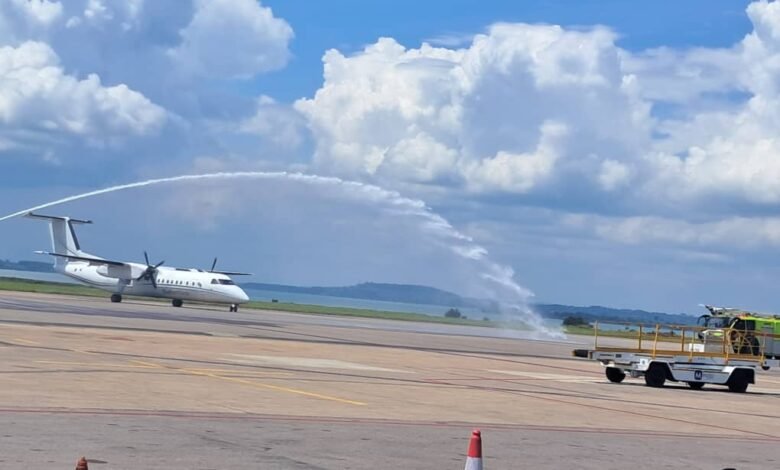
Safarilink Aviation announced on X that starting Friday, May 1, 2026, the airline will operate non-stop direct flights between Nairobi and Entebbe, while keeping its existing twice-daily Nairobi–Kisumu–Entebbe service running. It is a meaningful upgrade for travellers who want to skip the Kisumu stop and shave the trip down to roughly 75 minutes in the air.
This is the second big move Safarilink has made on the Uganda corridor in less than five months. Back in December 2025, the airline launched its multi-stop Wilson Airport → Kisumu → Entebbe routing, with introductory fares pegged at $150 (around KES 19,400) one-way from Nairobi to Entebbe and $110 from Kisumu. According to the Kenya Association of Travel Agents, that service was pitched as a same-day connector for business and leisure travellers between Kenya’s western circuit and Uganda’s capital.
Why the direct route matters
A non-stop flight changes the maths for two distinct customer segments.
For business travellers, a non-stop NBO–EBB hop is just over an hour. The current via-Kisumu schedule is closer to three and a half hours gate-to-gate when you factor in the Kisumu turnaround. That is the difference between a doable day trip and an overnight stay. Listings on Google Flights now show Safarilink running six non-stop NBO–EBB flights a week from Jomo Kenyatta International, operating Monday, Tuesday, Wednesday, Friday, Saturday, and Sunday.

For tourism, the play is more nuanced. Uganda’s biggest pull factors for Kenyan travellers are gorilla and chimpanzee tracking in Bwindi and Kibale, plus Lake Victoria and Murchison Falls. A non-stop flight makes a long weekend feel realistic. The via-Kisumu service still has a job: it serves Western Kenya travellers who want to fly to Entebbe without first heading east to Nairobi.
Safarilink is moving beyond bush airstrips
Safarilink has historically been Kenya’s “safari airline.” Its bread and butter has been Cessna Caravans and Dash 8s flying tourists into airstrips at Maasai Mara, Amboseli, Samburu and Lamu. The Entebbe push, alongside its newly upgraded third-daily Nairobi–Arusha schedule celebrated by the Ministry of Roads and Transport in late April, is a clear signal that the airline is repositioning itself as a regional connector across the East African Community, not just a bush carrier.
The competitive landscape it is walking into is crowded. Kenya Airways already runs 23 non-stop NBO–EBB flights a week. Uganda Airlines does 18. RwandAir, Ethiopian, and Qatar Airways pile on with one-stop connections. Safarilink’s pitch will lean on schedule convenience, regional onward connections through Wilson Airport to Diani, Lamu, Malindi and Zanzibar, and competitive introductory fares.
What this means for Kenyan travellers
If you are flying for work, the morning JKIA departure is what you want. If you are heading west first, or your meetings are in Kisumu and Kampala on the same trip, the via-Kisumu morning rotation is genuinely useful. The morning schedule departs Wilson at 0800, lands in Kisumu at 0845, departs for Entebbe at 0945, arrives at 1030, then turns around with Entebbe departure at 1115 and Wilson arrival at 1330.
Baggage allowance on the international sectors is 20kg, and check-in opens 90 minutes before international departures. Worth knowing if you are pricing this against Kenya Airways or Jambojet, which we’ve covered before on its own loyalty push.
The bigger story to watch is whether Safarilink can convert this network expansion into sustained passenger volume. Six flights a week is a foot in the door. Holding the slot, filling the seats, and adding frequencies is the harder part. If East African Community aviation liberalisation keeps progressing, expect Rwanda to be next on the route map.








Join the discussion