

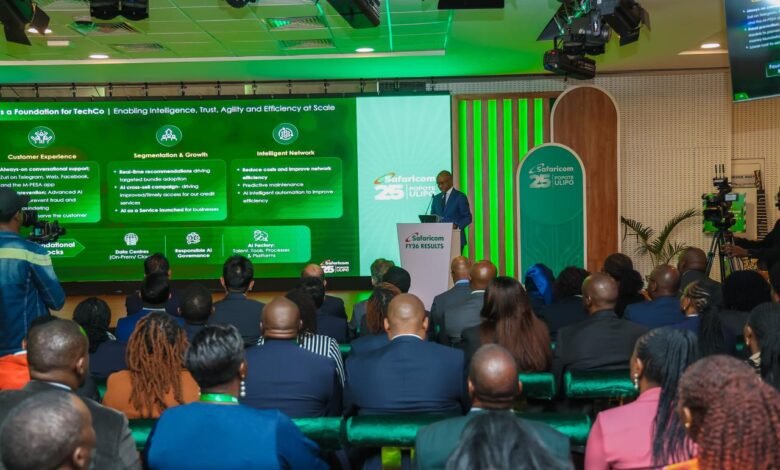
When Safaricom released its FY25 results last May, the consensus take on its Ethiopian operation was bleak. Heavy losses. Currency depreciation eating into reported numbers. A long, expensive road ahead. We summed it up at the time as a major opportunity and a financial sinkhole.
A year later, that framing needs revisiting.
In FY26, Safaricom Ethiopia’s operating losses halved. Customer growth accelerated. Network coverage hit 59.2% of the population. M-PESA Ethiopia more than doubled its active customer base. And for the first time, Safaricom has put a concrete target on the table: Earnings Before Interest, Taxes, Depreciation, and Amortization (EBITDA) will break-even by the end of FY27.
The Ethiopia bet is no longer just a leap of faith. The numbers are starting to support it.

What the headline numbers actually say
Service revenue grew 58.3% year-on-year in shilling terms to KES 14.08 billion. But that figure understates the underlying momentum. The Ethiopian birr depreciated 23.7% against the US dollar during FY26. Strip out the currency effect and look at performance in local currency, and service revenue grew 130.9% to ETB 15.9 billion. That is the number that reflects the actual business.
EBIT losses (the operating loss before interest and tax) narrowed from KES 61.1 billion in FY25 to KES 30.1 billion in FY26, a 50.7% reduction. EBITDA losses (which exclude depreciation) narrowed even more sharply, from KES 43.0 billion to KES 15.1 billion. Both figures exclude IAS 29 hyperinflationary accounting adjustments, which Safaricom is winding down following Ethiopia’s exit from hyperinflationary status in mid-2025.
For context, Safaricom’s total investment in Ethiopia through its parent stake is now USD 1.22 billion. Total funding raised across the consortium has reached USD 2.65 billion, including the USD 850 million spectrum licence and the USD 150 million M-PESA licence fees. This is a serious capital commitment by any measure.
Customer growth has stopped being aspirational
Three-month active customers grew 54.2% year-on-year to 13.6 million. One-month active customers reached 10.7 million, up 48.3%. These numbers reflect a network that now covers 59.2% of Ethiopia’s population, with 3,504 sites split between own-built (2,076) and collocated (1,428).
Active 90-day M-PESA customers more than doubled, growing 119.4% to 5.2 million. That is roughly 49% of all Safaricom Ethiopia GSM customers now using M-PESA. Transaction value reached ETB 32.5 billion (KES 28.6 billion) on volumes of 442.2 million. The merchant base reached 70,045 active monthly merchants.
For comparison, Safaricom Ethiopia’s M-PESA reached 5.2 million 90-day active customers in roughly two and a half years from launch. M-PESA Kenya took longer to reach a comparable share of its addressable market. Safaricom’s “leapfrog strategy” of compressing 18 years of Kenyan learnings into 18 months of Ethiopian execution appears to be working.
The Q4 inflection point matters
Inside the FY26 numbers is something more interesting than the annual totals. In Q4 FY26, Mobile Data Average Revenue Per User (ARPU) jumped 22.5% quarter-on-quarter to ETB 162.9. Voice ARPU jumped 42.6% quarter-on-quarter to ETB 42.7. Rate per minute on voice rose 44.0% in a single quarter.
These gains reflect the impact of regulator-led industry price corrections that took effect in late 2025. Ethiopia’s telecom regulator has been implementing what the industry calls a “cost of service” framework, designed to bring tariffs to economically sustainable levels after years of rates that were among the lowest in Africa. Safaricom Ethiopia implemented price adjustments in December 2025 across key products, with further phased increases expected.
This is significant for one reason: the cost base in Ethiopia is partly dollarised (network equipment, software licensing, foreign currency debt). The revenue base, until now, has been birr-denominated at unsustainably low rates. As prices rise toward economic levels, unit economics improve substantially. Q4 FY26 was the first quarter to show this clearly.
What “EBITDA break-even” actually means
Safaricom has set a clear target: deliver EBITDA break-even in Ethiopia in FY27. This is worth understanding precisely, because it is easy to misread.
EBITDA measures whether a business can cover its day-to-day operating costs from its revenue. EBITDA break-even means revenue is enough to pay the bills, but it does not yet cover the cost of the network and equipment Safaricom has built (depreciation) or the interest on its borrowings.
Safaricom’s own FY27 guidance reflects this carefully. The company expects an Ethiopia EBIT (Earnings Before Interest and Taxes) loss of KES 12–15 billion in FY27, even if EBITDA reaches break-even. Real net profitability is still likely two to three years further out.
That said, EBITDA break-even is a meaningful milestone. It is the point at which the Ethiopia operation stops consuming Group cash to fund its day-to-day running. From there, every shilling of additional revenue starts moving the business toward genuine profit.
The risks have not disappeared
Three things still matter for the Ethiopia thesis. First, the birr. It depreciated 23.7% against the Dollar and a punishing 39.6% against the Euro in FY26. Continued depreciation will keep eroding shilling-denominated reported results, even when local-currency performance is strong.
Second, foreign aid disruption. Safaricom flagged this directly in its operating environment review. Ethiopia has been a major recipient of bilateral and multilateral aid, and disruptions could affect macroeconomic stability. The June 2026 Ethiopian elections add another variable.
Third, capex is being deliberately reduced. FY26 Ethiopia capex was KES 18.7 billion, down 52.2% from FY25. FY27 guidance is KES 6–9 billion. This signals a shift from network build-out to optimisation. It is the right move at this stage, but it also means the easy customer growth from greenfield expansion is largely behind. Future growth has to come from monetisation, not coverage.
Where this leaves the bet
Safaricom Ethiopia is no longer the open-ended cash drain it was framed as a year ago. The trajectory is clear, the target is explicit, and the FY26 numbers genuinely back up the narrative. EBITDA break-even in FY27, if delivered, will be the moment Ethiopia stops pulling Group earnings down.
Real profitability remains further out, and the macro risks have not gone anywhere. But for the first time since Safaricom Ethiopia switched on its network in October 2022, the question is no longer whether the bet will work. It is when.
This is the second in a four-part series on Safaricom’s FY26 results. Read Part 1: M-PESA’s KES 183 billion year. Next: Part 3: The connectivity inversion and what Safaricom’s “Tech-Co” claim actually means.




Join the discussion