

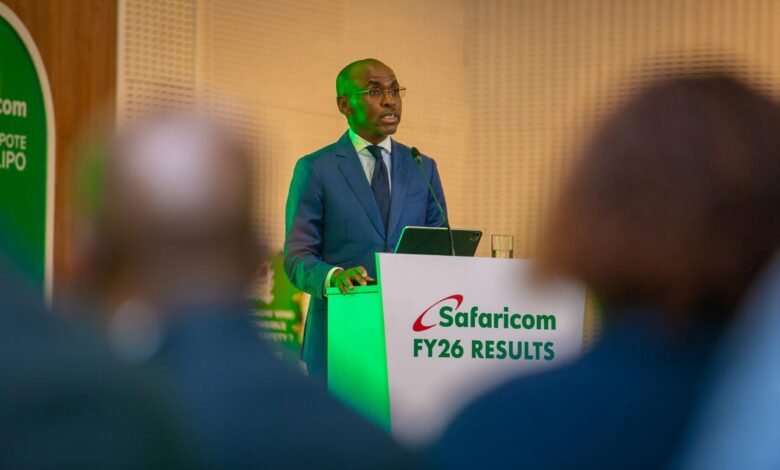
Safaricom has released its audited results for the financial year ended 31 March 2026. Kenya service revenue grew 10.0% year-on-year to KES 400.8 billion. Net income rose 24.7% to KES 119.1 billion. The Group, which includes the still loss-making Ethiopian operation, posted service revenue of KES 414.1 billion, up 11.5%.
Those are strong headline numbers. But the real story is in the composition of the revenue, and how fast it is shifting.
M-PESA’s share keeps climbing
In FY22, M-PESA contributed 38.3% of Safaricom Kenya’s service revenue. In FY25, that figure was 44.2%. This year, it reached 45.6%. That is a steady gain of roughly 1.5 percentage points every year, and there is no sign of it slowing down.
M-PESA revenue hit KES 182.7 billion, growing 13.4% year-on-year. Connectivity revenue, the combined total from voice, data, and messaging, grew a slower 6.9% to KES 197.9 billion. The gap between the two is now just KES 15.2 billion. A year ago, it was KES 24 billion. At these growth rates, M-PESA will likely be the larger revenue line before the end of FY28.

To put it plainly: Safaricom’s identity is shifting. It began life as a voice company, became a mobile data company, and is now becoming a financial services company that also sells airtime and internet.
Where the M-PESA money comes from
Consumer payments were the largest growth driver, contributing KES 74.5 billion in revenue, up 18.4%. Business payments followed at KES 56.7 billion, up 16.5%. Together, payments contributed nearly 91% of the year’s M-PESA revenue growth. Withdrawals, once the backbone of M-PESA’s earnings model, actually declined 1.3% to KES 36.8 billion. The old model of making money when people cash out is being replaced by making money when people pay.
Transaction volumes tell a striking story. The total number of M-PESA transactions in FY26 was 46.4 billion, up 25.1%. But the total value grew only 8.9% to KES 41.68 trillion. More transactions, for smaller amounts. This is what financial inclusion looks like in practice: millions more people using M-PESA for everyday purchases rather than just the occasional large transfer.
A significant share of those transactions are free. Kadogo (micro) transactions, those below KES 101 for person-to-person transfers and below KES 201 for merchant payments, accounted for 17.1 billion transactions in FY26. That is 36.8% of all M-PESA volumes. These are zero-rated under the Central Bank of Kenya tariff. Safaricom earns nothing directly on them but they keep users inside the ecosystem and drive merchant adoption.
3.1 million merchants and counting
The merchant base expanded 71% to 3.1 million. Most of that growth came from Pochi La Biashara, the informal business wallet product designed for mama mbogas, boda-boda riders, and kiosk owners. Pochi tills grew 81.5% to 2.1 million. Lipa na M-PESA merchants grew 54.2% to 1.0 million.
Pochi revenue nearly doubled, rising 86% to KES 4.0 billion. This is significant because Pochi targets Kenya’s informal sector, the part of the economy that formal banking has largely failed to reach. Every new Pochi till is a small business being digitised for the first time.
Lending and wealth management are scaling
Beyond payments, Safaricom’s financial services products are gaining serious traction.
Fuliza, the overdraft product operated with NCBA, KCB, and Sidian Bank, disbursed KES 1.47 trillion during the year, up 49.3%. Distinct Fuliza users more than doubled to 17.7 million. The repayment rate held at 101.5% of disbursements, suggesting the credit quality remains healthy, though independent verification of the underlying portfolio health is limited.
Wealth management was the breakout story. Assets under management across Ziidi and Mali more than doubled to KES 21.0 billion, from KES 9.6 billion in FY25. Active customers grew from 600,000 to 2.2 million. During the year, Safaricom launched Ziidi Trader in partnership with the Nairobi Securities Exchange and Kestrel Capital, allowing M-PESA users to buy and sell NSE-listed shares directly from their phones. As of the results, 511,000 users had opted in and 84,000 were actively trading.
Ziidi Trader is still small. But the direction it signals is important. M-PESA is moving from being just a payment and lending platform, to becoming a wealth and investment platform. The competitive implications for banks, SACCOs, and standalone fintechs are real.
The platform underneath
What most readers will not see in the headline numbers is the technology shift that happened during the year. In September 2025, Safaricom migrated the entire M-PESA platform from its legacy G3 architecture to Fintech 2.0, a cloud-native system now capable of processing 6,000 transactions per second, with headroom to scale to 12,000. The platform now supports 149,000 ecosystem developers and runs with 99.999% uptime.
This upgrade unlocked new capabilities including Shiriki Pay, which lets users authorise a trusted person to spend from their wallet, and enhanced fraud detection powered by AI. Over 1 million users had adopted Shiriki Pay by year end. The upgrade also tripled Fuliza’s processing capacity, which explains part of the surge in overdraft usage.
What to watch
M-PESA’s trajectory is impressive, but there are real questions worth tracking. Take rates on chargeable transactions have been compressing for five straight years, falling from 93 basis points in FY22 to 60 basis points in FY26. That means Safaricom is earning less per shilling transacted even as total volumes surge. Growth is being powered by volume, not pricing power.
The Ziidi MMF yield of 5.8% also sits well below competing money market funds in Kenya, several of which offer 9% to 12%. Safaricom’s distribution advantage is enormous, but yield-sensitive customers may eventually notice the gap.
And while M-PESA’s revenue continues to climb, the growth rate itself has been gradually decelerating: from 15.2% in FY25 to 13.4% in FY26. On a KES 183 billion base, that is still impressive. But sustaining double-digit growth gets harder every year.
For now, though, the direction is clear. Safaricom is being reshaped by M-PESA more than by any other part of the business. The question is no longer whether it will become a fintech-first company. The question is when the market starts valuing it as one.
This is the first in a four-part series on Safaricom’s FY26 results. Next: Part 2: Safaricom Ethiopia — how the company’s biggest bet is approaching break-even.






Join the discussion