
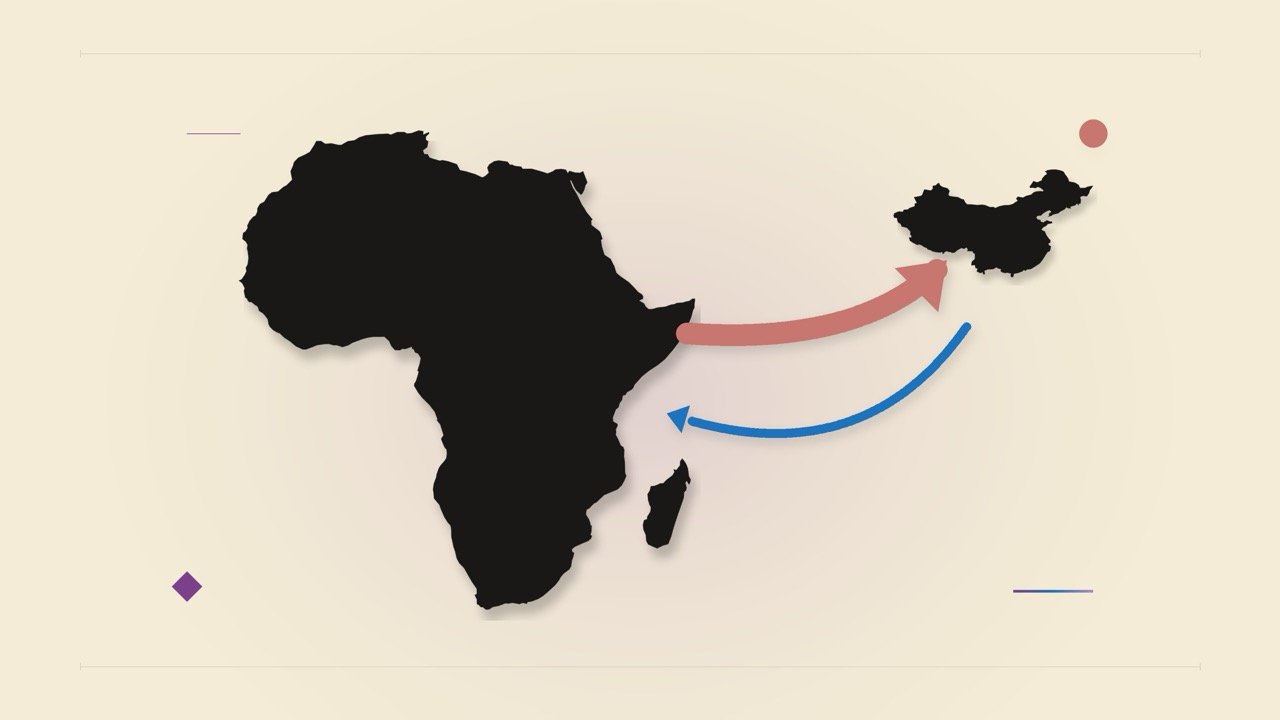
For most of the last two decades, the story of China in Africa was a story of money flowing in. Chinese banks financed railways, ports, roads and power plants across the continent, and the headline question was always how much Beijing would lend next.
New research released on 20 May 2026 shows that era has ended. The 2026 edition of the China–Africa Economic Bulletin, published by the Boston University Global Development Policy Center and the African Economic Research Consortium (AERC) ahead of the African Development Bank’s annual meetings, finds that the relationship has shifted from large infrastructure lending toward trade. And for the first time at scale, the cash is now moving in the opposite direction. African governments are repaying Beijing more each year than they receive in new loans.
Trade is booming, but it is lopsided
The top-line number is a record. Africa’s total trade with China reached $275 billion in 2024, made up of $182 billion in imports from China and $93 billion in exports to it. China was the single largest export destination for 19 of Africa’s 54 countries.
That sounds like a continent doing brisk business. The problem is the shape of it. Africa imports roughly twice as much from China as it sells back, and that gap has been widening. The report puts Africa’s trade deficit with China at about 3.1% of the continent’s entire GDP, and warns it could grow.

The reason is what Africa actually sells. For 20 years, exports to China have been dominated by raw materials. In the most recent five-year period, extractives made up 87% of everything Africa exported to China — copper, bauxite, cobalt, manganese and other minerals that feed Chinese factories. Manufacturing and agriculture each account for less than a tenth. Africa digs things up and ships them out, then buys back finished goods. Two decades of trade growth have not changed that.
This is why a policy Beijing is promoting heavily may matter less than it sounds. In 2026, China extended zero-tariff access to 53 African countries, removing import duties on African goods. The report’s authors are blunt that cheaper market access will mostly increase the volume of raw materials Africa already exports, rather than help it sell higher-value products. Without African industrial policy to back it up, tariff-free trade could even widen the deficit.
The lending boom is over
The bigger change is in finance. Chinese loan commitments to Africa have collapsed from their 2010s peak, when they exceeded World Bank lending in some years. In 2023, eight African countries and two regional lenders took 13 loans worth about $4.61 billion. In 2024, that fell to just six loans worth $2.1 billion — a fraction of the tens of billions seen a decade ago.
The most striking finding is what the report calls a turn to negative net transfers. In plain terms: add up all the new money China lent African governments in a year, then subtract everything those governments paid back in principal and interest. For years that sum was positive, with billions flowing into the continent. It peaked around $7.4 billion in 2014. It has since fallen steadily, crossed zero around 2021, and by 2024 sat at roughly -$2.9 billion. Africa is now a net payer to China.
That matters because debt repayments compete directly with everything else a government wants to spend on. Nigeria’s president said in May 2026 that the country would spend $11.6 billion servicing debt this year, nearly half its projected revenue. Many African states face the same squeeze, and money sent to creditors is money not spent on hospitals, schools or the energy transition.
Investment is back, but narrow
Chinese direct investment did rebound in 2023 and 2024 after pandemic lows. But the report cautions this is driven by a handful of large projects, not a broad recovery. Between 2004 and 2024, Chinese firms announced $73.9 billion in greenfield investment (building new operations) and $38.1 billion in mergers and acquisitions. Since the 2013 launch of the Belt and Road Initiative, the balance has tilted toward greenfield projects, with a record of nearly $14 billion announced in 2023.
There is a green-tech angle worth watching. China’s exports of low-carbon technology to Africa — solar panels, batteries, electric vehicles, pollution control gear — hit $9.8 billion in 2024, more than double the 2013 level. But these go overwhelmingly to a few large economies like South Africa, Egypt and Nigeria. And China has stopped financing fossil-fuel projects in Africa since 2019, while its lending to renewables has stayed tiny, at roughly $1.7 billion across the entire 2000–2024 period. Beijing is selling Africa clean technology far more than it is financing clean power on the continent.
What this actually means
The report’s careful conclusion is that this is evolution, not transformation. China is not leaving Africa. It is changing how it engages, moving from a single big-lender model toward trade, selective investment and country-by-country deals. As we’ve seen in our coverage of how the Railway Development Levy on Kenyan fuel quietly funds SGR repayments, the cost of the last lending boom is now a fixed line in national budgets, and that bill does not disappear when the loans stop.
The practical takeaway for readers across the continent is this: the question is no longer how much China will lend. It is whether African governments can turn raw-material exports into something more valuable, manage the repayments already owed, and negotiate the next phase of this relationship country by country rather than waiting for one continent-wide deal from Beijing. The data says the leverage is shifting. What Africa does with it is the open question.









Join the discussion