

When news first broke that the Finance Bill 2026 proposes new taxes on digital services and payments, many Kenyans immediately focused on the pain points: M-PESA, paybills, and online transactions becoming more expensive.
Then came reports of a 25% tax on mobile phones, and social media exploded.
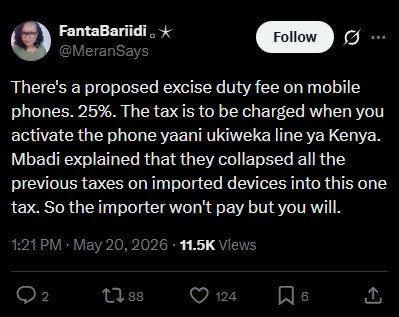
At first glance, it sounded like smartphones in Kenya were about to become even more expensive. But after listening carefully to Treasury CS John Mbadi explain the proposal, I think many people — understandably — misunderstood what is actually being proposed.
And if the government implements this exactly as explained, smartphones in Kenya could actually become cheaper and more accessible than they are today.

Phones in Kenya are already heavily taxed
One thing that stood out to me from Mbadi’s explanation is that the proposed 25% tax is not an entirely new charge being added on top of existing taxes.
“There is already 10% excise duty as we speak. So excise duty is not new,” the CS explained.
According to the CS, imported mobile phones currently attract:
- 16% VAT
- 10% excise duty
- 25% import duty
- 2.5% import declaration fee
- 2% railway development levy
Combined, these charges create what Treasury estimates is an effective tax burden of about 55.5%.
And honestly, this explains a lot.
It explains why smartphones in Kenya often cost significantly more than they do internationally. It explains why budget devices sometimes stop feeling “budget” once they hit local shelves. And it explains why retailers frequently struggle with pricing flexibility.
Under the proposed Finance Bill 2026 framework, the government says it wants to collapse all those taxes into a single 25% excise duty.
“The proposal under the Finance Bill 2026 seeks to simplify the existing structure by replacing the current fragmented framework with a single 25% excise duty collected upon activation of the phone,” he explained.
That is a massive difference.
The “activation tax” is being misunderstood
A lot of the backlash online seems to come from one phrase: the tax will be charged upon activation. Many interpreted this to mean consumers will suddenly receive an extra bill after buying a phone. But that’s not what Treasury appears to be saying.
From Mbadi’s explanation, the idea is that retailers will no longer pay multiple taxes upfront when devices arrive at the port. Instead, they import the phones without those layered charges, stock them in stores, sell them normally, then remit the single 25% tax, down from 55.5%, once the device is actually purchased and activated by the final user.
Today, traders must pay huge taxes before a phone is even sold. That locks away business capital in inventory sitting on shelves. Under the proposed model, retailers retain more liquidity, can import more stock, and potentially price devices more competitively.
From a tech consumer perspective, this is arguably one of the most important parts of the Finance Bill 2026 conversation, and strangely, one of the least discussed. Mbadi himself questioned why people were resisting the proposal:
“Tell me how that makes phones more expensive than the current arrangement.”
He also confirmed that several current charges would effectively disappear under the new framework.
"Mobile phones will no longer be subject to 16% VAT, 2.5% import declaration fee and 2% railway development levy under the proposed framework. The 25% import duty will also be removed."
This could be a win for Kenya’s digital economy
I’ve spent years covering smartphones and consumer tech, and one thing has remained consistent: phones are no longer luxury gadgets. They are work tools. School tools. Banking tools. Business tools.
A cheaper smartphone market benefits everyone, from students and creators to online workers and small businesses. And at a time when Kenya is rapidly digitising services, lowering the tax burden on smartphones could have a much bigger long-term economic impact than people realize.
Of course, this is still a proposal and public participation is ongoing. But based on the explanation Treasury has provided, this particular change in the Finance Bill 2026 may actually be one of the rare tax proposals that could genuinely work in favour of Kenyan consumers.
Especially in a country where mobile money transaction fees already remind us how expensive digital access can become.









Join the discussion