

Africa’s smartphone market is still growing, but the latest numbers from Omdia suggest the continent may be approaching a difficult turning point. According to Omdia’s latest Smartphone Market Pulse for Q1 2026, smartphone shipments across Africa grew 3% year-on-year to 19.9 million units. On paper, that sounds healthy enough. But the story underneath those numbers is far less comfortable.
The research firm now warns that Africa’s smartphone outlook for 2026 could contract by as much as 28% as rising component prices, currency volatility, supply chain pressures, and weakening consumer purchasing power continue to squeeze the continent’s most important device categories.
And honestly, this report reads less like a victory lap and more like an early warning.
For years, Africa’s smartphone growth story has been powered by one thing above everything else: affordable phones. Not premium devices. Not flashy AI features. Not foldables. Affordable smartphones built for first-time buyers and price-sensitive consumers.

That market is now under pressure.
Omdia says the sub-US$200 segment still accounted for 75% of smartphone shipments in Q1 2026, reinforcing just how dependent Africa remains on low-cost devices. But vendors are increasingly struggling to sustain those price points as memory prices rise and profit margins continue shrinking. At the same time, consumers are reacting exactly how you’d expect: by holding onto their phones longer.
Kenya is perhaps one of the clearest examples of this shift. Omdia says the country’s smartphone market declined 16% year-on-year in Q1 2026 as rising retail prices pushed consumers to significantly extend replacement cycles. That tracks with what many of us have been observing locally for months now. Smartphones are becoming harder to replace, not because people no longer want upgrades, but because the cost of upgrading keeps moving further away from ordinary buyers.
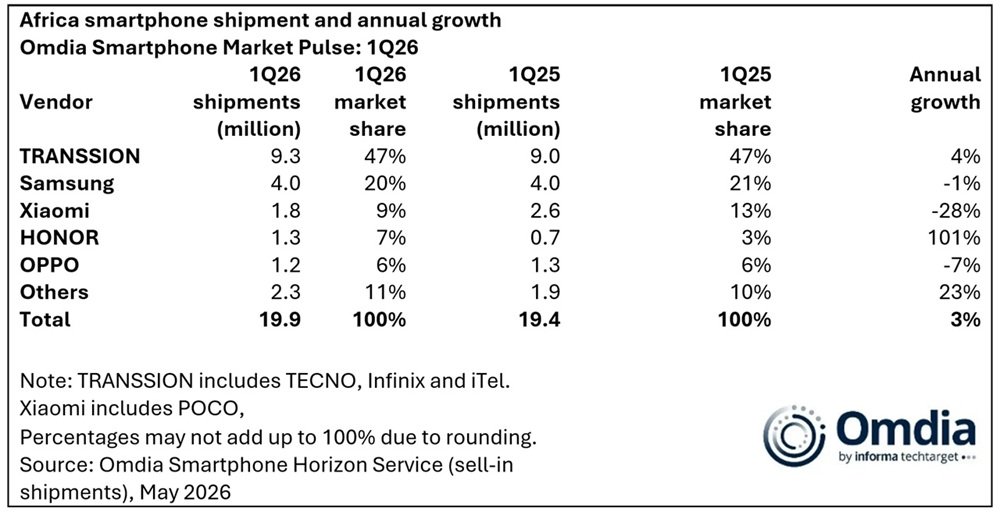
Elsewhere across the continent, the picture was mixed.
South Africa emerged as one of the strongest-performing markets, growing 17% year-on-year as premium and upper mid-range demand remained relatively resilient. Nigeria also posted 8% growth, largely supported by demand for affordable 4G and 5G smartphones in the US$200–299 range. But Egypt fell 10% amid supply chain disruptions and weaker consumer sentiment, while Algeria recorded a steep 28% decline due to import restrictions, forex constraints, and manufacturing delays. Interestingly, Morocco managed to grow 6% after reducing import duties from 17.5% to 2.5% from January 2026, showing just how much policy decisions can influence smartphone affordability and market momentum.
That’s exactly why Kenya’s ongoing tax debate around smartphones matters so much.
According to the Finance Bill 2026 proposal on smartphone taxation, the government plans to replace the current layered tax structure, which reportedly pushes smartphone taxation to around 55.5% at importation, with a single 25% activation-based tax. If implemented properly, that proposal could meaningfully reduce entry barriers for lower-end smartphones, particularly in the exact price categories that continue to drive Kenya and Africa’s digital adoption.
Because the truth is this: smartphones are no longer luxury products in African markets. They are infrastructure.
They are how people access mobile money, digital banking, education, work opportunities, ride-hailing services, healthcare information, and increasingly even government services. Every extra tax layer added onto a low-cost smartphone pushes digital participation further out of reach for millions of people.
Omdia also points to another important shift happening quietly in the background. While the entry-level market remains dominant, financing programs are gradually helping consumers move into slightly more expensive devices. The US$300–499 smartphone segment reportedly grew 43% year-on-year in Q1, driven partly by stronger financing ecosystems and operator partnerships.
And this is where Kenya may actually be better positioned than several other African markets.
Unlike many regions where smartphones are still largely cash purchases, Kenya already has a relatively mature device financing ecosystem through mobile operators, banks, retailers, and fintech partnerships. That doesn’t solve affordability pressures entirely, but it does soften the impact for consumers looking to upgrade.
Still, the broader warning in Omdia’s report is difficult to ignore. Africa’s ultra-budget smartphone market, the very segment that powered the continent’s digital decade, is becoming increasingly difficult to sustain. And unless affordability improves through better policy, financing, localized manufacturing, or reduced supply chain costs, Africa’s next smartphone adoption wave could arrive much slower than many expected.








Join the discussion