

Kenya’s home internet market is no longer moving slowly. Over the past few months, nearly every major player in the fixed broadband space has made an aggressive move, be it through lower pricing, higher speeds, wider expansion, or flashy new packages meant to lure frustrated customers away from rivals.
Now, Zuku has joined the fight in a very noticeable way.
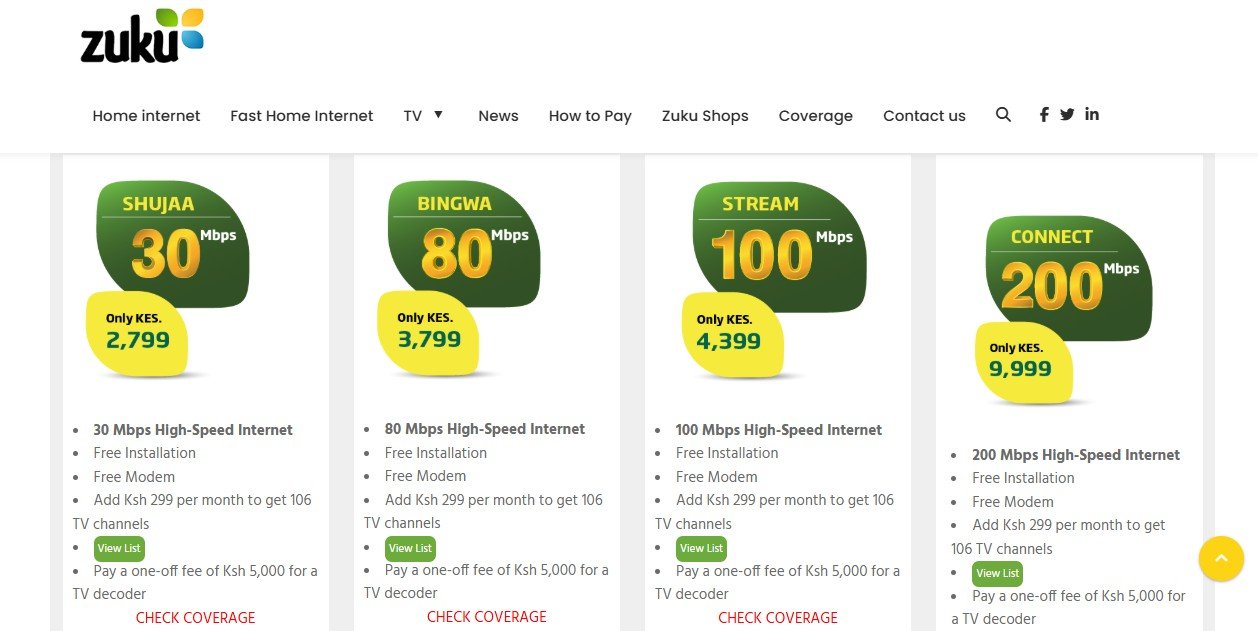
The Wananchi Group-owned ISP has quietly doubled speeds across its major home internet packages without changing monthly prices, effectively giving customers more bandwidth for the same amount of money. The company hasn’t made any loud public announcement yet as far as I can tell, but its official website has already been updated with the new packages.
And honestly, this move was inevitable.

For years, Zuku has occupied a strange position in Kenya’s home internet market. It remains one of the most recognizable fixed internet brands in the country, especially in urban estates and apartment blocks. But in recent years, the company has increasingly found itself squeezed between Safaricom’s rapid fibre expansion, Faiba’s speed reputation, and newer disruptive challengers targeting price-conscious users.
Now the pressure appears to have finally forced a response.
Previously, Zuku’s entry-level Shujaa package offered 15Mbps at KES 2,799. Bingwa delivered 30Mbps at KES 3,799, Stream offered 50Mbps at KES 4,399, while the top Connect package came with 100Mbps for KES 9,999.

Those same prices now deliver 30Mbps, 80Mbps, 100Mbps, and 200Mbps, respectively.
That is a massive jump overnight.
In practical terms, Zuku customers are now getting double the speeds they used to get at the exact same cost, at least on paper. The updated packages are already visible on Zuku’s official website, complete with the same installation and modem benefits the company has traditionally bundled with its fibre plans.
What makes this especially interesting is the timing.
Just weeks ago, Airtel Kenya officially launched XStream Fibre, marking one of the telco’s biggest entries into the fixed internet market in years. Airtel’s pricing immediately got attention because it undercut some competitors while simultaneously offering significantly higher speeds.
Safaricom quickly responded too. The telco recently refreshed its Home Fibre packages with higher speeds, pushing its low and mid-tier offerings even further as the competition intensified. But almost immediately after that, the company also quietly reduced Fair Usage Policy (FUP) limits, a move that sparked criticism among heavy internet users who felt the speed increases were being balanced out by stricter usage caps.
Meanwhile, Faiba continues to build momentum. According to the latest nPerf fixed internet performance report for Kenya, Faiba emerged as the top-performing fixed internet provider in several key metrics, reinforcing its growing reputation among users who care more about consistency and latency than just marketing numbers.
Then there are the smaller challengers steadily disrupting the market from below.
Earlier this year, we saw Savanna Fibre introduce aggressive new home internet pricing, while Poa Internet revealed plans to expand into Kisumu, a notable development for a city where reliable and affordable home internet options have historically been limited.
All these developments are happening against the backdrop of Kenya’s broader digital transformation push. Safaricom’s FY26 results recently showed just how central connectivity has become to the economy, with the company reporting major growth in both data usage and digital services. In fact, the operator’s latest financials revealed that mobile data is increasingly becoming the centre of Kenya’s digital economy story, not traditional voice services anymore. (FY26 data and techco breakdown and M-PESA FY26 analysis).
And that’s why Zuku’s latest move matters.
Internet access in Kenya is still expensive relative to the rest of East Africa. Kenya also ranks among the slowest in the world for fixed internet. While speeds have improved in 2026, affordability remains a real barrier for many households trying to work remotely, study online, stream content, or run small businesses from home.
So whenever competition forces providers to offer more value without raising prices, consumers benefit.
Of course, the real test will not be the numbers on Zuku’s website. It will be whether users consistently experience these upgraded speeds in real-world usage, especially during peak evening hours when congestion usually exposes weak networks very quickly.








Join the discussion