
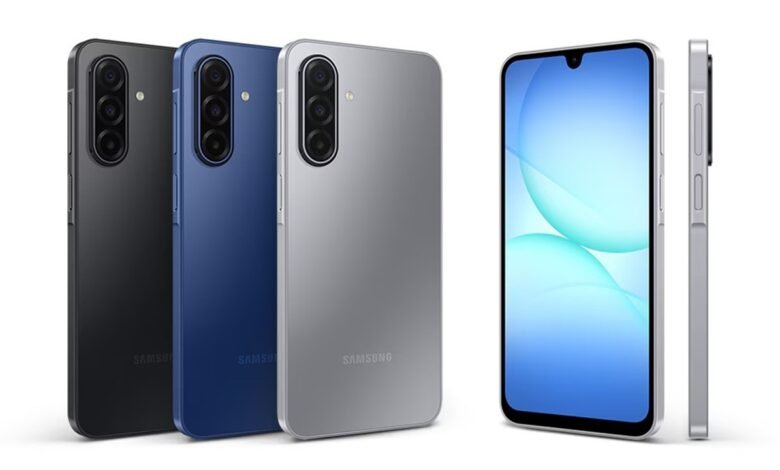
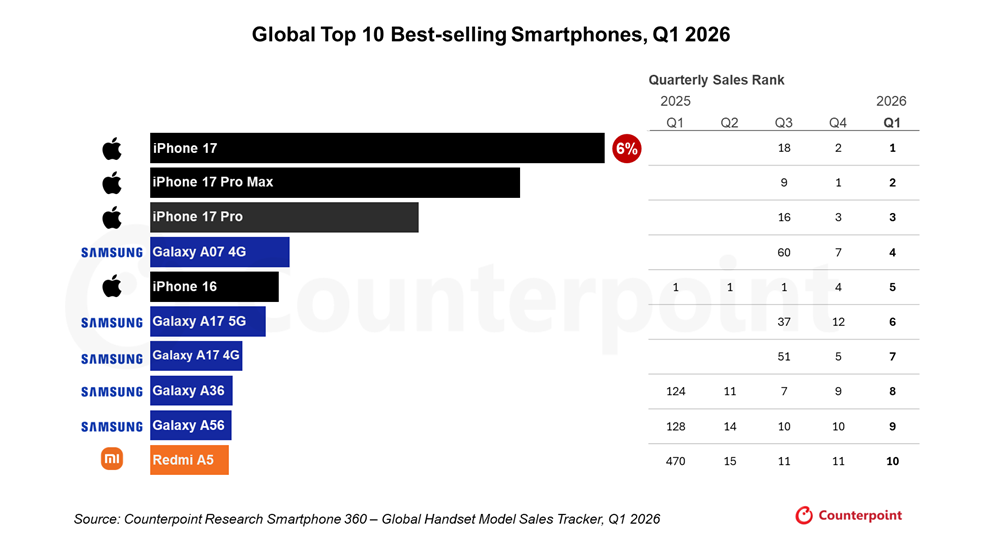
Looking at Counterpoint Research’s latest Global Handset Model Sales Tracker for Q1 2026, I can’t help but notice a glaring reality about the global smartphone market: we are living in a tale of two extremes. The numbers are out, and the major headline here is that Samsung Galaxy phones took a whopping 5 spots in the global top 10 best-selling smartphones, leaving Apple and Xiaomi/Redmi to share the remaining five.
But a closer look at which phones actually made the cut tells a fascinating story about who is buying what. In short? The monied buy iPhones, and the less monied go for budget Androids.
Apple takes the crown where it matters most
It’s no surprise that Apple’s high-end iPhone 17 series dominated the very top of the charts. The base iPhone 17 led the entire list with a commanding 6% market share, followed closely by the iPhone 17 Pro Max and the iPhone 17 Pro in second and third place, respectively. Apple’s performance here is nothing short of stellar. The iPhone 17 registered double-digit year-over-year growth in key markets like the US and China, and an insane 3x growth in South Korea. The older iPhone 16 also hung on tightly to the number 5 spot.
Overall, the contribution of the top 10 best-selling smartphones reached 25%, the highest we’ve ever seen for a March quarter. According to Counterpoint, this concentration at the top is expected to remain high throughout 2026 as brands push limited models amidst an otherwise declining general market.

Samsung’s mid-range masterclass
Android definitely had a better quarter this time around, thanks almost entirely to an exemplary showing from Samsung. But unlike Apple, which relies on its premium flagship series to top the charts, Samsung’s leading pack is packed exclusively with mid-range and budget phones.
Taking the number 4 spot globally and wearing the crown for the best-selling Android smartphone is the Galaxy A07 4G. What is driving its massive success? Samsung’s brilliant promise of six years of software and security updates has turned this budget device into a long-term investment for everyday users. In markets like Kenya, it’s devices like the Galaxy A07 4G that dominate the device financing market. This positioning favours Samsung by helping push more units locally and in other markets where young people are just switching to their first smartphone. Or phone, for that matter.

In fact, the best-selling Android smartphones right now are sub-KES 20,000 phones. The Galaxy A07 4G, the Galaxy A17 4G (7th), and the slightly pricier Galaxy A17 5G (6th) are moving massive volumes. If you are shopping in this specific tier locally, we highly recommend checking out our guide on the best smartphones in Kenya under KES 20,000.
The Galaxy A36 (8th) and Galaxy A56 (9th) round out Samsung’s sweep, representing the next best and most affordable steps up from the A17 series. This time, there’s no room for the A26.
Where are the Android flagships?
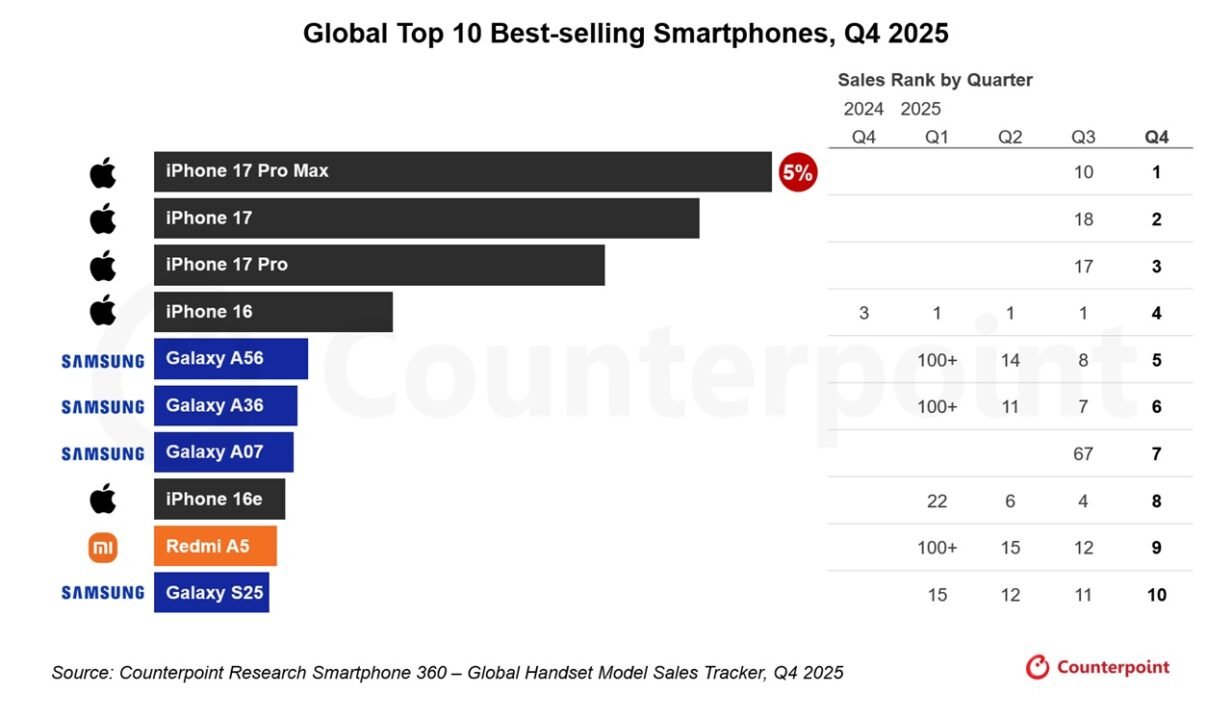
If you look back at Q4 2025, the flagship Galaxy S25 was sitting comfortably in the number 10 spot. Before the S25, the S25 Ultra featured regularly in the top 10 list throughout 2025. Fast forward to Q1 2026, and it has completely dropped off the list. Meanwhile, the newer Galaxy S26 didn’t make the cut either, though that’s largely because it started selling late in Q1 2026. Still, I’m willing to bet my bottom dollar that the Galaxy S26 Ultra will claw its way onto this list from Q2 as the year progresses and sales stabilize.
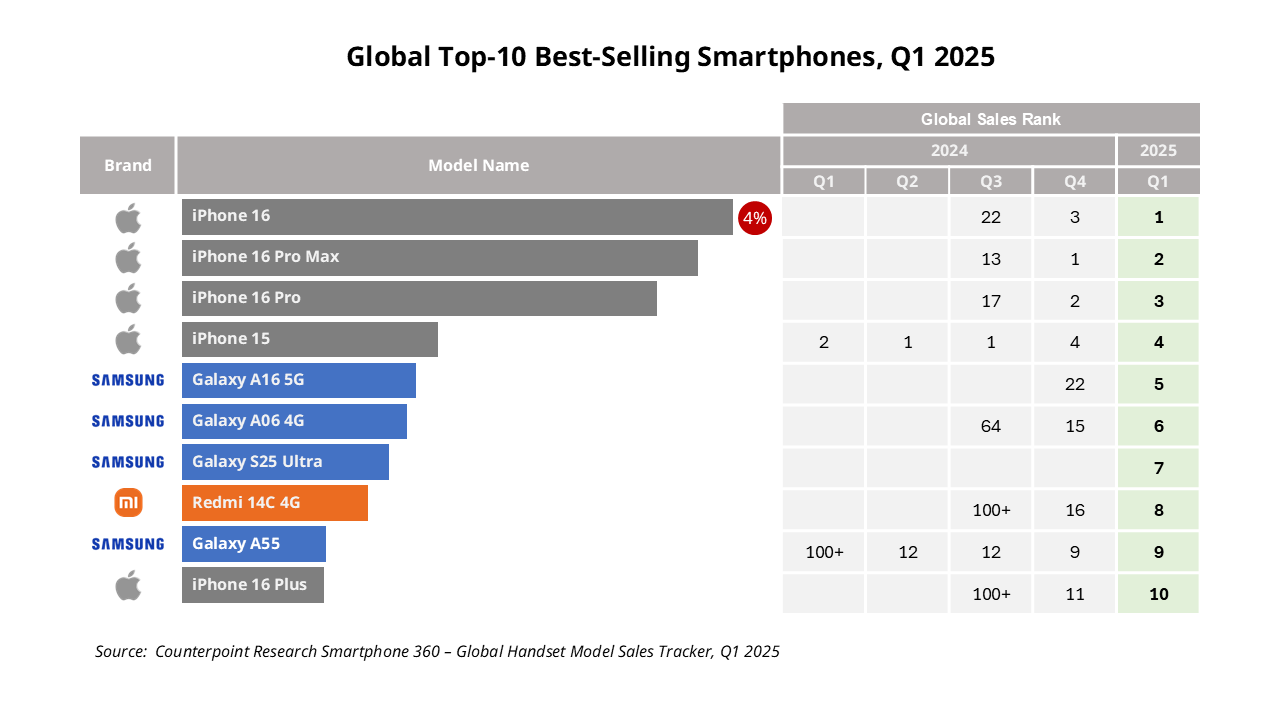
When we rewind a full year to Q1 2025, the contrast is quite interesting:
- The Apple shift: A year ago, the iPhone 16 series held the top three spots, exactly mirroring how the iPhone 17 series is performing now. Apple’s consistency at the top is mechanical at this point.
- The flagship dropout: In Q1 2025, the premium Galaxy S25 Ultra made the top 10 list at number 7. This year, Samsung doesn’t have a single “S” series phone in the Q1 top 10, relying entirely on the “A” series for volume. This is because the S25 series launched in January and started selling in early February, while the S26 series started selling in mid-March, less than two weeks before the end of Q1 2026.
Xiaomi holds the line
Finally, we have to talk about Xiaomi. The Redmi A5 is the only other Android phone in the top 10, sitting at number 10. Interestingly, this budget champion managed to keep its place in the top 10 list from Q4 2025, though it did drop down one spot from 9th.
Just like Samsung’s A-series dominance, the Redmi A5’s presence says a lot about the current state of the smartphone economy. Premium buyers are completely locked into the Apple ecosystem, while the rest of the world relies on Samsung and Xiaomi to deliver reliable, long-lasting budget devices.




Join the discussion