

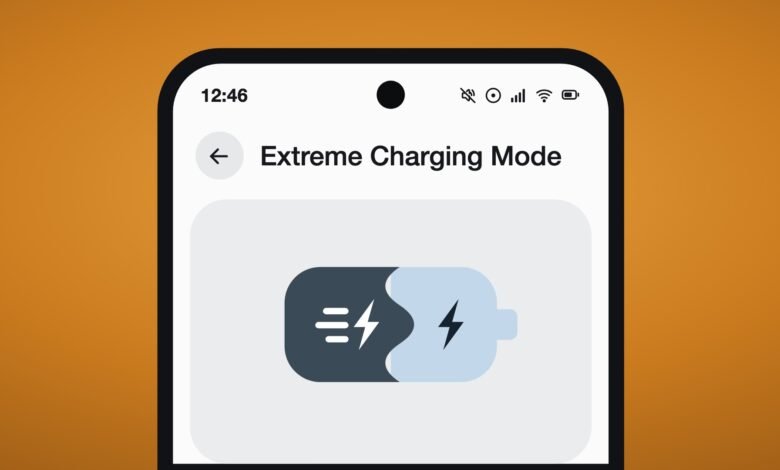
Google gave the Pixel 11 a setting called Extreme Charging Mode. Let me tell you exactly what it does, because the name suggests something the phone cannot do.
It does not raise the charging speed. Google says the mode cuts background activity and lets the phone run hotter while it charges. The Pixel 11, 11 Pro and 11 Pro Fold still stop at 30W, and the Pro XL at 45W. You can only turn it on below 50%, and it stays on until the phone is full. Google published no figure for how much time it saves.
So the feature is permission to get hot. That is the whole thing. Google marketed 30W charging on the Pixel 6 in 2021, and Notebookcheck’s testing that November found the Pixel 6 Pro never even reached it. Five years and six phones later, the number is the same and the new idea is a heat allowance with a name on it: EXTREME CHARGING.
What the other side has been doing
Heat is the real enemy in charging. Every honest engineer says so. Now look at how a company most Western reviewers ignore handles the same problem.

Infinix, owned by Transsion, has shipped bypass charging across cheap phones for years. Bypass charging sends wall power straight to the board and leaves the battery out of it, so the cell is not being charged and drained while you game. The NOTE 50s 5G+ has it. The GT 50 Pro that launched in April does it wirelessly, through a magnetic cooler that adds 12W of Peltier cooling on top of 15W of power. GSMArena calls that an industry first and filled its 6,500mAh battery in 67 minutes on the bundled 45W brick.
Then there is the charger still on my desk. The Infinix Zero Ultra arrived in 2022 with 180W, achieved by splitting the pack into two 8C cells running at 90W each. Infinix claimed a full 4,500mAh battery in twelve minutes. Four years ago. From a brand people call cheap.
The 200-cycle problem
Here is the comparison that made me write this. Google’s Battery Health Assistance starts lowering the Pixel’s maximum battery voltage at 200 charge cycles and keeps going to 1,000. Google’s own words: it “will also tune the phone’s charging speed based on adjusted capacity”. You cannot switch it off.
Infinix advertises the opposite on the GT 50 Pro, claiming its cell recovers 1% of capacity every 200 cycles. I have not seen that verified by anyone and I am not asking you to believe it. But can you see the glaring difference?
How did this happen
The issue is also there on overall battery capacity. My Honor X9d holds 8,300mAh of silicon-carbon in a 7.76mm body for about KES 55,000. The Pixel 11 Pro holds 4,850mAh and starts at $1,099, roughly KES 142,000 before shipping and duty.
Samsung sat in the same corner until last month, when it finally put silicon-carbon in the Galaxy Z Fold 8 line. Apple now charges faster than Google, hitting 50% in about 20 minutes on the iPhone 17. Google is alone at the back.




The phones never even hit 30w. I can get maybe 22w charging with Google\’s own 65w dual charger on the 11pro. It doesn\’t charge very long at 22w either because the phone throttles as soon as it gets hot. If the 11 pro could hit 30w for longer periods it would be plenty fast for most.