

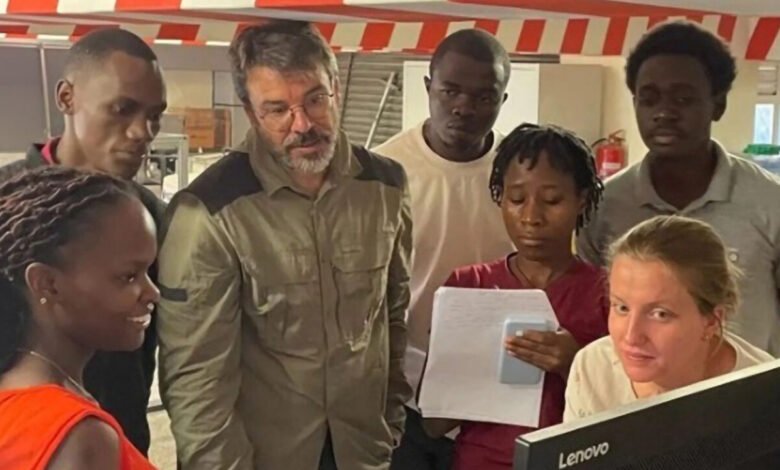
Researchers from Spain’s Institute of Instrumentation for Molecular Imaging (I3M) and Uganda’s Mbarara University of Science and Technology (MUST) are using Tyger, an open-source cloud platform built by Microsoft Research, to dramatically improve the quality of MRI scans from low-cost scanners. The announcement, made on June 10, 2026, points to a practical way of expanding access to medical imaging in regions where conventional MRI machines remain out of reach.
To understand why this matters, it helps to understand what makes MRI so expensive in the first place. A conventional hospital MRI machine relies on a very powerful superconducting magnet, which needs liquid helium cooling, a shielded room, stable power, and trained technicians. The machines themselves cost upwards of a million dollars, and the supporting infrastructure adds even more. That price tag is why, in some parts of Uganda, the nearest MRI scanner can be hundreds of kilometres away.
One workaround is the ultra-low-field MRI scanner. These machines use much weaker magnets, which makes them smaller, cheaper, and far easier to run. The catch is physics: a weaker magnet produces a weaker signal, and a weaker signal means noisier, blurrier images. The scanner at Mbarara could capture signals just fine. Turning those signals into images a doctor could confidently interpret was the hard part, especially without powerful local computers to run the heavy processing.
This is the problem Tyger solves. Instead of treating the scanner as a complete imaging system, Tyger treats it as a signal-capture device. The raw data is streamed to Microsoft Azure, where the computationally heavy work happens: image reconstruction, distortion correction, and AI-based denoising using models like SNRAware, which Microsoft Research also developed. The cleaned-up images are then sent back to the researchers. The scanner stays simple and cheap. The intelligence lives in the cloud.

“By enabling image reconstruction and enhancement in the cloud through Tyger, researchers can produce clearer MRI images without relying on expensive local computing infrastructure,” said Michael Hansen, General Manager of Medical Imaging at Microsoft Research Health Futures. “This opens new possibilities for making high-quality diagnostic imaging more accessible in underserved communities.”
The collaboration began in 2023, after conversations between I3M and Microsoft Research about MRI challenges in low-resource settings. Since then, the teams have been exchanging data, testing reconstruction methods, and connecting the Ugandan scanner to Tyger’s pipeline. Microsoft Research has published a detailed account of the project, and the underlying technical framework is described in an open-access research paper covering streaming and cloud processing of low-field MRI data.
The progress is tangible. “We have scanned dozens of volunteers since 2025,” said Eng. Dr. Johnes Obungoloch, Dean of the Faculty of Applied Sciences and Technology at MUST, who has spent years working on low-field MRI for Uganda. “Early on we could only image part of the head. Today, we can acquire full-head images.”
The stakes go beyond research milestones. Conditions like stroke, traumatic brain injury, and hydrocephalus need timely imaging to guide treatment. Hydrocephalus, a buildup of fluid in the brain, is particularly common in infants in East Africa, and delayed diagnosis can be devastating. When the nearest scanner requires a long, expensive journey, many patients simply never get scanned at all.
There is also a skills story here. At Mbarara, the project doubles as a training programme. Engineering and medical students, along with community healthcare workers, are learning MRI technology, electronics, signal processing, and image reconstruction. The goal, as the I3M side puts it, is to produce locally the knowledge needed to build and use these machines, not just to import finished products.
Microsoft Research has been building its Africa presence for a while now. We already covered the launch of Microsoft’s first African research institute in Nairobi back in 2022, which listed extending healthcare beyond the clinic among its focus areas. The Tyger work in Uganda is one of the clearest examples yet of that ambition producing something concrete.
Some honest caveats. This is still research, not a clinical service. The images are being used to validate the approach, and regulatory approval would be needed before cloud-reconstructed scans from low-field machines inform actual patient diagnoses. The model also depends on reliable internet connectivity, which is improving across East Africa but is not guaranteed everywhere a cheap scanner might go. And streaming patient imaging data to overseas servers raises data governance questions that health ministries will eventually need to answer.
Still, the core idea holds up: the most expensive parts of MRI no longer have to sit in the same room as the patient. If cheap scanners handle the signal and the cloud handles the brains, advanced imaging starts to look feasible in places it never was before. That is the shift to watch as this work moves from research labs towards actual clinics.







Join the discussion