

Midjourney is famous for one thing: you type a few words, and it draws you a picture. So when the company announced on 18 June 2026 that it was building a machine to scan the inside of your body, it came as a shock for pretty much everyone. Midjourney has started a new division called Midjourney Medical, and its first product is a full-body scanner it calls “Ultrasonic CT.”
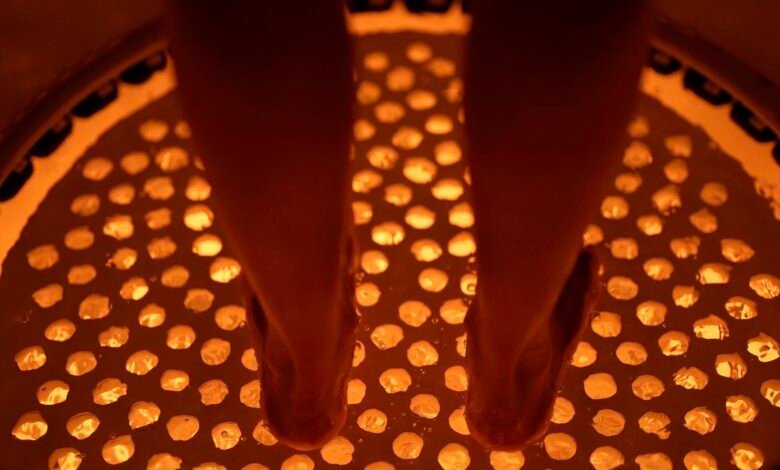
Here is the simplest version of how it works. You step onto a platform inside a shallow pool of warm water. The platform slowly lowers you down, about five centimetres every second. As you sink, your body passes through a ring packed with around half a million tiny elements. Each one is about the size of a grain of sand, and each can do two jobs: it can make a sound, and it can listen. The ring fires ultrasound, meaning sound too high-pitched for humans to hear, through your body from every angle, then listens to the echoes that bounce back. A computer collects all those echoes and rebuilds a 3D map of your insides. Midjourney compares each little element to a dolphin using echolocation, the trick dolphins and bats use to “see” with sound. A scan is a bit like being surrounded by half a million dolphins all pinging you at once.
There is a good reason for all the water. Sound does not pass easily from your skin into open air, because it mostly bounces off. That is why, in a normal ultrasound today, the technician squirts cold jelly on you. The gel helps the sound slip into your body instead of bouncing off the thin layer of air against your skin. A whole-body scanner does the same job on a bigger scale by putting you in water, which carries the sound smoothly into your body from every side at once.
The honest version of the timeline

Several of the most exciting numbers are targets, not things the machine does today. Midjourney’s “60-second scan” is a goal. The current prototype takes about 20 minutes, because the machine cannot yet move all that data around fast enough. The team that built it is roughly nine people. Only about a dozen people have been scanned so far. The first Midjourney Spa, where you would actually use one, is not due to open in San Francisco until the end of 2027. The very big numbers, like 50,000 scanners worldwide doing a billion scans a month, are an ambition for 2031.

There is a second surprise. Midjourney is known for AI, but its founder, David Holz, said plainly that there is no AI inside the scanner yet. The technology that does the actual imaging is not Midjourney’s own invention either. The company licensed it from a medical-device firm called Butterfly Network, which makes tiny ultrasound sensors built onto computer chips. Under a deal signed in November 2025, Midjourney pays Butterfly fifteen million US dollars upfront and ten million dollars a year for five years, with extra payments if it hits certain targets. A clearer way to describe the launch, then, is this: an AI image company has taken another firm’s ultrasound chips, built them into a large scanner, and placed that scanner inside a spa.
Three machines, three different jobs
The names attached to the scanner can mislead you. “Ultrasonic CT” and “like an MRI” sound impressive, but they mix up three different machines that work in completely different ways. Here is what each one actually does, because that explains why the new scanner cannot simply replace the equipment in a hospital.
A CT scanner takes X-ray photos from many angles and stitches them into one detailed picture. It uses radiation, and it is very good at imaging lungs and bone. An MRI uses powerful magnets instead of radiation. It is brilliant at soft tissue and at the brain, but it is slow, loud, and expensive. Ultrasound, the type Midjourney uses, sends sound waves and reads the echoes. It is cheap, safe, fast, and uses no radiation. It is best at soft, watery parts of the body that sit near the surface: a thyroid, a breast lump, kidneys, the gallbladder, blood flow, lymph nodes, and a baby in the womb.
But ultrasound has two enemies, and both come down to simple physics: air and bone. Sound bounces off both instead of passing through. Your lungs are full of air, so ultrasound cannot see deep inside them the way a CT can. That gap matters, because catching lung cancer early usually needs a CT. Your brain sits inside a bony skull, so a sound-based machine is not going to give you a brain map the way an MRI does. A clever AI might one day read messy ultrasound data better than a human can. But AI can only find patterns in the data the machine actually collected. It cannot magically recover information that the physics never let the scanner capture in the first place.
There is one more thing no scan can do: reach inside you and fix the problem. During a colonoscopy, a doctor can spot a small growth in your colon that might later turn into cancer, and then remove it on the spot. That is prevention, not just detection. A full-body scan cannot do that. Different scans answer different questions, and we keep all of them because each one covers a gap the others leave open. A new scan adds to that set. It does not replace what is already there.
Where this could genuinely help
There is one part of the idea that could really matter: scanning the same person often. Most medicine has to compare how you look today against how an average person looks. A scan that is cheap, safe and quick enough to repeat could instead compare you against you. You could look year after year and ask a simple question: did anything grow, shrink, or move? Having that personal baseline could become a useful part of future healthcare.
There is a fair worry on the other side. Cheap scans for everyone might also turn up lots of harmless oddities, the kind of small findings that lead to needless anxiety and extra tests, and we do not yet have the data to know how often that happens. Midjourney is starting carefully with regulators. It will launch by offering only body-composition maps, basically how much muscle, fat and bone you have, with no disease diagnosis attached. That kind of “wellness” data sidesteps the strict approval that medical diagnosis requires from the FDA, the United States health regulator. It is the same route that existing scan services like Prenuvo and Ezra already take. Midjourney says it will keep sending test results to the FDA to unlock more over time.

What Midjourney has shown is a real and promising new way to image the body, built on licensed chips and wrapped in a spa, with the speed, the AI and the medical proof all still to come. It is a new tool, not a replacement for the machines we already rely on. Three things are worth watching from here: whether independent doctors confirm the image quality, what the FDA actually clears it to find, and whether, by late 2027, real people are happy to step into the water.








Join the discussion