

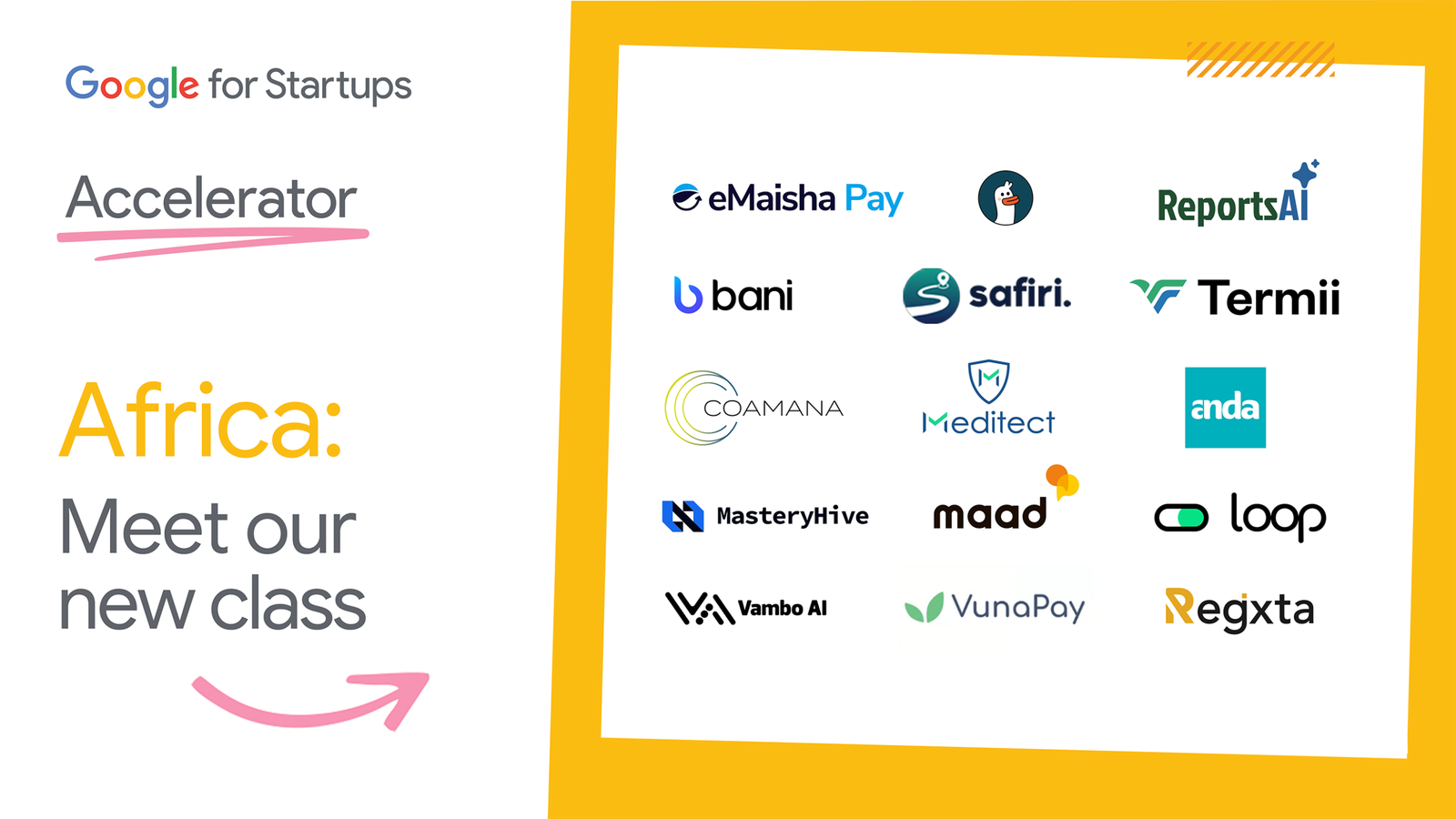
Fifteen African startups have graduated from the tenth class of the Google for Startups Accelerator Africa, closing out a three-month programme with a Demo Day held in Nairobi this week. Four of them are Kenyan: Coamana, Duck, ReportsAI and VunaPay.
The cohort ran from 13 April to 19 June 2026, and it is the most selective class the accelerator has ever fielded. Google picked the 15 from roughly 2,600 applications, an acceptance rate below 1%. We covered the selection back in April, when Kenya landed its strongest ever showing in the programme.
What ties the class together is a deliberate focus on artificial intelligence applied to specific, unglamorous problems. The startups span fintech, mobility, healthtech, agritech and SaaS. Most are solving infrastructure gaps that rarely make headlines.
The Kenyan four are a good illustration. Coamana uses AI to read real-time data from informal food markets, making supply chains that governments and large buyers usually cannot see suddenly trackable. Duck pulls live sales and stock data from supermarket checkout systems, giving consumer brands instant visibility into what is selling and where to restock. ReportsAI turns messy, unstructured data into compliance-ready reporting for NGOs, donors and impact investors, work that normally eats up enormous staff time. VunaPay builds payment and data infrastructure for agricultural cooperatives, tackling the delays that leave smallholder farmers waiting to be paid. By our earlier reporting, VunaPay had already processed roughly KES 75 million in payments and onboarded thousands of farmers across coffee, dairy and maize cooperatives.
The other eleven graduates come from across the continent. Tanzania’s Safiri builds digital infrastructure for transport and tourism. Nigeria placed four: Bani for cross-border payments, MasteryHive AI for transaction reconciliation and anti-money-laundering monitoring, Regxta for credit scoring aimed at unbanked micro-businesses, and Termii for communications infrastructure in financial messaging. South Africa contributed Loop, a mobility and payments platform, and Vambo AI, which builds multilingual AI for African languages. Senegal’s Maad runs an AI omnichannel platform for consumer brands. Uganda’s Emaisha Pay handles agro-trade payments and embedded financing. Angola’s Anda Africa scores credit for informal moto-taxi riders, and Côte d’Ivoire’s Meditect digitises pharmacies.
The accelerator is equity-free, which is its main draw. Founders give up no ownership. Instead they get mentorship from Google engineers, technical workshops built around Google’s AI and cloud stack, and up to USD 350,000 (about KES 45 million) in Google Cloud credits per startup. For AI companies whose biggest cost line is compute, those credits buy real runway.
Google says this class arrived more commercially mature than earlier ones. By its account, 60% of the cohort were already profitable, with the profitable startups posting average monthly revenue of around USD 60,000 (roughly KES 7.8 million) and about USD 1.1 million (around KES 142 million) raised. We could not independently verify these cohort figures, which Google disclosed at the Demo Day.
Speaking at the event, Alex Okosi, Google’s Managing Director for Africa, said the company was proud of how the startups were using AI to tackle real problems, and pointed to the equity-free model as the kind of support founders need to thrive. Folarin Aiyegbusi, Head of Startup Ecosystem for Africa, said this year’s programme deliberately centred AI and machine learning aimed at social impact across the same five sectors.
Since 2018, the accelerator has supported 106 startups across 17 African countries, according to Google. Those alumni have collectively raised more than USD 263 million (about KES 34 billion) and created over 2,800 jobs. The full Class 10 list and company profiles are on Google’s Africa blog.
For Kenya, the more useful thing to watch now is not the graduation itself but what follows it. The accelerator does not hand out cash, so the real test is whether these four turn the Google association into follow-on funding, new hires and enterprise cloud deals over the coming months. That is where a programme like this actually proves its worth.






Join the discussion