

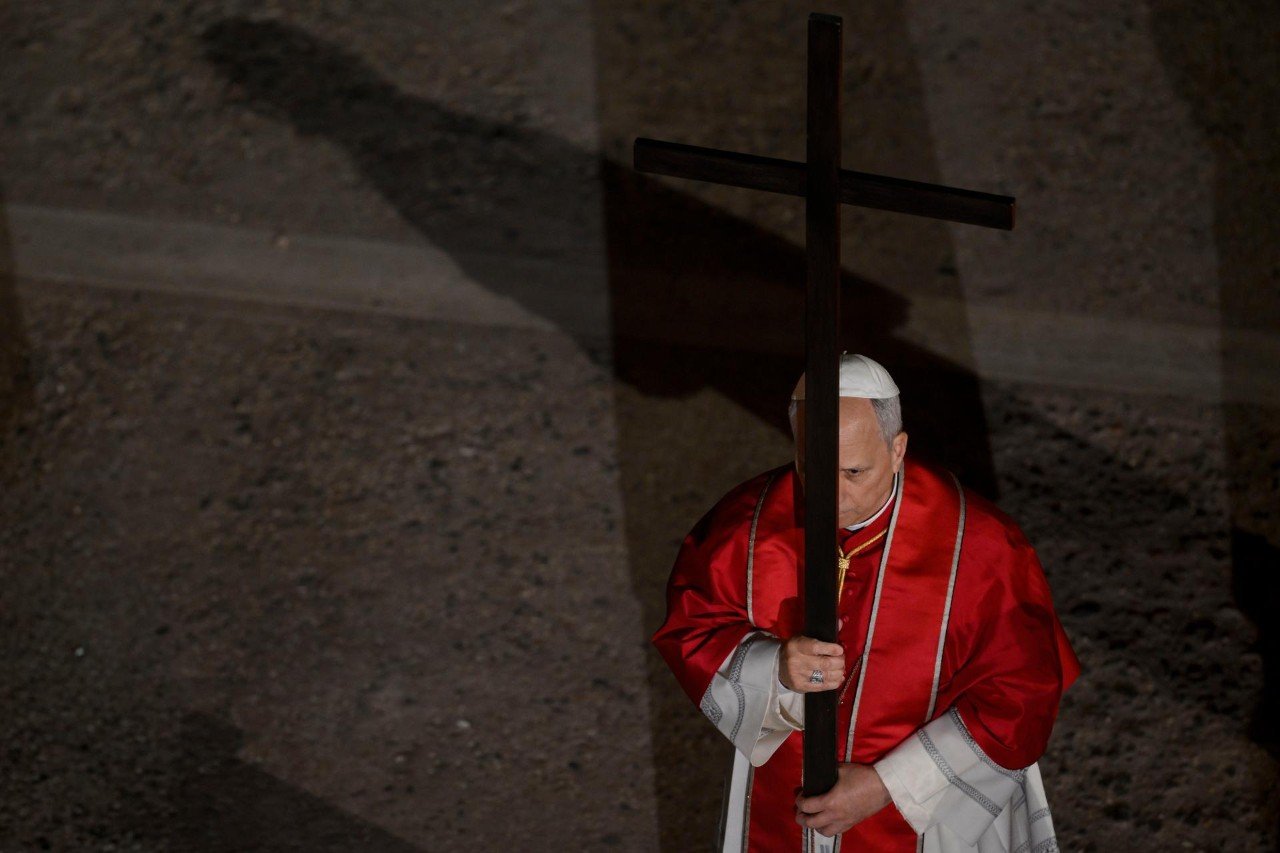
Two posts from Pope Leo XIV’s account raced past six million views this week. In them, he says artificial intelligence cannot be treated as morally neutral, and that whoever builds and uses these systems must answer for what they do. The posts read like a sudden intervention. They are not. They are lifted, almost word for word, from his first encyclical, a long teaching document published a month earlier in May 2026. The tweets are the trailer. The encyclical is the film.
Most of the internet concluded based on the tweets that the “Pope is saying AI is bad.” That is wrong, because the document is more careful, and more interesting.

First, what is an encyclical, and why is a Pope talking about AI?
An encyclical is a Pope’s most authoritative kind of teaching letter. It is normally addressed to the whole Catholic Church, and in this case it is aimed at everyone, believer or not. This one is titled Magnifica Humanitas, which means “Magnificent Humanity,” and it is subtitled as being about safeguarding the human person in the time of artificial intelligence.
The choice of subject is not random, and neither is the Pope’s name. He took the name Leo on purpose. Pope Leo XIII wrote a landmark letter in 1891 called Rerum Novarum, about the rights of workers during the industrial revolution. Leo XIV signed his AI encyclical on the same calendar date, 135 years later. The message is deliberate. He is framing AI as this generation’s version of that upheaval. Not a gadget, but a moral test for how society is organised.

The core claim, in plain terms
The headline argument is that AI is not morally neutral. In engineering terms, this is less dramatic than it sounds, and largely true. A model reflects what its makers choose to measure, to optimise for, and to ignore, and how it decides to sort people into categories. It is trained on human data, and human data carries human bias. So the system is never a blank, neutral tool. It carries the priorities of whoever shaped it.
This is not a religious eccentricity. It is mainstream thinking in AI research, and I have made the same argument on this site before. I already wrote, back in January, that the powerful AI systems being built will reflect the values, biases, and priorities of whoever builds them, and that the people left out of the building end up with a future “designed for us rather than with us.” The Pope reaches the same worry from a different door. In my article, I arrived through power and governance. He arrives through human dignity.
What the document actually asks for
The encyclical is not a ban. It calls AI a valuable tool and supports innovation. What it asks for is structure around that innovation.
It wants a clear chain of accountability, so that when an automated decision harms someone, there is a human who must explain it, justify it, and put it right. It wants real law and independent oversight, not ethics spoken in the abstract. It wants data treated as a shared resource rather than hoarded by a few firms. It even flags the environmental cost of AI, which uses large amounts of energy and water.
Then it draws one hard line. It says AI must be “disarmed.” Leo admits the word is strong and says he chose it to grab attention. He is clear that disarming does not mean rejecting technology. It means refusing to let AI become a tool of domination, and rejecting the idea that holding the most technical power earns you the right to rule. Inside that broad call sits a specific rule: no machine should ever autonomously make a lethal decision. A human must always be answerable, so that blame is never quietly handed to “the machine.”
The AI lab in the room
Here is the detail that breaks the simple story. When Leo personally presented the encyclical, which is itself unusual for a Pope, one of the speakers beside him was Chris Olah, a co-founder of Anthropic. Anthropic makes the Claude AI assistant.
Olah leads the Anthropic team that studies what is actually happening inside AI models. At the Vatican he raised three concerns. First, that AI is concentrated in a few rich countries, and could displace human work on a large scale. Second, that there is no working mechanism to share the economic gains fairly, which he called an unsolved problem. Third, that the models remain partly mysterious even to the people who build them. He framed the Church as useful precisely because it sits outside the money, describing the value of “moral voices that the incentives cannot bend.”
This comes as Anthropic recently refused to let its models be used for autonomous weapons or mass surveillance. The Pentagon responded by labelling the company a supply chain risk, and a rival, OpenAI, signed a defence contract in its place. So a lab that had drawn a weapons red line was standing next to a Pope who was about to demand exactly that line.
Some critics asked whether the Vatican was handing Anthropic a quiet blessing. Church figures pushed back, comparing the appearance to a papal audience with a head of state, not an endorsement. My own view is simpler. Talking is good. I argued in January that getting the conversation about the future of humanity and the real risks of AI into the open is how you avoid sleepwalking into a future built by a handful of people. A Pope and an AI lab in the same room, disagreeing in public, is that conversation happening.
No machine should ever autonomously make a lethal decision. A human must always be answerable, so that blame is never quietly handed to “the machine.”
– Pope leo xiv
The hidden workforce behind AI
The encyclical’s most concrete passage is also its most uncomfortable, wherever you happen to be reading this. Leo warns of “new forms of slavery” in the AI economy. He means the people who label the data, train the models, moderate the worst content, and mine the minerals that go into the hardware, often for low pay and in harsh conditions. Every polished chatbot sits on top of this hidden layer of human work. It is spread across the Global South, from the Philippines to India to Venezuela, and it is mostly invisible to the people who use the finished product.
Kenya is the clearest and best-documented case, which is why it is worth looking at closely. Nairobi spent years as a back office for this work. In April 2026, the outsourcing firm Sama issued redundancy notices to 1,108 workers after Meta ended its contract. A group of 185 former content moderators is suing Meta for 1.6 billion US dollars over working conditions, trauma, and dismissal. A Swedish investigation earlier in the year found Sama staff labelling intimate footage captured by Meta’s smart glasses, including people undressing and handling bank details. OpenAI’s early training data was labelled there for between 1.32 and 2 US dollars an hour. A clinical assessment found most of the moderators studied carried severe symptoms of post-traumatic stress. The Pope’s argument is not theoretical. It has names, a place, and a court case. The same pattern, with far less documentation, exists in every country that does this work.
The hard questions we should not skip
There are two questions the document asks, whose answers it doesn’t present.
The biggest is the one the Pope cannot solve. If AI carries the values of its makers, then whose values should it carry, and who decides? The Vatican is, in the end, one more party arguing its vision of the human person should sit inside the machine. The honest answer to “how do we fix this” is unsettled. More competing models, open-source alternatives, strong guardrails, settings users can adjust, all of these are on the table, and none is obviously the right one. Leo names the problem clearly. He does not close it, because nobody has.
The second weakness is enforcement. The Church cannot write law. Leo says abstract ethics is not enough and asks for hard rules, but he is not the one who can pass them. The disarm line is the clearest test. As a red line it is a good initiative, and it forces a conversation the world needs, especially as governments lean harder into AI and sign military contracts. Whether anyone actually holds that line during an arms race is a different question.
So does any of this matter?
We are no longer in an age where a religious leader decides what gets invented. That authority has moved to the labs and the scientists. What a Pope still holds is reach. He speaks to well over a billion people, and this letter is aimed at everyone, so he genuinely shapes how a huge number of us think about AI. That is not nothing.
But shaping how people think about AI is not the same as shaping how AI is built. The people writing the code, raising the capital, and signing the contracts are still the ones holding the pen. So watch two things from here. Watch whether the encyclical shows up where it actually counts: in new laws, in real regulation, in court, including the cases against Meta in Kenya, and in how the labs behave when a defence cheque is on the table. And watch whether any government, anywhere, decides to speak up for the workers the Pope just described to the world. He has moved the conversation. Moving the build is still up to the people who build it, and to whoever can hold them to account.






Join the discussion