

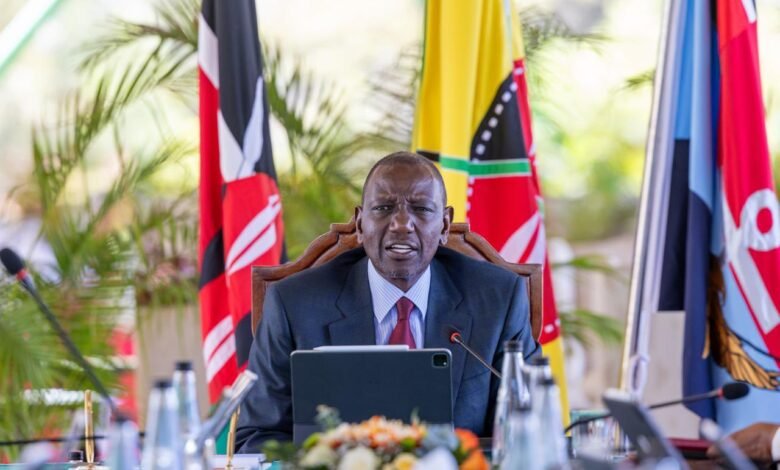
President William Ruto has announced that the government will fully fund every student placed in a public university or college in Kenya. Family background will no longer determine how much support a student gets. He made the announcement at State House, Nairobi, on Monday, 21 July 2026, while receiving a report titled “Developing a New Vision for Kenya: Towards a First World Nation.”
“Any university student, so long as they have passed their exams and have been placed in a college or a university, each one of them will get full funding,” the President said. “It will not matter the background of any child in Kenya. It will matter how good they are only.”
Parents can still contribute if they choose to. But inability to pay will not block a student from enrolling. “It will be the choice of parents to pay. If they don’t want to pay, we have a model to pay for them,” Ruto said.
The President asked Parliament to fast-track the amendments so the changes take effect before universities reopen in September. He did not name the specific bill, and no official document naming it has been published yet.

Why the old model is being dropped
This announcement buries the funding model the government introduced in 2023. That model, officially the Variable Scholarship and Loan Funding Model, used a Means Testing Instrument to sort students into five bands. Band 1 students, assessed as the neediest, got the most support. Band 5 students got the least. We already explained how that model worked and what the bands meant when it first confused thousands of families.
The model ran into trouble almost immediately. Students reported being placed in the wrong bands. Appeals piled up. Families assessed as able to pay could not. Then the courts stepped in. On 20 December 2024, the High Court declared the model unconstitutional, ruling that it was rolled out without adequate public participation. The Court of Appeal stayed that judgment in March 2025, which allowed the model to keep running while the appeal was heard. The Kenya Human Rights Commission, one of the original petitioners, maintained the stay was not a validation of the model.
On Monday, Ruto offered his own verdict on the system. He said the earlier differentiated model promised students 80% government support but delivered only about 40%, and that the shortfall strained universities to the point where some “almost closed down.” That is his assessment, and the government has not published the figures behind it.
The awkward timing problem
Here is where things get complicated for students joining university this year. The Universities Fund is currently running scholarship applications under the old band model. Applications for the 2026/2027 cohort opened on 8 July on the Higher Education Fund portal, with a deadline of 6 September 2026. The Fund has allocated KES 30.8 billion for scholarships this cycle, covering the 202,133 students placed through KUCCPS. We already covered the 2026 KUCCPS application cycle and its deadlines.
No official has explained how the two processes reconcile. If Parliament passes the amendments before September, students currently filling in means-testing forms would presumably fall under universal funding instead. If Parliament does not, the band model continues into another academic year. Students and parents should complete the current applications as instructed until the government says otherwise.
What we do not know yet
Several important details are missing. The government has not named the bill or published its text. It has not said whether “full funding” covers tuition alone or also accommodation and upkeep. It has not said whether the money comes as a grant or as a loan that students repay, or what happens to HELB and existing loan obligations. It has not given a cost estimate, and universities are already dealing with a funding shortfall that has been reported at over KES 223 billion. It has also not said whether students in private universities or TVET institutions are included, though all reporting so far points to public institutions.
The practical takeaway for now: nothing changes today. Continue with the current scholarship applications before the 6 September deadline. Watch for the bill in Parliament, because its text, not Monday’s speech, will determine who gets what. We will break down the bill the moment it is published.






Join the discussion