

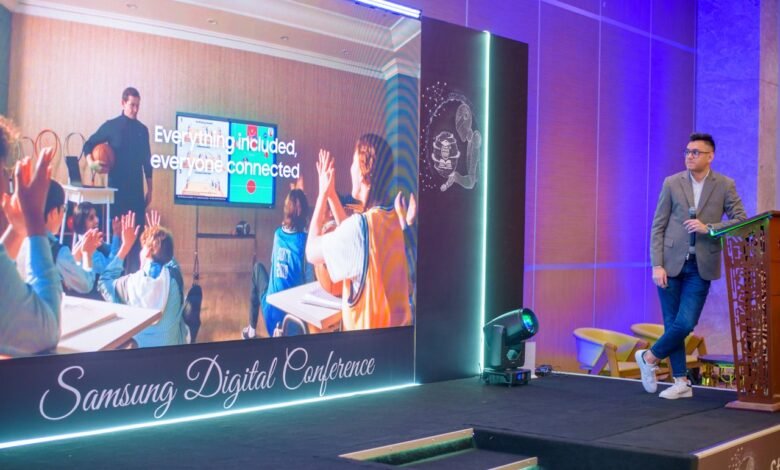
Samsung Electronics East Africa launched a product called Samsung Digital Classroom in Nairobi on 29 July 2026. The package has three parts that a school would otherwise buy separately: Samsung tablets for learners, a Samsung interactive board for the front of the room, and software that lets a teacher or an IT administrator control every tablet in the school from one screen. Samsung says a teacher can push a lesson from the board to every tablet, watch who is following along, run a quiz and give feedback on the spot, without leaving that one screen.
The tablets are ordinary Samsung Galaxy tablets, already sold in Kenya from cheap A-series models up to the Galaxy Tab S10 Ultra at KES 189,000. Nothing in the announcement points to a school-specific model.
The interactive board is a large touchscreen that does the job of a whiteboard and a projector at once. Samsung’s education panels, the WAD and WAF series, come in 65, 75 and 86-inch sizes and run Android. They are certified under Google’s Enterprise Devices Licensing Agreement, or EDLA, which means the board can install Google Play apps including Google Classroom. So the board itself is not tied to Samsung’s own teaching software.
The third part is device management software, which Samsung calls Knox for Classrooms. It enrols tablets in bulk so they reach the classroom already loaded with the school’s apps and settings. It can lock a tablet to one app during a lesson or an exam, block websites, apply one rule set in school and a stricter one at home, and wipe a stolen device. There is a separate management tool for the boards themselves, and Samsung’s own WAD product page says the cloud version of it is free for one year and paid after that.

The name needs a footnote. Samsung’s published education software goes by Knox Suite and Knox Manage. Samsung’s own June announcement in Kisumu called this layer Samsung Knox for Education. Neither name appears in the Kenyan launch, and its education stand at BETT in London in January used neither. We found no global Samsung product page for Knox for Classrooms, so it reads as regional packaging of existing Knox tools rather than new software.
What Samsung did not say
Samsung gave no price for the tablets, the board, the software or the bundle, did not say when or how schools can order, and named no Kenyan school using it. A footnote in the release says the product was developed for East African markets only.
At least one Kenyan institution is already using it, though the launch did not mention it. In June, Great Lakes University of Kisumu opened a language and culture centre built on Samsung Digital Classroom, with Airtel, Jamii Telecommunications and Starlink listed as connectivity partners.
There is one indication of the software cost, though not a Kenyan one. Resellers in the United States list Samsung’s one-year Knox Suite Essentials licence at about USD 30 per device, roughly KES 3,900 at 129.5 shillings to the dollar. For a school running 200 learner tablets, that is about KES 780,000 a year on top of the hardware. Samsung has not published a Kenyan figure, so treat the number as an order of magnitude.
The classroom Samsung is walking into
The government is already doing a version of this. Since June, the ICT Authority has been distributing one teacher laptop and one 65-inch interactive board to each of 10,382 public junior schools under the Kenya Digital Economy Acceleration Project, with World Bank support. The government says more than 62,000 junior school teachers have been trained to use them. The remote lesson demonstrated at that flag-off came from a Nairobi school already running a smart board donated by Huawei. Each of the 10,382 schools gets one board for the whole school, and no learner tablets.
Before that came the Digital Literacy Programme, branded DigiSchool, which from 2016 set out to spread 1.2 million devices across all public primary schools, tablets for pupils and laptops for teachers. Official counts of what was delivered do not agree. The ICT Authority told the ITU in 2018 that over a million devices had reached more than 19,000 schools. Its chief executive said in 2021 that more than 1.2 million tablets were installed in 21,638 schools.
Getting those devices online is a separate problem. The European Union, reporting on its Last Mile Connectivity of Schools project in January, said about 30% of Kenya’s 23,400 public primary schools are online. At that point the project had reached 363 schools of a planned 1,000 across 14 counties. The ICT Authority put the figure above 780 schools in July, without breaking down the count.
Then there is the device shortage. Grow X Education and CEMASTEA installed Starlink in 29 schools across 28 counties and surveyed them a month later, in a study we reported on in June. In 89% of those schools, more than five learners shared a single device. Only 4% had one device for every four or five learners. Desktops averaged 27 per school, laptops nine. Smart boards were close to non-existent. It is a small sample, and the schools had opted into a satellite internet pilot, so read it as a snapshot rather than a national figure.
Content is the cheapest piece. Airtel zero-rated the Kenya Education Cloud and KICD’s Elimika teacher-training portal in October, so curriculum material costs nothing in data on that network.
A 2025 report on African education technology, which we covered at the time, urged governments to favour offline-first tools and open platforms to avoid expensive proprietary lock-in. A single-vendor package pulls the other way, though the Google certification on Samsung’s boards softens that.
Samsung’s release also refers throughout to the Competency-Based Curriculum. The Ministry of Education rebranded it Competency-Based Education in April 2025.
What to take from this
The realistic buyers here are private schools, universities, technical training colleges and county governments with their own budgets, rather than the public schools the government is already equipping. For those buyers, the argument is that one supplier and one management console is less work than assembling the same setup from three. That is a real saving in staff time, and it comes with a licence fee that recurs every year.
Two things to watch. First, whether Samsung publishes Kenyan pricing, and in particular the annual per-device software fee, because that number decides whether a school can budget for it. Second, whether any Kenyan school beyond Great Lakes University is named with learner tablets at any real scale. Samsung provided neither at the launch.





Join the discussion