

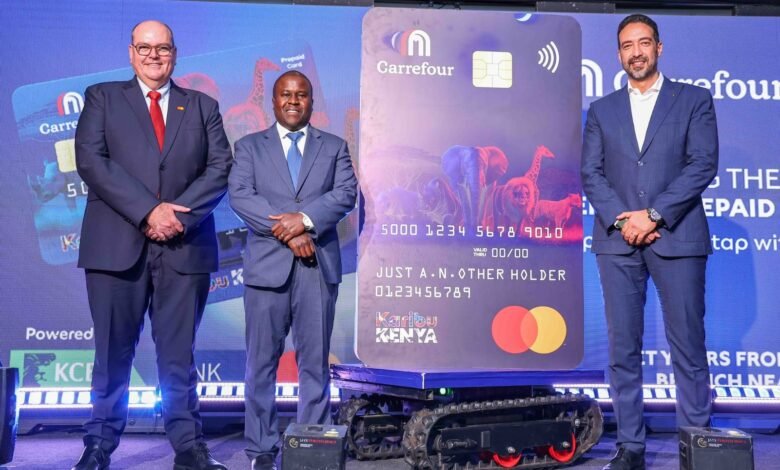
Carrefour Kenya, KCB Bank Kenya and Mastercard launched the Carrefour Prepaid card on 30 July 2026 at Carrefour’s East Africa offices at Two Rivers in Nairobi. Gabriel Swanepoel, who runs Mastercard’s Africa division, John Wagacha, head of FMCG at KCB’s corporate banking arm, and Rachid Nouri, finance vice president at Majid Al Futtaim Retail, unveiled it together.
The card holds money already loaded onto it and nothing beyond that. You top it up, you shop at Carrefour, and when the balance runs out the card declines until somebody puts more on. A debit card would draw on a bank account and a credit card on a limit the bank had granted. This one has neither behind it.
Carrefour says people can get a card in store, with staff there to do the activation, or through its digital channels. Early sign-ups are promised cashback and reward points, although no figure is attached to either. Points are familiar ground for the retailer, which has run MyCLUB through its app since 2019 at 2.5 points per KES 100 spent, and ran a Visa discount campaign in 2023.
Where the money comes from
Top-ups run through Mastercard Gateway and accept a bank card issued anywhere in the world. Someone in Doha or Atlanta can load a card held by a relative in Nairobi, and the money lands already committed to a Carrefour till.

Kenyans abroad sent home USD 5.04 billion in 2025, roughly KES 650 billion, the first year the figure has passed USD 5 billion on Central Bank of Kenya numbers. That makes remittances the country’s biggest single earner of foreign currency, ahead of tourism.
It works closer to home too. A parent in Kisumu can fund a student in Nairobi, or two people in one household can load a single shopping card rather than each buying separately.
Carrefour also says the card is made available to businesses through Merchant Cloud, the platform Mastercard launched in October 2025 to bundle payment acceptance, gateway routing and fraud screening for merchants. What a company would do with it is not explained anywhere in the announcement. An employer loading grocery money onto staff cards is the nearest obvious use, and that would bring up how KRA treats the benefit.
What the announcement leaves out
The money, mostly. There is no card fee in it, no reload fee, no exchange rate for a top-up funded from abroad, and no statement about whether the card can be used anywhere other than a Carrefour till.
Carrefour’s pitch is that money on the card gets spent as intended, and that only works if the card is confined to its own stores. If it is confined, the money cannot go to the estate duka or the open-air market, where a great many households buy food more cheaply than in a hypermarket.
On the exchange rate, the World Bank prices a transfer as the fee plus the gap between the real rate and the one the provider hands you. Its data on the United States to Kenya route shows services advertising no fee at all still taking about 3% on the rate. A top-up funded by a card in dollars or pounds gets converted into shillings somewhere in the chain, and while the rate stays unpublished there is no way to line this card up against M-Pesa Global, WorldRemit or an ordinary bank transfer.
KCB and Mastercard did this with Nakumatt
In 2013 the two of them launched the Nakumatt Global card alongside Diamond Trust Bank, a prepaid Mastercard that also carried loyalty points. Mastercard said at the time it was aiming for a million of them. It cost KES 100 at a Nakumatt till and KES 500 at a bank branch, and it worked at any Mastercard merchant and at ATMs rather than inside one chain. When Nakumatt collapsed, DTB halted transactions on the cards and had to tell holders how to get their balances back. Naivas and Visa went after the same territory from the loyalty end in 2024.
Each company takes something out of this. Carrefour ends up holding money committed to its tills before anyone has walked through the door, a share of which would otherwise have gone to Naivas or Quickmart. For KCB it means deposits, new customers and a cut of every swipe, on top of the payments work it has been pushing all year. Mastercard takes a transfer that would probably have gone through mobile money and puts it on its own network.
Before signing up, establish what the card and its top-ups cost, and whether it works anywhere besides Carrefour. Neither is published. Until they are, money loaded onto one of these is store credit, and worth thinking about the way you would think about paying a supermarket in advance.






Join the discussion