

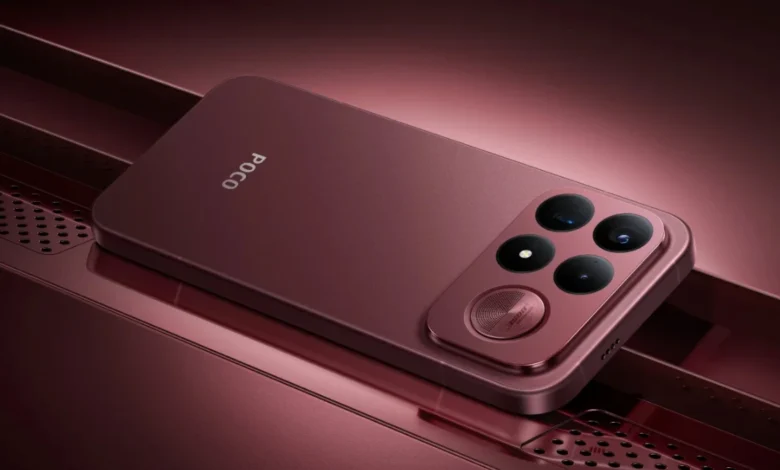
POCO will launch the F9 Ultra and the F9 Pro on 1 September 2026 at 20:00 GMT+8, which is 3pm Kenyan time. The launch is streamed online from mi.com. Xiaomi’s official launch page has confirmed not only the date, but that there will be two processors, an AnTuTu benchmark score of 4,165,108, an 8,050mAh battery and speakers tuned by Bose.
POCO is a Xiaomi sub-brand, started in 2018 with the Pocophone F1 and made a separate brand in January 2020. Most POCO phones are Redmi models sold outside China under a different name. The F9 Pro and F9 Ultra follow that pattern. They are the Redmi K100 Pro and the Redmi K100 Pro Max, which launched in China on 11 August.
Two phones, two versions of the same chip
POCO’s teaser posters set out a split between the two models. The F9 Ultra runs the Snapdragon 8 Elite Gen 5. The F9 Pro runs the Snapdragon 8 Elite Gen 5 V Series.
Those are not the same processor. Qualcomm’s own specification sheet for the V Series lists an Adreno graphics processor with 2 slices at 1.2GHz and 12MB of dedicated graphics memory. The standard chip has 3 slices at the same clock speed and 18MB. A slice is a self-contained block of the graphics processor, so dropping one from three removes roughly a third of that hardware.

The processor cores are identical on both chips: two Oryon cores running up to 4.6GHz and six running up to 3.62GHz. The modem, the AI processor and the camera pipeline also match. In practice the F9 Pro should match the Ultra in everyday use and fall behind it when playing demanding games.
What the benchmark number means
The 4,165,108 on POCO’s poster is an AnTuTu score. AnTuTu runs a fixed set of tests on a phone and adds the results into one number for processor, graphics, memory and interface speed.
For scale, AnTuTu’s flagship chart for January 2026 put the RedMagic 11 Pro+ at the top with an average of 4,104,271, and eight of the ten phones on that list ran the same Snapdragon chip. AnTuTu builds its rankings from monthly averages of thousands of user runs rather than one controlled test.
The 185Hz screen
POCO describes the screen on both phones as a 185Hz AMOLED panel. This is not a first. The Asus ROG Phone 9 Pro reaches 185Hz in its gaming mode and Honor’s Win series uses a 185Hz panel. POCO’s poster claim is that on these devices, users will enjoy “industry-leading 185FPS gaming” with “20+ titles with native 185FPS” support.
Audio, battery, and WildBoost
Both phones carry Bose tuning. The F9 Ultra adds an independent subwoofer in the camera housing, which together with the two stereo speakers makes a 2.1 system. POCO’s page says the subwoofer is on the Ultra only. I don’t think we’ve seen a phone with a subwoofer before.
The battery is also Ultra-only: 8,050mAh with 100W wired and 50W wireless charging. The Redmi K100 Pro Max that the F9 Ultra is based on carries 9,070mAh, so the global model gives up about 11% of the capacity.
POCO calls its gaming software an “all-new WildBoost Engine”. WildBoost is not new. POCO shipped WildBoost Optimization 3.0 on the X7 Pro and 4.0 on the F7 series in March 2025. T
What this is likely to cost in Kenya
Reports say the F9 Pro would start at 799 euros and the F9 Ultra at 999 euros. That’s about KES 120,000 and KES 150,000 respectively before all our punitive taxes.
POCO came back to Kenya in November 2024, when we covered the launch of the C75 and M6 Pro at the budget end. As of late August 2026, Nairobi listings put the POCO F8 Ultra between KES 109,000 and KES 111,000, and the F8 Pro at about KES 78,000.
The F9 Ultra will probably sit above that. Memory and storage prices have risen through 2026, and we explained in December why phones are getting more expensive, including Xiaomi president Lu Weibing’s warning that retail prices would rise this year.
Xiaomi gives its flagship phones four Android upgrades and six years of security patches, a policy we covered when the company announced it.








Join the discussion