

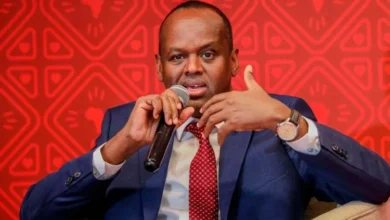
Microsoft has appointed Angela Ng’ang’a as country lead for East Africa, effective 26 August 2026. She is based in Nairobi and will run Microsoft’s dealings with governments, enterprise customers and partners across the region.
Ng’ang’a joined Microsoft in 2012. Her most recent role was regional director of customer success for East and West Africa. Before that she was director of corporate affairs for the Middle East and Africa, and education industry director for Africa. Her career before Microsoft was in corporate affairs and public policy at Telkom Kenya and at AAR Health Services, and Microsoft puts her total experience at more than 20 years across technology, telecommunications, healthcare, public affairs and policy.
“I am delighted to lead Microsoft’s work in East Africa as the region strengthens its position as an innovation and AI hub,” she said in the announcement. “I look forward to partnering with governments, enterprise and the local startup ecosystem to build AI skills and workforce readiness.”
The job has changed shape
Microsoft’s Kenya operation was run by a Kenya country manager. Phyllis Migwi held that title from 2022 and announced in January 2026 that she was leaving in February, after three and a half years. Microsoft opened applications for a replacement at the time.

What it has filled is a different post. Country lead for East Africa is a regional title. Microsoft’s announcement does not say which countries the region covers, does not name a predecessor and does not say whether a separate Kenya country manager role still exists.
What she inherits
The largest item on Microsoft’s East African books is a project that has stopped moving. In May 2024 Microsoft and G42, the Abu Dhabi artificial intelligence company, announced a USD 1 billion digital ecosystem plan for Kenya. Its centrepiece was a data centre at KenGen’s Green Energy Park near the Olkaria geothermal fields in Naivasha, running on geothermal power, with a first phase of 100MW and an eventual target of 1,000MW. It was to host an Azure East Africa cloud region, meaning Microsoft’s cloud services would run on servers inside Kenya rather than in Europe or South Africa.
In May 2026 the Kenyan government stalled it. We covered why the power arithmetic broke the plan: President William Ruto said supplying the full project would take a share of national generation the grid does not have, and the Treasury did not sign off on the capacity payment guarantees Microsoft wanted. John Tanui, principal secretary in the Ministry of Information, Communications and the Digital Economy, said the project had not been withdrawn and that talks were continuing.
A regional lead in Nairobi whose brief covers governments and enterprise customers inherits a stalled billion-dollar data centre, an unlaunched cloud region and a customer base that has been told for two years that local Azure capacity is coming.







Join the discussion