

Geely revealed a new SUV called the Xingyue L Plus on the evening of Friday 5 September, at the Shaanxi Grand Theatre in Xi’an, China.
Geely is a Chinese carmaker. Its parent group, Zhejiang Geely Holding, also owns Volvo Cars, Polestar, Lotus, Lynk & Co and the maker of London’s black cabs.
The Xingyue L Plus is the second generation of the Xingyue L, an SUV Geely has sold in China since 2021. Outside China that car is called the Geely Monjaro.
Friday was a reveal, not a launch. Geely confirmed the specifications but gave no price, no on-sale date beyond “soon”, and no word on selling the car outside China. Two things still remain: pre-orders date, and when sales will start.

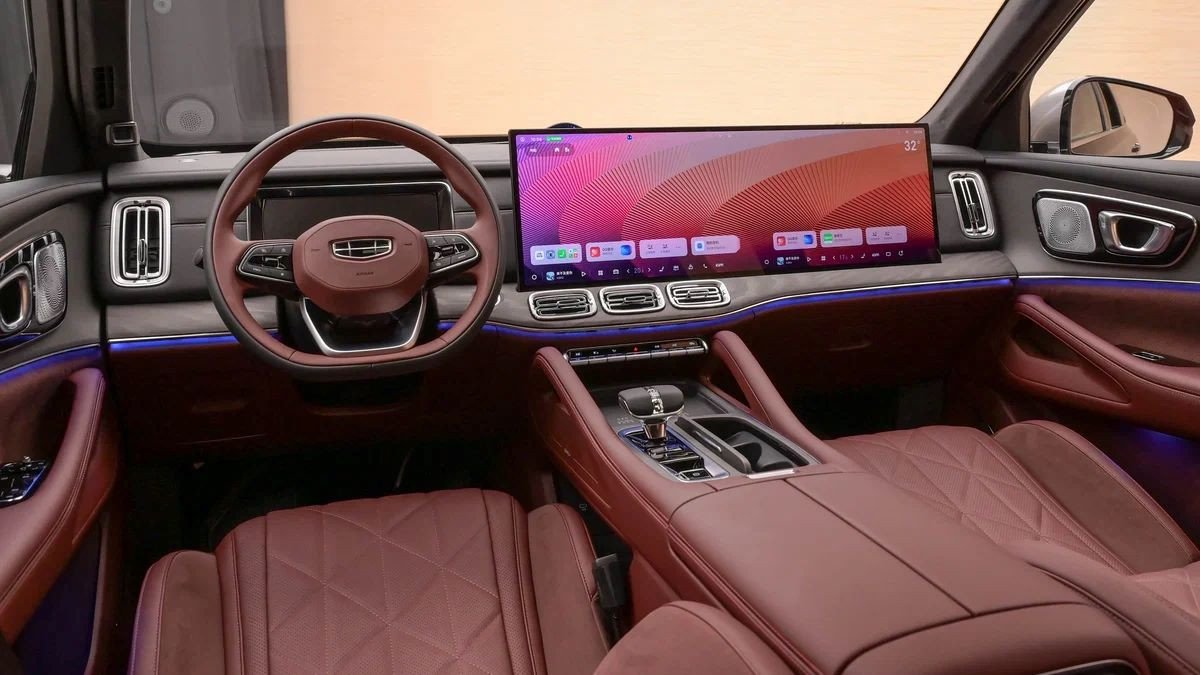
The cabin runs software made by a phone company
Two screens sit side by side across the dashboard. One faces the driver, one faces the front passenger, and together they form a single panel 30 inches wide that Geely calls the Skyline. A third screen, 17.3 inches, hangs behind the front seats for passengers in the back.
The software on those screens is called Flyme Auto.
Most drivers meet car software through Apple CarPlay or Android Auto. Those are borrowed screens. Your phone does the work and the car displays it. Unplug the phone and the interface disappears.
Flyme Auto is different. It is the car’s own operating system on the car’s own hardware. No phone required.
It came from a phone, though. Flyme was the version of Android that Meizu, a Chinese phone maker, put on its handsets. In July 2022 a company founded by Geely’s founder Li Shufu bought a 79.09% stake in Meizu. Three months later Meizu turned Flyme into a car system, first used in the Lynk & Co 08 in 2023. Geely now fits it to Geely, Lynk & Co, Zeekr and Polestar models.
Underneath sits a Qualcomm Snapdragon 8295, a processor that does the same job for a dashboard as a phone chip does for a phone. It is Qualcomm’s fourth generation of cabin chip, built on a 5 nanometre process, and it can drive 11 screens at once.
For scale, the Jetour SUVs that went on sale in Kenya in November 2025 from KES 4.9 million use the Snapdragon 8155, one generation older. Qualcomm has since moved past the 8295 too.
The roof scanner, and what it does not do
A lidar unit sits on the roof. It fires invisible laser pulses and times how long they take to bounce back, which builds a three-dimensional map of the road. It works in the dark, where cameras struggle.
It feeds a system Geely calls Qianli Haohan H5, a family of driver aids Geely announced in March 2025. The range runs from H1 to H9, and H5 sits in the middle.
What it can do: steer, brake and change lanes on motorways and city roads, follow a route without pre-loaded high-definition maps, park itself, and repeat a parking route it has learned.
What it cannot do: drive the car for you. Geely calls this assisted driving, and that is the correct term. The driver watches the road and stays responsible at all times.
The current Xingyue L uses an older system, G-Pilot H3, with no lidar and motorway navigation only.
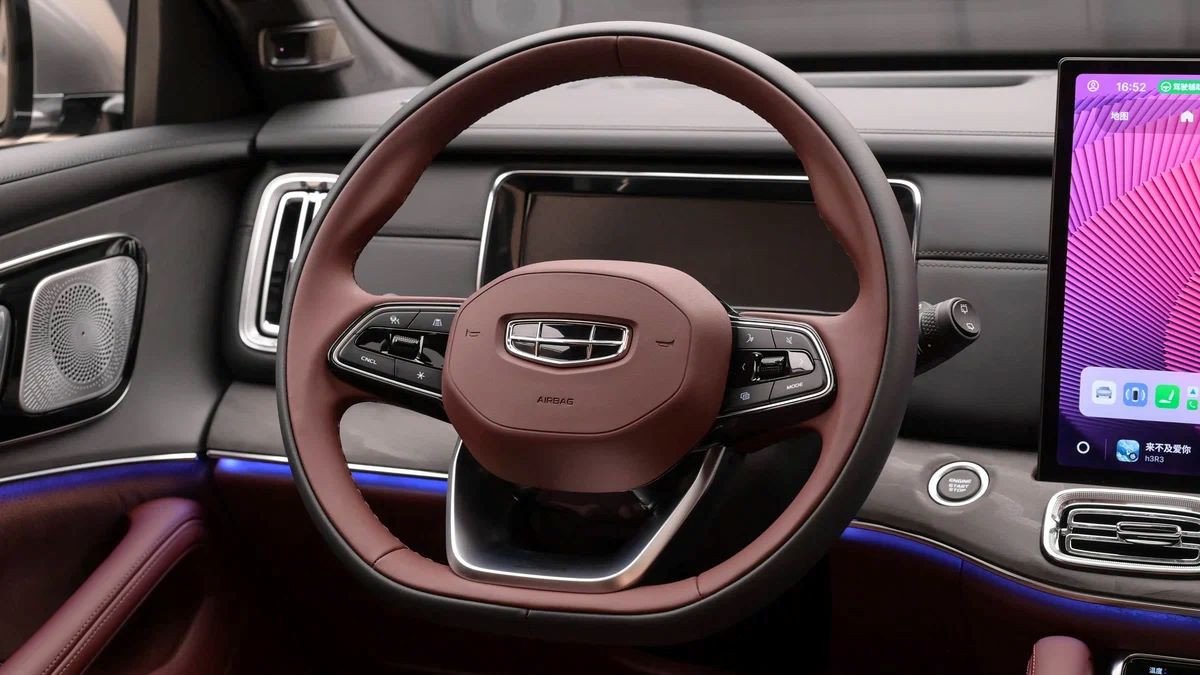
Petrol or hybrid, and no plug on either
Two engine options, both 1,999 cc. The petrol version is straightforward: engine, fuel tank, no electric help.
The hybrid version adds an electric motor and never plugs in. Its battery is small and charges itself, partly from the engine and partly from energy recovered when you brake. Toyota has sold this arrangement for decades.
Geely has not published fuel economy for the Plus. The current Monjaro hybrid, which uses a smaller 1.5-litre engine, is rated at 21.1 km/l.
The specification sheet
- Length, width, height: 4,955 x 1,960 x 1,769 mm
- Wheelbase: 2,900 mm
- Growth over the current Xingyue L: 160 mm longer, 65 mm wider, 80 mm taller, 55 mm more wheelbase
- Seats: five, in two rows. No third row
- Petrol engine: 1,999 cc, code BHE20-PFZ, 213 kW (286 hp), 205 kW net, top speed 210 km/h
- Hybrid engine: 1,999 cc, code BHE20-EFZ, 160 kW (215 hp), 360 Nm
- Hybrid drive motor: 230 kW (308 hp)
- Screens: 30-inch joined front pair, 17.3-inch rear
- Cabin chip: Qualcomm Snapdragon 8295, 5 nm, 30 TOPS
- Cabin software: Flyme Auto with the Super Eva assistant
- Driver assistance: Qianli Haohan H5, 11 cameras, three radars, one roof lidar
- Price: not announced
Will Kenya get it?
Cars built for the Chinese market are left-hand drive. Kenya needs right-hand drive, and the KS 1515:2000 inspection standard blocks left-hand drive imports for private use. That is the same rule that keeps Xiaomi’s new SUVs out. Geely has not said whether it will build the Plus in right-hand drive, or export it at all.
Our taxation policy would not help either.
Let’s wait for price all the same. The current Monjaro hybrid sells in China for 145,700 to 159,700 yuan, about KES 2.8 million to KES 3.1 million.




Join the discussion