
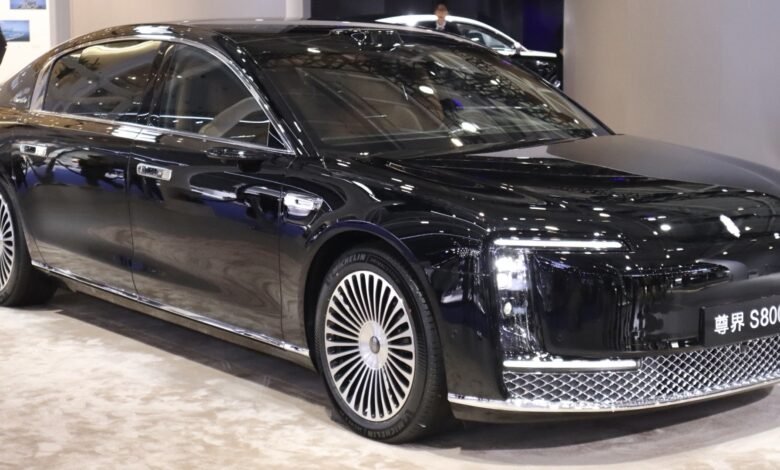
Stellantis is in talks with Huawei and JAC Group about a long-term industrial partnership for Maserati. As of 4 September the talks were at an advanced stage, with nothing signed. Huawei and JAC have said nothing about them. Stellantis only confirms that it “holds discussions with a range of industry players around the world on various topics, always with the ultimate aim of providing customers with the best mobility choices”.
The proposal splits one car three ways.
- Huawei would run product strategy and the technology inside the vehicle, built on its Harmony Intelligent Mobility platform.
- JAC would handle engineering and production.
- Maserati would supply the styling, the badge and access to its dealers outside China.
The finished car would then carry two names: Maextro in China, Maserati everywhere else. Production of the first jointly developed model would start by the end of 2027. Where it would be built has not been settled, and could be Italy, China or both.
Huawei does not sell cars, it sells what is inside them
Huawei has no car brand of its own. It supplies the software, the electronics, the driver assistance system and, increasingly, the product decisions, through an arrangement called the Harmony Intelligent Mobility Alliance.

Five Chinese carmakers build under it:
- Seres makes Aito,
- Chery makes Luxeed,
- BAIC makes Stelato,
- SAIC makes Shangjie, and
- JAC makes Maextro.
The cars run on Huawei’s Harmony software, the same family of code behind the phone system that is now the world’s third-largest mobile operating system.
Maextro is the most expensive brand in that group. Its first model, the S800 saloon, launched on 30 May 2025 from RMB 708,000, about $98,000 at the time, with Huawei’s ADS 4 driver assistance system on board. Deliveries began in August. On 16 December, JAC and Huawei delivered the 10,000th S800.
Maserati is the side that needs the help
Maserati shipped fewer than 8,000 cars in 2025 and posted an adjusted operating loss of €198 million, about $230 million. So a single Huawei and JAC model, in under five months of deliveries, moved more cars than Maserati sold worldwide in the whole year. One is a shipment figure and one a delivery figure, but the gap is not close.
In December, Maserati is due to present its own long-term strategy. Stellantis chief executive Antonio Filosa said earlier this year that a new Maserati deal would lift production at the Cassino and Modena plants in Italy, where Maserati’s cars are made.
Stellantis has done this before
Filosa has made manufacturing partnerships part of a €60 billion plan running to 2030, and has already announced tie-ups with Leapmotor and Dongfeng. Stellantis bought roughly 21% of Leapmotor in October 2023 and owns 51% of Leapmotor International, the joint venture that sells and builds Leapmotor cars outside greater China. In May 2026 the two companies said Opel would get an all-electric SUV built on Leapmotor’s platform, the first time Leapmotor technology has gone into a Stellantis brand.
Maserati would be the same trade at the expensive end of the range. Filosa is buying engineering and software that Stellantis has not been able to produce at a price that works, and paying for it with badge and distribution.
The traffic is going the other way
This is a different way than what we normally see. Usually, a Chinese company arrives in Europe or Africa with hardware and software at a price local/existent companies cannot match and takes over. The plan under discussion would have Maserati, a company founded in 1914, take Chinese in-car technology so that its cars can compete again.
Kenyan buyers already see this in action with cars we buy. Stellantis sells here through Urysia, which handles Peugeot, Jeep and Citroën; Peugeot assembly at Kenya Vehicle Manufacturers in Thika started in 2017. The Chinese brands arrived later and moved faster. BYD has sold the Dolphin, Seal and Atto 3 through Loxea since 2024, and Jetour launched four SUVs here in November 2025 with KES 1.4 billion committed to assembly in Mombasa.








Join the discussion