

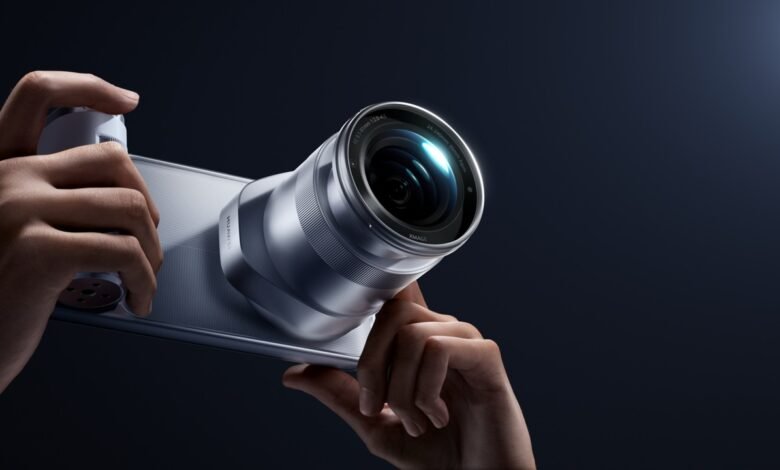
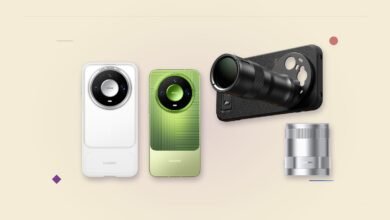
Huawei has made a camera that locks onto the back of a phone. It’s called the XMAGE Z10, and it costs CNY 5,999, or about KES 116,000. It isn’t one of those clip-on lenses sold for phones. It’s a whole camera, with its own sensor and zoom lens. It has no screen, so the phone shows you the picture, processes it and saves it.
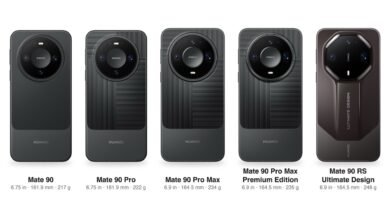
It only fits works with 2 of the new 5 smartphones in the Mate 90 Series:
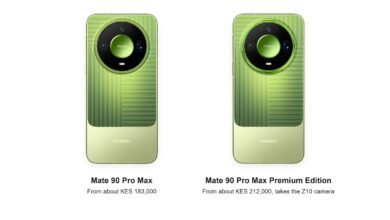
- the Mate 90 Pro Max Premium Edition, a pricier version of Huawei’s new flagship with a mount built into its camera ring, and
- the Mate 90 RS Ultimate Design.
Huawei launched both, with the Z10, in China on 1st October 2026.
So why add a camera to a phone that already has three? Because phones are bad at zoom.

Why phones are bad at zoom
On a camera, zooming moves glass inside the lens. Zoom in and the glass moves away from the sensor, zoom out and it moves back. That’s why zoom lenses are long: the glass needs room to travel. The Mate 90 Pro Max is 8.15mm thick, so it has no such room. Phone makers work around it with several lenses that don’t move, each set to a different zoom. That’s why you see three or four cameras on the back of flagship phones.
The Mate 90 Pro Max has three lenses at the back: 13mm, 24mm and 89mm. Those are focal lengths, in the 35mm-equivalent terms photographers use to compare cameras: the lower the number, the wider the view. 24mm is the normal view when you open a phone camera, and 89mm is about 4x closer.
The problem is the gaps. Want a portrait at 50mm? The phone has no 50mm lens, so it shoots at 24mm and crops into the middle, throwing pixels away. At 240mm it crops its 89mm camera by about 2.7 times. So the further you are from your subject, the less real detail the phone captures.
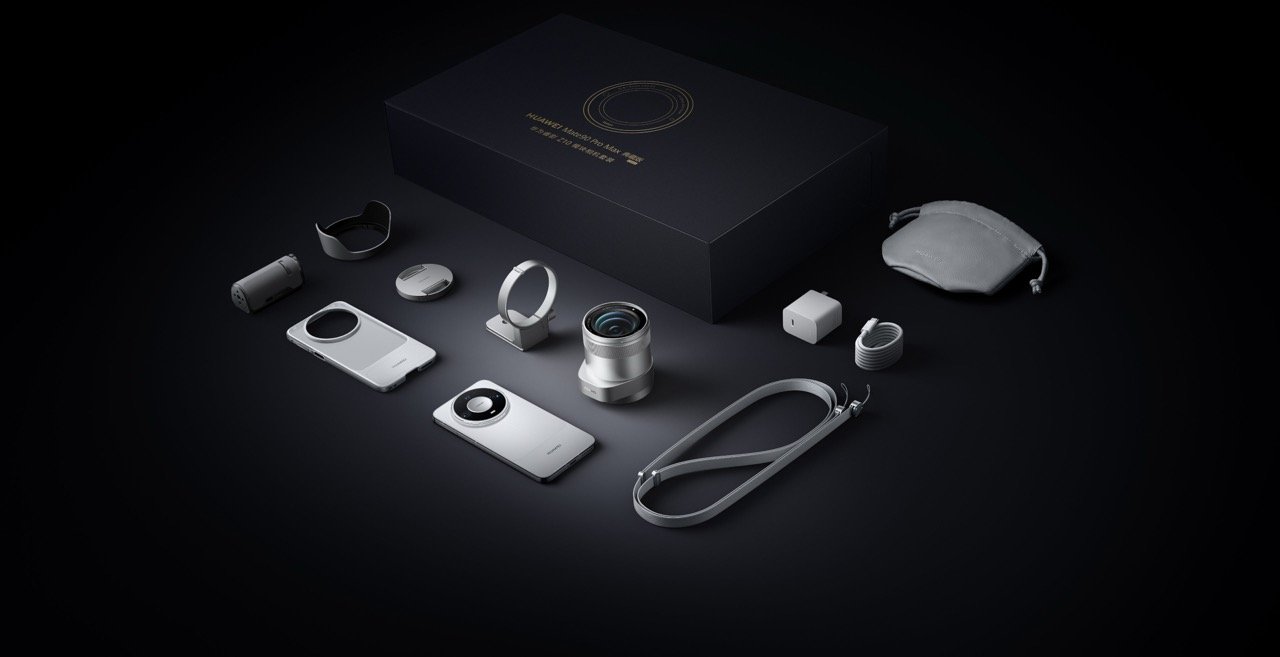
What the Z10 does differently
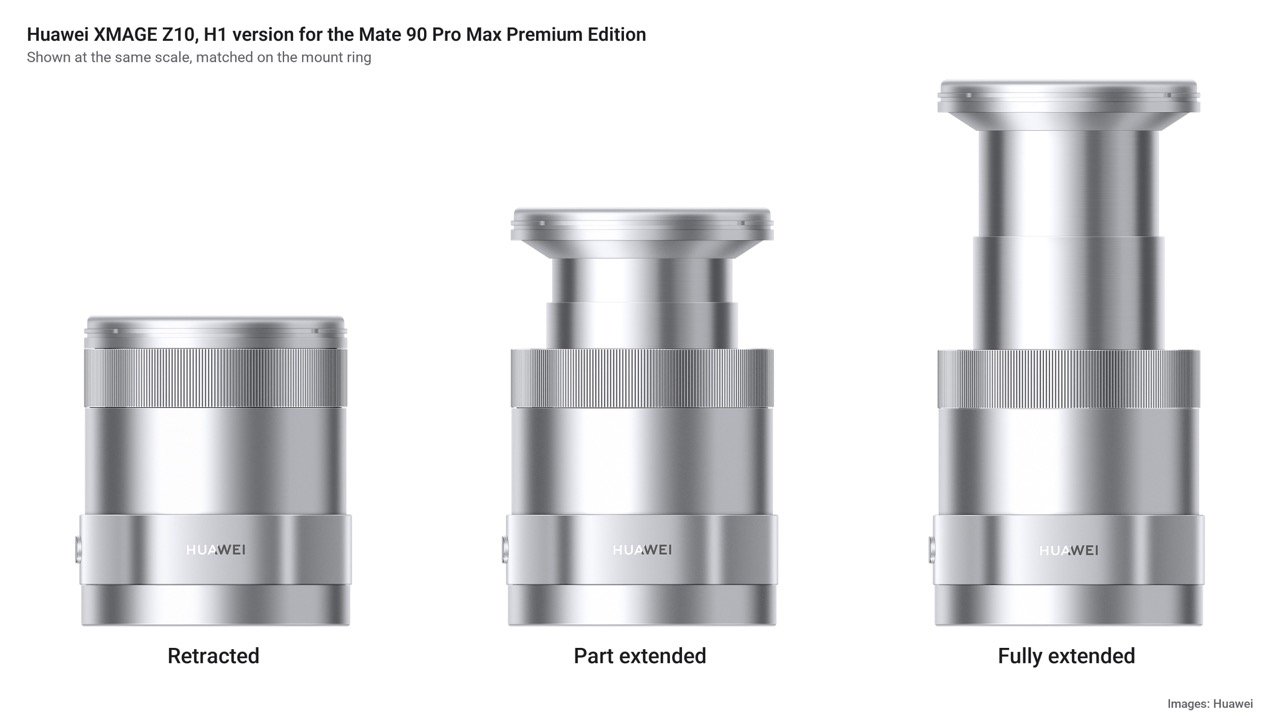
Since it’s a camera that’s not limited to the phone, the Z10 can thus be as long as it needs. Its barrel slides out so its glass moves like a camera lens and covers 24mm to 240mm without cropping. So at a concert, from the back of the hall, you keep every pixel.
The sensor matters too. The Z10’s is 1-inch and 50MP, about 1.6 times the area of the phone’s own main sensor, which is 1/1.28-inch. A bigger sensor catches more light, so indoor and night shots come out with less grain, and backgrounds blur more naturally behind people.
The catch is the aperture, the opening that lets light in. The lower its f-number, the wider it is. The Z10 opens to f/2.0 at 24mm but only f/4.5 at 240mm, so full zoom works best in good light. Huawei showed lab charts at launch putting the Z10 ahead of a professional 18-200mm lens on sharpness.
The Z10 also has a laser to help it focus and a third-generation True-to-Color camera, which reads the colour of the light so skin tones come out right. Huawei says it improves colour accuracy by 37% and skin-tone accuracy by 62%.
For video, it records up to 4K, at 30 or 60 frames per second, and 1080p slow motion at up to 960. Huawei hasn’t given the codec, bitrate or bit depth, which decide how much detail the footage keeps and how far you can edit it. Launch coverage lists optical stabilisation, but Huawei’s spec sheet doesn’t. We don’t have the camera and phones to test.
How it attaches
It twist-locks on like a camera lens: line up the red dot with the phone’s camera ring and turn. There are two versions because the phones’ mounts differ, H1 for the Mate 90 Pro Max Premium Edition and H2 for the RS, both CNY 5,999, so buy the right one.
NOTE: standard Mate 90 Pro Max has no mount and can’t use it.
The Z10 weighs about 346g. With the 235g Premium Edition, that’s 581g.
The phone’s own cameras
The Z10 will spend most days in a bag, so these are the cameras you’ll actually use.
| Camera | Sensor | Focal length (35mm equivalent) | Maximum aperture | Stabilisation |
|---|---|---|---|---|
| Ultrawide | 40MP RYYB | 13mm | f/2.2 | Not listed |
| Main | 50MP RYYB | 24mm | f/1.4 to f/4.0, continuously variable | OIS |
| Telephoto | 200MP RYYB | 89mm | f/2.6 | OIS, rated CIPA 7.5 |
| Z10 (Mate 90 Pro Max Premium Edition and RS only) | 1-inch 50MP RYYB | 24 to 240mm | f/2.0 to f/4.5 | Not listed by Huawei |
RYYB sensors swap green for yellow in the colour filter, which lets in more light.
The main camera’s aperture slides between f/1.4 and f/4.0, where most phones have one fixed opening. Wide open, it blurs the background behind a portrait. Closed down, a whole group photo stays sharp. Huawei says it also stops video flickering when the light changes. Huawei rates the camera at 18EV of dynamic range, its lab figure for how much of the darkest and brightest parts of a scene it can keep. That’s what decides whether you see both a person’s face and the bright window behind them, or the window goes white.
The telephoto’s 200MP sensor is there for cropping. Its full 200MP mode only works at 4x. Huawei doesn’t say how it gets to 8x “optical-quality” zoom. Cropping into that many pixels is how phone makers usually do it.
NOTE: If you have the standard Mate 90 Pro Max and want more reach, SmallRig sells a 3.3x teleconverter, the clip-on kind of lens the Z10 isn’t, for CNY 1,799, or about KES 34,700. It fits both Mate 90 Pro Max versions, and the phone has a teleconverter mode for it.
Prices
| Item | Price (CNY) | USD | KES |
|---|---|---|---|
| Mate 90 Pro Max, 12GB + 512GB | 9,499 | 1,410 | 183,000 |
| Mate 90 Pro Max Premium Edition, 16GB + 512GB | 10,999 | 1,640 | 212,000 |
| Z10, H1 or H2 | 5,999 | 890 | 116,000 |
| Premium Edition 16GB + 1TB and Z10 kit | 19,499 | 2,900 | 376,000 |
| SmallRig teleconverter kit | 1,799 | 270 | 34,700 |
Do you need the Z10?
For most people, no. The phone’s own cameras give you real lenses at ultrawide, normal and 4x, plus a main camera whose aperture you can control. That covers holidays, family photos and food.
The Z10 is for people who regularly shoot from a distance, at stage shows, sport or portraits across a room, and want a real lens there instead of a crop.




Join the discussion