

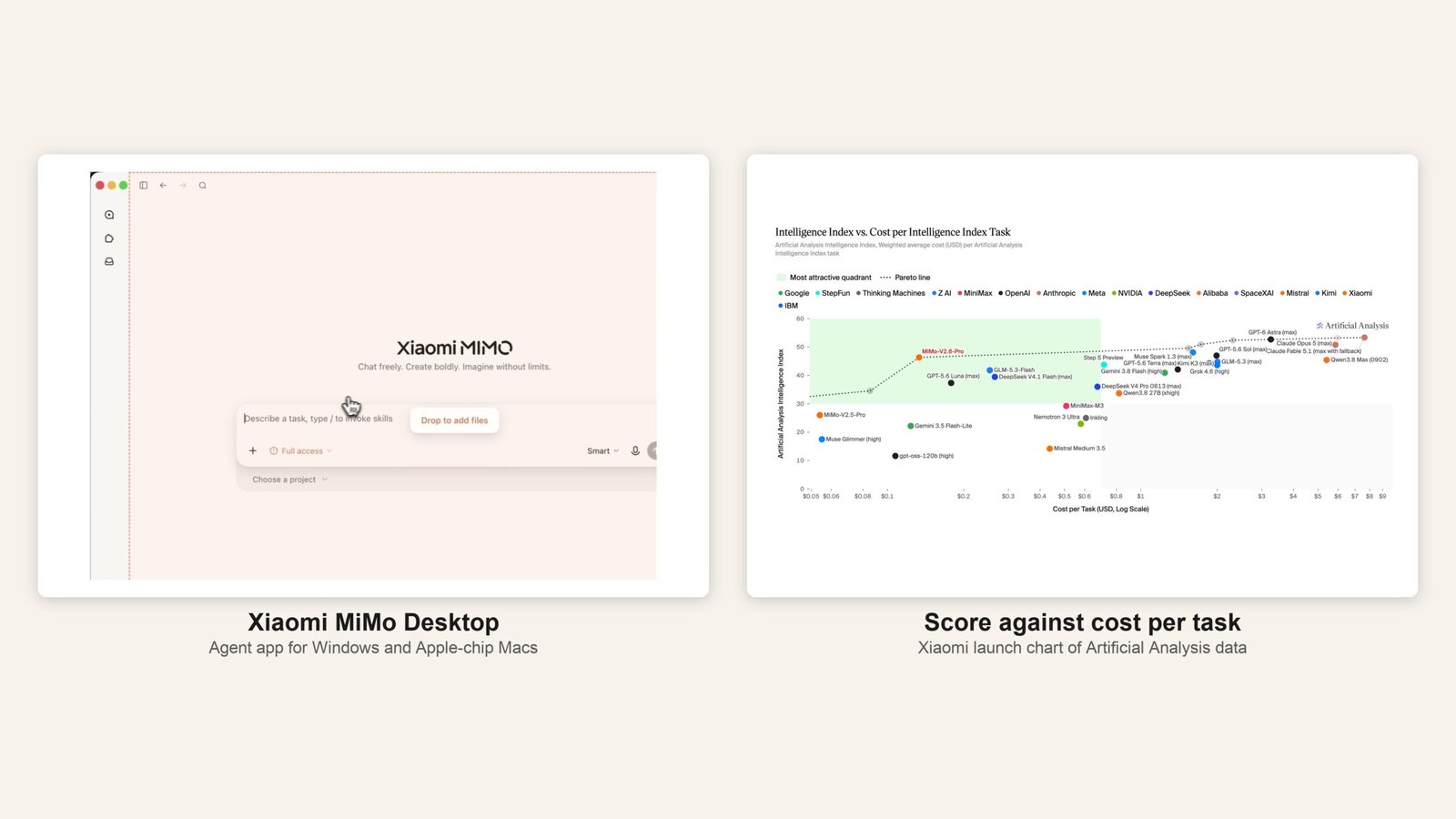
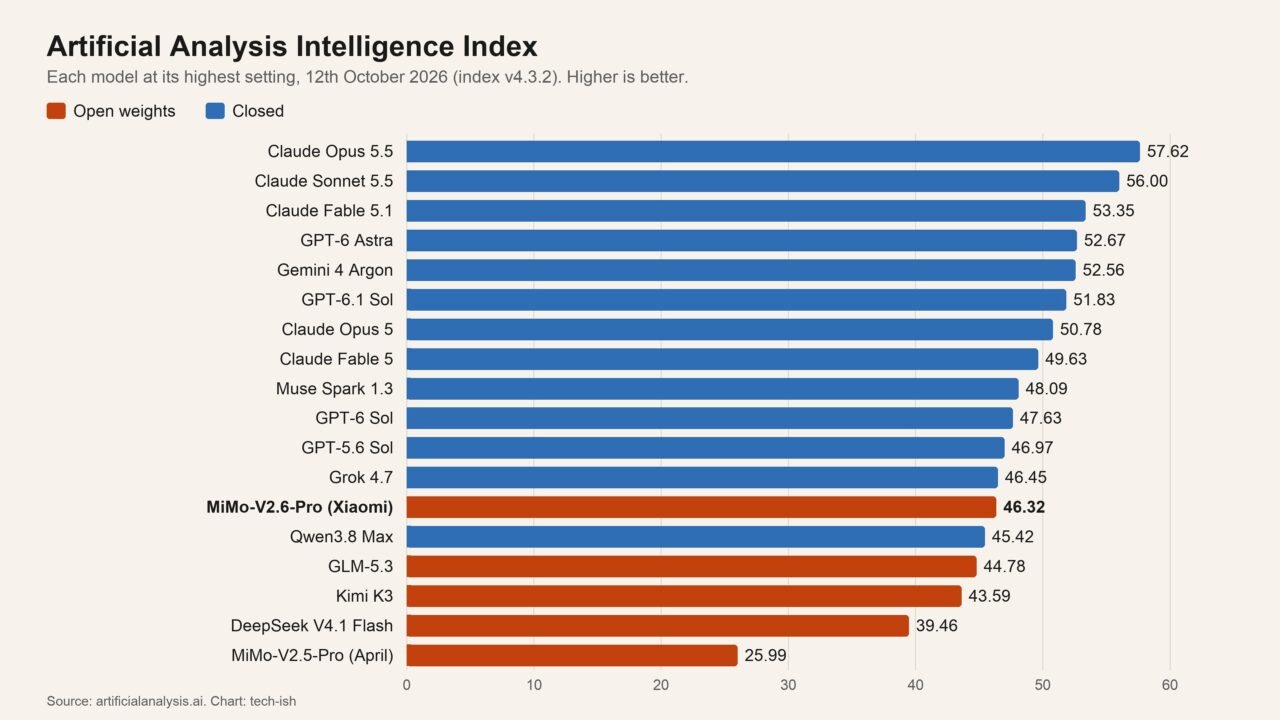
Xiaomi, the company behind the Redmi phones sold in Kenya, now makes the highest-scoring AI model that anyone can download. Its AI team released MiMo-V2.6-Pro on 22nd September 2026, and it scores 46.32 on the Artificial Analysis Intelligence Index. The next two open-weights models are Z.ai’s GLM-5.3 at 44.78 and Moonshot AI’s Kimi K3 at 43.59.
Developers on the older MiMo have a deadline. Apps still calling MiMo-V2.5 models get switched to V2.6 automatically on Wednesday 14th October, and the old model names stop working a week later, on 21st October.
So how good is it really, what does it cost, and can you use it from Kenya?
How far it is from the best closed models
Artificial Analysis is an independent firm that runs ten tests of its own on AI models and combines them into one score. Earlier this month we used the same index to rank Google’s Gemini 4 Argon.

On that index, MiMo-V2.6-Pro is about 11 points behind the leader, Anthropic’s Claude Opus 5.5 at 57.62. Twelve closed models score higher, most of them from Anthropic and OpenAI. A closed model is one you can only use through its maker’s own apps or its paid API, the service that lets your own software send the model a request and get its answer back. Grok 4.7 is just ahead at 46.45, and Alibaba’s Qwen3.8 Max, which isn’t open, sits just behind at 45.42.
Xiaomi’s own model card shows the same gap. It compares V2.6-Pro with Claude Opus 5, the model Anthropic launched in July, not the newer 5.5, and on the 14 tests where both have a score, Opus 5 is ahead on 10, MiMo on three, and one is a tie.
Xiaomi has moved fast, though. Its previous best, MiMo-V2.5-Pro, came out in April and scores 25.99 on the same index. V2.6-Pro scores 46.32 five months later, at the same API price.
What “open” gets you
An open-weights model is one whose trained file is published for anyone to download and run, as we explained when Kimi K3 became a free download in July. Xiaomi has put MiMo-V2.6-Pro’s weights on Hugging Face, and the model card lists the MIT licence, which lets you use the model commercially and build paid products on it.
MiMo-V2.6-Pro is also enormous. It has 1.02 trillion parameters, the numbers a model learns during training. It’s a mixture-of-experts model, so only 42 billion of them work on each piece of text it processes, which keeps it quick. But all of them still have to be loaded, and the files come to about 573GB, which must sit in the memory of graphics cards while the model runs. That’s why Xiaomi’s simplest setup on the model card spreads it across eight server graphics cards, and its faster one uses 16 cards across two machines.
Which means the free download matters mostly to companies and universities with their own AI servers. For a Kenyan developer or business, MiMo-V2.6-Pro is something you rent through an API instead.
What it costs to use
Xiaomi bills by the token. A token is a chunk of text, usually a word or part of one, and you pay separately for the tokens you send and the ones the model writes back. Xiaomi’s API prices for overseas accounts are USD 0.435 per million tokens sent (about KES 56) and USD 0.87 per million tokens written (about KES 110), the same as V2.5-Pro cost.
Say you run an online shop and put a support chatbot on WhatsApp. It handles 300 chats a day, and each chat sends the model 2,000 tokens (your instructions, the product list and the customer’s messages) and gets 500 tokens back. Over 30 days that’s 18 million tokens in and 4.5 million out.
| Model | Price per million tokens in / out | Index score | That month’s bill |
|---|---|---|---|
| Claude Opus 5.5 | USD 4 / USD 20 | 57.62 | USD 162, about KES 21,000 |
| MiMo-V2.6-Pro | USD 0.435 / USD 0.87 | 46.32 | USD 11.75, about KES 1,500 |
| DeepSeek V4.1 Flash, peak hours | USD 0.30 / USD 1.20 | 39.46 | USD 10.80, about KES 1,400 |
| MiMo-V2.6-Flash | USD 0.14 / USD 0.28 | 37.88 | USD 3.78, about KES 490 |
So the same chatbot costs about 14 times more on Claude Opus 5.5. DeepSeek’s row uses its peak-hours price, and it charges half that outside its weekday peak hours.
But real bills will be higher than the table shows. These are reasoning models, which think through a problem before answering, and that thinking is billed as output. Artificial Analysis measured what each model spent per task across its tests, thinking included: MiMo-V2.6-Pro cost USD 0.13 (about KES 17) a task, Claude Opus 5.5 USD 5.98 (about KES 780) and DeepSeek V4.1 Flash USD 0.27 (about KES 35). DeepSeek’s Flash came out slightly cheaper in our table, but on those tests it wrote 250 million tokens to MiMo’s 140 million, so MiMo cost less per task. Xiaomi also charges 99% less for input it has already seen and cached, so a chatbot that sends the same instructions every time pays far less for that part.
Using MiMo from Kenya
You need a Xiaomi account, which you can create with an email address, and Xiaomi’s sign-up page lists Kenya as a region. Outside China the platform takes cards, Apple Pay and Google Pay, billed in US dollars. We didn’t put a Kenyan card through it. The same models are also on OpenRouter, a site that resells many companies’ AI models through one account, at the same prices.
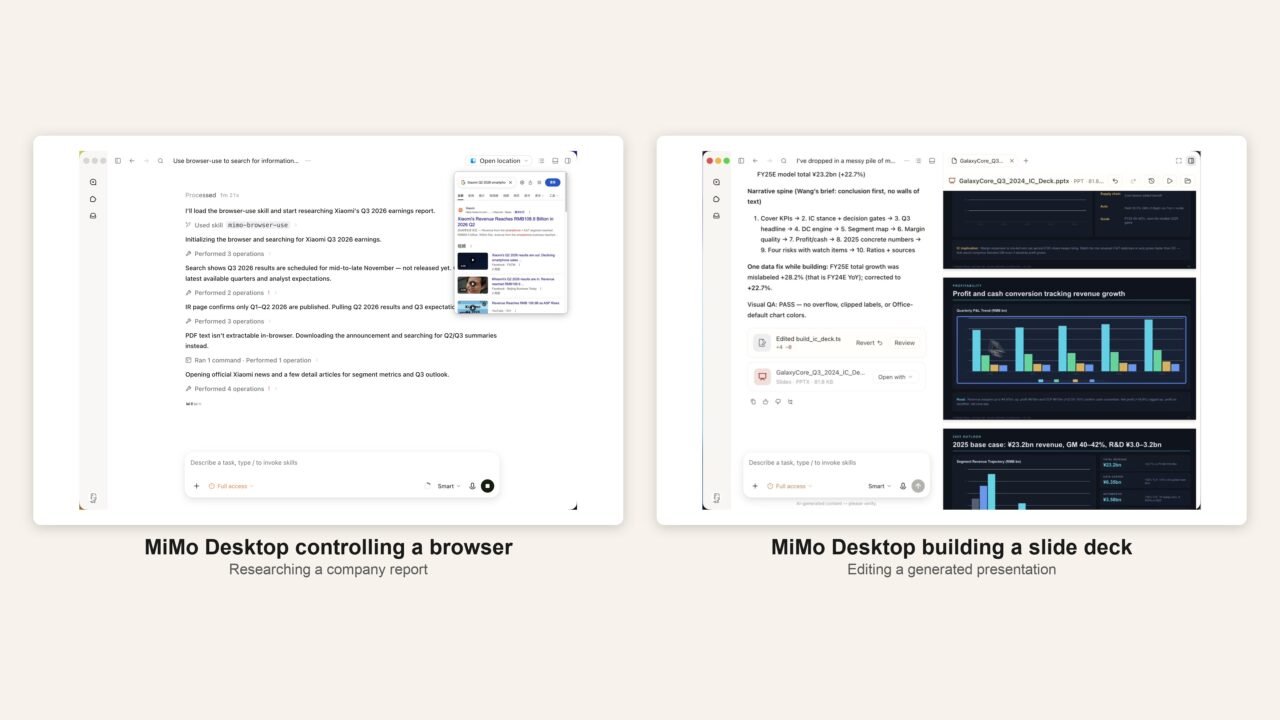
There are apps too. MiMo Studio is a browser chat Xiaomi calls a demo of its models. MiMo Desktop, for Windows and Apple-chip Macs, is an agent app that makes slides, documents and spreadsheets and can control your browser. It left early access with V2.6, isn’t available in South Korea, the UK or the EU, and its memberships start at USD 20 a month (about KES 2,600). MiMo Code is an open-source coding assistant that runs in your terminal, like Claude Code. Heavy users can buy a Token Plan, a monthly usage allowance, from USD 6 (about KES 780).
What changes for developers on 14th October
From 18:00 Beijing time on 14th October, which is 1pm in Kenya, requests to mimo-v2.5-pro go to mimo-v2.6-pro, and requests to mimo-v2.5 go to mimo-v2.6-flash. They’re billed at the new models’ prices, which are the same. Xiaomi’s deprecation page gives two times for that switch: its note says 18:00, but its table says 10:00, which is 5am in Kenya. Plan for the earlier one.
From 10:00 Beijing time on 21st October, 5am in Kenya, the old names return an error. If you were on mimo-v2.5 and don’t set a maximum output length, the default goes from 32,768 tokens to 131,072, so a long answer can cost more. On the Pro side, mimo-v2.6-pro accepts images, video and audio, where v2.5-pro took text only.
Why a phone maker is building this
Xiaomi also makes electric cars, earbuds, watches and smart home gadgets, a setup it calls “Human × Car × Home”, and MiMo is the AI it wants running across all of it. In its results for April to June 2026, Xiaomi says MiMo powers Hyper XiaoAi 2.0, the voice assistant in the HyperOS 4 beta it released in August, and Miloco 2.0, its open-source home AI. The same results don’t say when, or whether, that MiMo-powered assistant will reach the global versions of HyperOS on phones sold in Kenya. In August we covered the Xring O3, the phone chip Xiaomi designs itself. MiMo looks like the same move for software, so that Xiaomi depends less on other companies’ AI.
Xiaomi is paying heavily for it. Founder and CEO Lei Jun said in March that Xiaomi would spend at least 60 billion yuan, about USD 9 billion or KES 1.16 trillion, on AI over three years. There’s no separate figure for what MiMo earns, because Xiaomi folds its AI revenue into a line that also covers after-sales service for its cars. That line came to about USD 150 million (KES 19.4 billion) between April and June, and over the same three months the segment that holds cars and AI lost about USD 390 million (KES 50.4 billion) from operations. Xiaomi points to usage instead: MiMo-V2.5 was the most-used model on OpenRouter for the week of 20th to 26th July, at 10.5 trillion tokens.
MiMo-V2.6-Pro is now the first model a Kenyan developer should test before paying for the closed leaders. It scores about four-fifths of what Claude Opus 5.5 does, and it cost Artificial Analysis about a forty-sixth as much per task. So try it on your own customer support or coding work. Move to a closed model only if your app needs the very best answers, because that’s where the 11-point gap starts to matter.




Join the discussion