

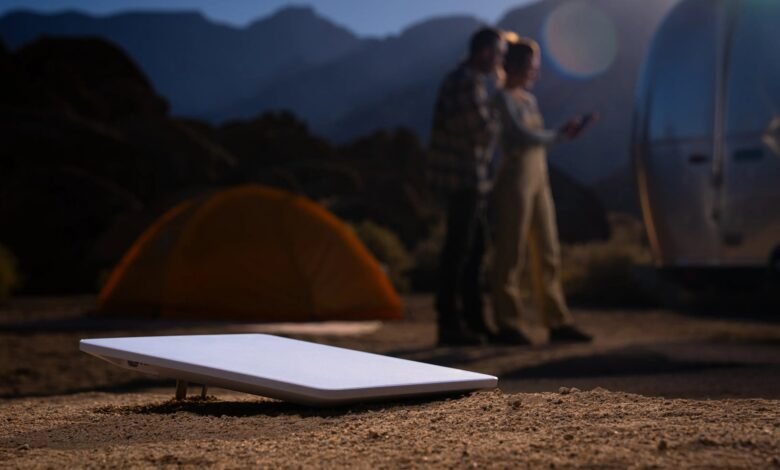
SpaceX has launched the Starlink Mini 2, the second version of its small portable satellite dish, and this one carries its own battery. It runs for up to 4.5 hours on a charge, so you can get online somewhere with no socket at all. Starlink announced it on X on 10th November 2026, with preorders open by invitation to some customers in the US.
The first Mini, which Starlink has sold in Kenya since September 2024, already had its Wi-Fi router built in. But it has no battery, so it has to be plugged in the whole time, either into a wall socket through its power supply or into a car socket or a power bank with an extra cable, and when the power goes, the internet goes with it.
What’s new
The Mini 2’s battery holds 71 watt-hours (Wh), the measure of how much energy a battery stores, and weighs 490 g. It charges over USB-C, the same port that charges most laptops, from the 60 W charger in the box, and Starlink says you can keep using the dish while it charges. When it runs low, you can swap in a second battery, which Starlink sells separately, or just plug the dish in. Starlink says it gets online in about 60 seconds once it has a clear view of the sky.
The Mini 2 is also thinner, 23.1 mm against the first Mini’s 38.5 mm, though it’s slightly bigger across at 263 × 314 mm against 298.5 × 259 mm. It weighs 1.6 kg with the battery and kickstand, against 1.16 kg for the original with its kickstand. Without its 490 g battery, the Mini 2 weighs about the same as the original.

The built-in router moves from Wi-Fi 5 to Wi-Fi 6, and Starlink says it covers up to 167 square metres, up from 112 on the first Mini. The dish is rated IP67, which means it’s sealed against dust and can survive a short time under shallow water, and it has a standard camera thread on the back, so it’ll sit on an ordinary tripod.
What 4.5 hours says about power use
A dish like this steers its signal electronically to follow satellites as they cross the sky, and that takes a fair amount of power for its size. Starlink’s own spec sheet for the first Mini puts its average draw at 25 to 40 watts. At that rate, a 71 Wh battery would run the first Mini for between about 1.8 and 2.8 hours.
So to reach 4.5 hours, the Mini 2 can average no more than about 16 W, well below even the low end of what the first Mini uses. Starlink hasn’t published the Mini 2’s power draw or any speed figures, so we can’t say exactly where those savings come from. In July, we covered leaked hardware details which suggested the Mini 2 transmits for a much smaller share of the time than the original, and so would upload more slowly. We think that’s part of how it stretches the battery, but it’s still unconfirmed. And 4.5 hours is Starlink’s “up to” figure, so treat it as the best case; we’d expect heavy use to drain the battery faster.
If you fly with it, the 71 Wh battery is under the 100 Wh limit the US Federal Aviation Administration sets for lithium-ion batteries in carry-on luggage without airline approval. Airlines can set stricter rules, so check yours.
What it costs
Starlink’s public page has no price. The invitations it emailed to some US customers offer the Mini 2 for USD 999 (about KES 130,000) with a year of Roam Unlimited, Starlink’s travel plan, included. Buyers put down a USD 100 (about KES 13,000) deposit and pay the remaining USD 899 (about KES 117,000) when the dish ships, which the invitations estimate at mid-December. The kit can’t be added to an existing service line, Starlink’s term for one paid subscription, and after the first year the service continues at whatever Roam Unlimited costs then.
A YouTuber going through the code on Starlink’s website also found a “Mini 2 Beta Kit” listed at USD 249 (about KES 32,400) and a spare battery at USD 50 (about KES 6,500). Starlink hasn’t confirmed either price.
Starlink also hasn’t said whether the first Mini stays on sale. The Mini 2 page doesn’t list an Ethernet port for a wired connection, which the first Mini has, or any details of the antenna.
| Starlink Mini 2 | Starlink Mini | |
|---|---|---|
| Battery | 71 Wh, up to 4.5 hours, swappable | None |
| Power | Battery or USB-C, 60 W | DC power cable, 12 to 48 V |
| Size | 263 × 314 × 23.1 mm | 298.5 × 259 × 38.5 mm |
| Weight | 1.6 kg with battery and kickstand | 1.16 kg with kickstand |
| Wi-Fi | Wi-Fi 6, up to 167 m² | Wi-Fi 5, up to 112 m² |
| Field of view | 110° | 110° |
| Water and dust | IP67 | IP67 with cable and plug fitted |
| Ethernet | Not listed | One port, through the Starlink Plug |
| Power draw | Not announced | 25 to 40 W average |
| Speeds | Not announced | Not on the spec sheet |
When it could come to Kenya
Starlink says the Mini 2 is coming to more customers and countries soon, without naming any or giving a date. When it does reach Kenya, the battery is the part buyers here will notice. As we said when the first leaks came out, power cuts here are common enough that people already pair home internet routers with battery packs. A dish that carries its own battery keeps you online through a few hours of blackout without a UPS, the backup battery box people plug their routers into. It also works on a road trip or at a campsite without a car socket.
For now, the first Mini is what’s on sale here. In June, Starlink dropped the KES 16,250 activation fee it charged Mini buyers paying in instalments, and the kit cost KES 27,000 upfront plus KES 3,010 shipping. Roam plans in Kenya start at KES 6,500 a month. Availability is the other catch. Starlink stopped taking new customers in seven counties, including Nairobi and Mombasa, in July, because its network there was full. A new dish doesn’t add satellite capacity, so the Mini 2 won’t change that on its own.
If you need portable Starlink in Kenya right now and you’re outside those seven counties, the first Mini is the one to get, and a 100 W USB-C power bank with Starlink’s USB-C to barrel jack cable covers most of what the battery would. If you can wait, the Mini 2 fixes the first Mini’s biggest weakness, but we don’t yet know what it’ll cost here or when it’ll arrive.







Join the discussion