

Just days after SpaceX quietly unveiled the new Starlink V5 dish aimed at customers on the more affordable Residential 100Mbps plan, another interesting development has surfaced. This time, it’s the Starlink Mini 2.
According to fresh information shared by well-known Starlink hardware leaker Oleg Kutkov, SpaceX is actively developing a new Mini terminal under the hardware revision mini2_prod1. And while the external changes may appear modest at first glance, one addition immediately stood out to me: a built-in battery.
For Kenyan users, and, frankly, much of Africa, that single feature could be more important than any increase in internet speeds.
Smaller, lighter, and now battery-powered
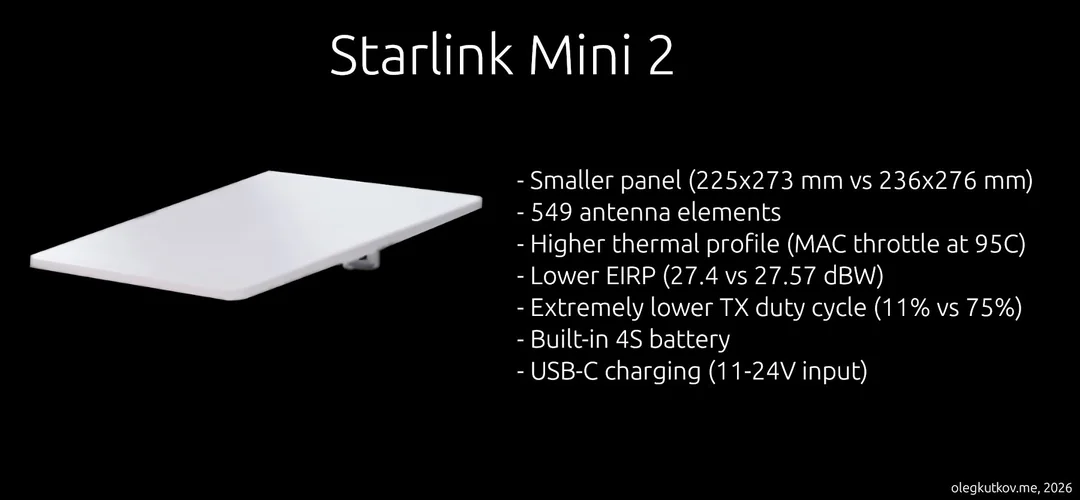
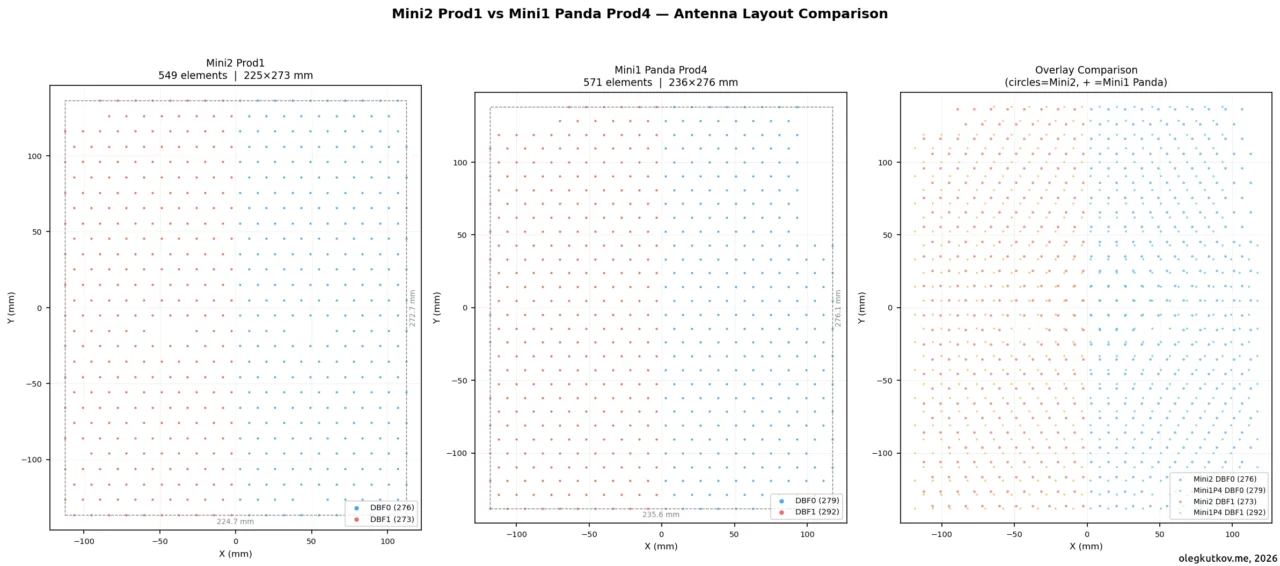
The leaked hardware details show that the Starlink Mini 2 is becoming slightly more compact than its predecessor. The internal antenna panel has shrunk from 236 × 276 mm on the original Mini to 225 × 273 mm on the new model. The antenna itself has also been redesigned.

Compared to the original Starlink Mini, which packs 571 antenna elements, the Mini 2 uses 549 elements, suggesting SpaceX has optimized the phased-array layout rather than simply shrinking existing hardware. The leak also shows that the device retains GPS support and is explicitly configured for in-motion use, meaning it should continue serving travellers, campers, boats and vehicles just like today’s Starlink Mini.
Interestingly, the terminal still uses the same Catapult SoC found in the original model.
The biggest upgrade isn’t speed, it’s the battery
This is where things become particularly interesting. The leak reveals that the Starlink Mini 2 includes a built-in 4-cell (4S) lithium battery managed by a BQ40Z-series battery management system (BMS). Battery capacity hasn’t been revealed yet, but charging will happen through USB-C Power Delivery, supporting an input voltage between 11V and 24V.
That’s a huge departure from the current Mini. And personally, I think this tells us far more about SpaceX’s strategy than any benchmark ever could. Across Kenya and many African countries, power outages remain common. It’s one of the reasons local ISPs and mobile operators have increasingly embraced battery-backed networking equipment.
Safaricom’s Home 5G routers, for example, can be paired with battery packs that keep households connected even after electricity goes out. Airtel has taken a similar approach. Now imagine a Starlink dish that already carries its own battery. Instead of scrambling for a UPS or external power station every time the lights go off, users could simply continue using the terminal.
I’m not suggesting SpaceX built the Mini 2 specifically for Kenya or Africa. That would be speculation. What I am saying is that its design fits remarkably well into markets where electricity reliability can be just as important as internet availability.
There are some performance compromises
The battery doesn’t come without trade-offs. According to the leak, the new terminal operates with a lower average EIRP (Equivalent Isotropically Radiated Power) of 27.4 dBW, down slightly from 27.57 dBW on the original Mini. More significantly, its transmit duty cycle has reportedly dropped from 75% to just 11%. That reduction will likely translate into lower uplink performance, particularly during sustained uploads.
The leaker believes this is probably a consequence of SpaceX trying to stay within the device’s new power budget. In other words, if you’re running the dish from an internal battery, conserving energy becomes far more important than squeezing out every last megabit of upload speed. For many residential users, that’s probably a reasonable compromise.
Starlink Mini 2 promises better thermal management
SpaceX also appears to have increased several thermal limits. The Starlink Mini 2 reportedly raises the MAC thermal throttling thresholds to 95°C and 99°C, compared to 79°C and 83°C on the first-generation Mini. Meanwhile, battery thermal shutdown is configured at 80°C.
These changes suggest the company expects the terminal to operate under more demanding conditions while still maintaining stable performance.
Viewed on its own, the Starlink Mini 2 looks like a routine hardware refresh. But when combined with last week’s launch of the new Starlink V5 dish, a much bigger picture begins to emerge. The V5 terminal appears designed to reduce hardware costs for customers joining Starlink through the new Residential 100Mbps plan.
The Mini, meanwhile, was already positioned as Starlink’s more affordable and portable option. Now SpaceX seems to be refining that formula even further with a smaller dish, USB-C charging, an integrated battery for portability, potentially lower manufacturing costs, and power-efficient operation.
These decisions suggest SpaceX is working to reduce not only the financial barrier to joining Starlink, but also the practical barriers that many users face once they own the hardware. For users living in areas with unstable electricity, that’s arguably just as valuable. For portability merchants, the built-in battery is an even better addition to the Mini 2.
Whether SpaceX eventually positions the Mini 2 as a direct replacement for today’s Mini or introduces it as a new entry-level option remains to be seen. For now, the device is still in development, meaning specifications could change before launch.
But if this leak proves accurate, the Starlink Mini 2 may end up being one of the most practical Starlink products we’ve seen yet. Not because it’s dramatically faster, but because it’s designed to keep working when everything else goes dark.







Join the discussion