

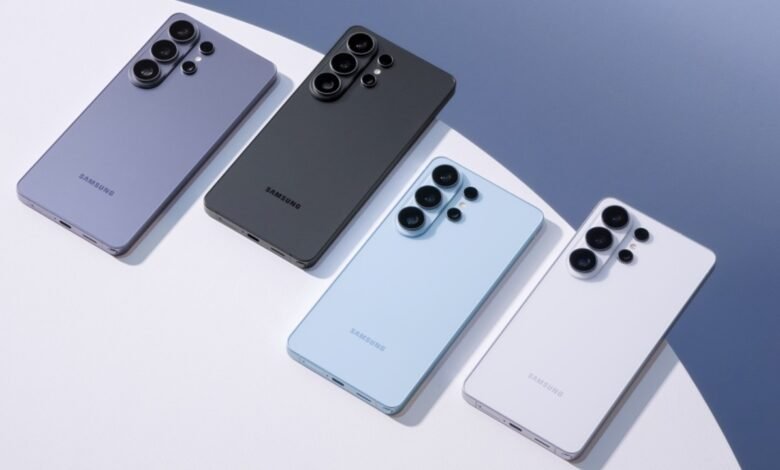
Samsung shipped more phones than anyone else between April and June 2026, taking 24% of global smartphone shipments and pushing Apple back into second place. Apple took 20%, which Counterpoint Research says is the highest share Apple has ever held in a second quarter. Apple set that record and lost first place in the same three months, because both companies grew inside a market that was shrinking underneath them.
Counterpoint published the numbers on 13 July. Global smartphone shipments fell 11% against the same three months of 2025, which is the weakest second quarter the industry has recorded since 2013. That was the year the Galaxy S4 launched.
Worth noting before we proceed is this: A “shipment” is not a sale to you. It counts phones leaving the manufacturer for distributors, importers and shops, which analysts call sell-in. The figure tracks what brands expect to sell rather than what has already sold. A fall this sharp means brands are building fewer phones because they no longer believe shops can move them at the new prices.
Memory chips are doing this
The cause is not consumer boredom. It is the cost of memory.

Every phone needs two kinds. DRAM is the working memory, the RAM figure on a spec sheet. NAND is the storage, the 128GB or 256GB number. Both come from a small group of firms, mainly Samsung, SK hynix and Micron, and all three have shifted capacity towards the high-bandwidth memory that AI data centres buy at far better margins. Less capacity for ordinary phone memory means a higher price for it.
IDC puts memory costs close to 300% higher than a year ago. On a cheap phone, memory now accounts for over 65% of the bill of materials, meaning the total cost of the physical parts. Counterpoint’s figure for an $800 phone is around 40%, up from roughly 14% in early 2025, as we covered when Samsung raised every foldable price in July.
That maths is brutal at the bottom of the market. A brand selling a KES 15,000 phone has almost no margin to absorb a component increase of that size. It either raises the price, cuts the specification, or stops making the phone. We laid out that trap in The End of Cheap Phones back in December 2025. Q2 2026 is the quarter it showed up clearly in the shipment data.
Who grew and who did not
Q2 is normally Apple’s weakest quarter, because it sits furthest from a September iPhone launch. Reaching 20% in that window is the record. Behind Samsung on 24% and Apple on 20%, Xiaomi held 12%, OPPO 11%, vivo 8%, and everyone else combined 26%.
Samsung and Apple were the only two of the top five to grow. Samsung gained about 4 percentage points of share year on year and Apple about 3. Xiaomi lost 2 points, OPPO and vivo 1 each, and the combined “others” group lost 2. Xiaomi, OPPO and vivo all recorded double-digit falls in actual shipments, because holding roughly the same share of a market that shrank 11% still means selling fewer phones.
Two brands outside the top five grew faster than anyone. Google shipped 16% more Pixels than a year ago, which Counterpoint credits to the Pixel 10 and Pixel 10a in what it calls mature markets, meaning North America, Western Europe and Japan. Huawei grew 6% on the Mate 80, Nova 15 and Enjoy 90 series. Google’s next launch is on 12 August.
Counterpoint, IDC and Omdia do not agree
Counterpoint is not the only tracker. IDC measured the same quarter at 277.5 million units, a fall of 6.7%. Omdia measured a fall of about 4%. Three firms, three headline numbers, same three months.
They are counting differently rather than contradicting each other. Each uses its own definition of a shipment, its own sample of distributors and its own method for estimating brands that do not publish figures. All three agree on the direction, on Samsung and Apple growing while the rest shrank, and on the damage being concentrated below $200.
What this means in Kenya
The 26% “others” group is where Kenya’s market lives. Transsion, which owns TECNO, Infinix and itel, sits in it. Safaricom said back in 2023 that Transsion brands made up over half the smartphones on its network, and that has not meaningfully changed. The bucket that shrank fastest in share terms is the bucket that supplies most Kenyan phones.
You can see it on shelves already. When the Galaxy A57 and A37 reached Nairobi shops in March, the 8GB/256GB A57 was listed at KES 67,999 against KES 54,995 for last year’s A56 at launch. The equivalent A37 was KES 56,999 against KES 46,995 for the A36. Some of that was early-stock markup, and prices settled once Samsung Kenya set official pricing. But the average pricing year on year was still an upward trajectory.
Two things are being used to soften the issue. Device financing through M-KOPA, Watu Credit and Lipa Mdogo Mdogo spreads a higher price over months, and Kenya’s financing model is now studied elsewhere for that reason. Older stock also stays on sale longer here than in most markets, so a 2024 phone remains a live option. Our guide to phones under KES 20,000 has fewer genuinely new entries than a year ago.
What to watch
In May we said the Q2 data would answer three questions, when we read Counterpoint’s Q1 reports together. Whether Samsung’s premium tier could take ground back from Apple: it did, on the Galaxy S26 series. Whether Xiaomi’s decline would narrow: it did not. Whether memory prices would moderate in the second half of 2026: they have not.
For the rest of the year, Counterpoint expects full-year shipments to fall about 14%, and IDC forecasts 13.9%. Those two agree closely. Counterpoint expects the memory shortage to persist into 2027, and some reports of its briefing say 2028.
If you’re a Kenyan buyer, know this entry-level and mid-range phones will keep getting more expensive or quietly worse specified through the rest of 2026. Flagships will hold up better, and there is no sign of relief before 2027. If you are due an upgrade in that bracket and you find stock at today’s price, buying now beats waiting for a discount the component market is not going to deliver.








Join the discussion