
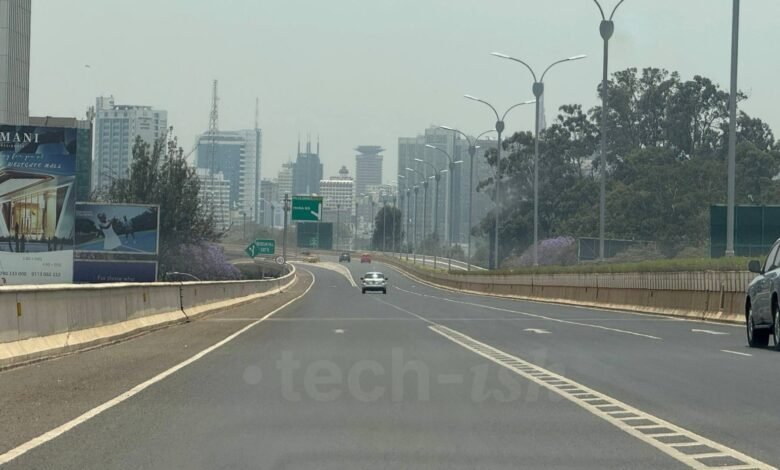
Moja Expressway, the company that financed and runs the Nairobi Expressway, lost KES 5.1 billion in 2025. It made KES 9.63 billion in revenue, but its costs came to KES 14.73 billion. The figures are in the National Treasury’s fifth annual report on public-private partnerships (PPPs), published on 16th November 2026.
More cars are using the road. It carried 7,209,038 vehicles between July and September 2025 and 7,359,277 between April and June 2026, about 80,000 a day. That last quarter was about 15% busier than the same quarter a year earlier, when 6.42 million vehicles used it.
Asked about the rising costs in a TV interview on 17th November 2026, Treasury Cabinet Secretary John Mbadi said: “Financial statements don’t mean much unless now you go deeper to understand why are the direct costs rising”.
Who carries the loss
The expressway is a 27.1km dual carriageway built along the middle of the A8, from Mlolongo on Mombasa Road to James Gichuru Road on Waiyaki Way. It started as a privately initiated proposal, meaning its builder, China Road and Bridge Corporation (CRBC), proposed the project to the government instead of winning a tender. Moja Expressway, CRBC’s local subsidiary, designed, financed and built it, and runs it under a 30-year contract with the Kenya National Highways Authority (KeNHA), after which the road goes back to the government. It cost USD 667.8 million, or about KES 86.8 billion at KES 129.97 to the dollar on 19th November 2026, and opened on 14th May 2022.

So the tolls are how Moja Expressway gets its money back, and if they don’t cover its costs, the loss is its own. Mbadi says the same: it’s a PPP largely run by Moja Expressway, so it doesn’t put the national budget at direct risk.
A loss in every reported period
All four sets of accounts the Treasury has reported show a loss:
| Period | Revenue (KES) | Costs (KES) | Loss (KES) |
|---|---|---|---|
| January to December 2022, tolling from May | 1.68 billion | Not given | 316 million |
| July 2023 to June 2024 | 4.63 billion | 5.86 billion | 1.23 billion |
| Labelled July to December 2024 | 7.16 billion | 9.01 billion | 1.85 billion |
| January to December 2025 | 9.63 billion | 14.73 billion | 5.10 billion |
The middle two rows need care. KES 7.16 billion in the six months the label gives doesn’t fit KES 4.63 billion for the year before. The 2022 and 2025 accounts run January to December, and we think the middle rows are really calendar 2023 and 2024, which would make the growth smooth.
Either way, between the 2023/24 accounts and 2025, revenue roughly doubled, costs went up two and a half times and the loss more than quadrupled.
The report doesn’t say why. It gives only revenue, “direct costs” and the loss, with no split between interest on the loans that built the road, depreciation, maintenance and currency losses. We think debt is the likeliest cause, since interest is due however many cars pass, but the Treasury’s figures can’t show it. The auditors still signed off the accounts as a “true and fair view”, and the directors expect the company to keep operating.
Where taxpayers come in
A loss doesn’t cost the government money, but an early end to the contract could. Kenya’s PPP contracts can make the government pay the company if either side defaults, or after force majeure or a political event. Kenya also gave the project a Letter of Support, a written promise covering early termination caused by political events. The worst-case payment for the expressway is KES 87.6 billion as at June 2026. Only two projects carry bigger figures, both parts of the new Rironi to Mau Summit toll road, where early works are under way. The total across all of Kenya’s PPPs is KES 400 billion. Applying the World Bank’s 6% probability of early termination, the Treasury reports KES 24 billion as its contingent liability.
What motorists get
Drivers with an electronic toll tag pass a gate in 3 seconds each way. In 2022, we explained how to get one. Paying cash takes 15 seconds on entry, and cash exits averaged 33 seconds in the second half of 2025 and 26 to 27 seconds in the first half of 2026. The PPP report lists the accuracy of those toll times as an open question.
Moja Expressway’s costs have gone up by KES 8.9 billion since its 2023/24 accounts, far more than the KES 5 billion its revenue added. Until the company or the Treasury breaks that down, there’s no way to tell whether it’s early-years debt or tolls that can’t cover the road.








Join the discussion