

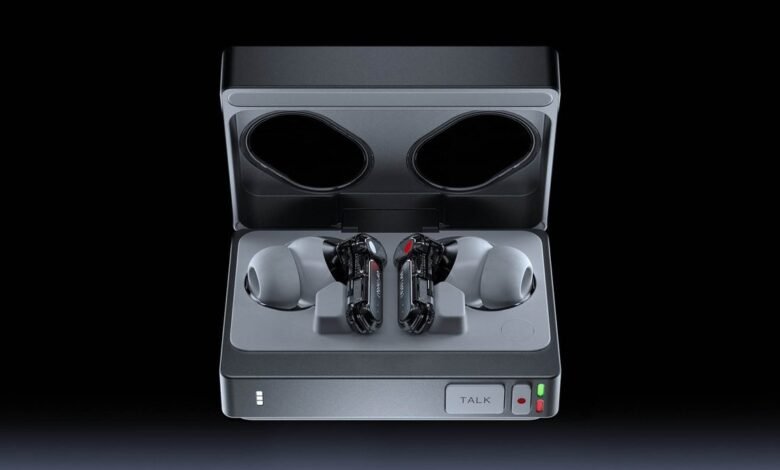
Nothing’s first AI-native device, meaning one built around AI, is a pair of earbuds. The London phone and audio brand showed off Ear (note) on Wednesday 25th November 2026 and will launch it on Tuesday 8th December. It records your calls and meetings and turns them into notes. Nothing’s plan is for AI to then do the work that comes out of them, like the email you promised someone on the call.
On Saturday, we wrote that we thought this device was a recorder that turns what’s said around you into notes. It is. But we expected a gadget of its own, and it’s earbuds and their charging case.
How it records
If you take a call on the earbuds, they can record it. When you’re sitting with people, you don’t want earbuds in, so the case has its own microphones. You can leave the earbuds inside it and it can still record the room. A RECORD button on the case captures calls, meetings and voice memos, and there’s a TALK button for recording your own thoughts. You then get a summary and a transcript, which is the conversation written out, so you can see who said what and what needs to happen next. After an hour-long meeting, you can read the notes and skip the audio.
But your phone can already record. Akis Evangelidis, a Nothing co-founder, says the trouble is the steps: you pull the phone out, unlock it, go through an app and hit record. Carl Pei, Nothing’s co-founder and CEO, argued earlier this month that when you take out your phone to write something down, “the moment has moved on without you”. If you carry earbuds anyway, there’s no extra gadget to remember and recording is one press away.


What the AI is meant to do
If you’ve ever pasted an email into ChatGPT before asking for help with it, you know why Nothing wants to record your meetings. The AI doesn’t know what happened in your day, so you have to tell it first. That background is called context, and Pei says the part that matters most is spoken and never reaches the AI.
Ear (note) is meant to pass it on to an agent, which is AI software that carries out tasks for you, often in other apps. Pei’s promise is “Docs drafted, emails sent, tasks assigned, before you’ve hung up.” You’d also get a brief before a meeting.
Say a client calls you about a logo (the example is ours). You promise a quote by Friday, and your colleague has to change the colours. A notetaker gives you a summary of that, and you still have to write the quote and message your colleague. The agent Nothing describes would draft the quote, assign the colour change and brief you before you meet the client again.
It has to hear you correctly first. If it hears fifteen when you said fifty, the quote has the wrong price. It also needs you to let it into your email and other apps, and we think most people will want to read an email before it leaves in their name. Nothing’s posts have only shown the hardware so far.
What’s already out there
The recording itself isn’t new. Nothing’s own Ear (3a), launched at USD 99 or about KES 12,900, records calls and online meetings, though local laws limit that to 21 countries and regions. Anker’s Soundcore Liberty 5 Pro Max does it the other way round: its case records the room, but not calls. It’s USD 183.99 (about KES 23,900) right now, down from USD 229.99 (about KES 29,900).
The Plaud One earbuds, from a company that makes AI recorders, are designed to record calls and the room. They’re on pre-order in the US at USD 229 (about KES 29,800), and Plaud says its agent can act in apps such as Gmail and Slack, though some connections may come later.
What we still don’t know
Pei hadn’t decided on a price as of Monday. Nothing hasn’t said if there’s a subscription, where Ear (note) will be sold, how long it records, or where recordings are processed. It’ll work with several agents, including Nothing’s own voice assistant.
Then there are the people being recorded. On a call, the Ear (3a) is meant to play a tone that you both hear. A room is harder, and Nothing hasn’t said how people around the case will know. Pei says Nothing worked with legal experts and obtained privacy certifications.
We think the agent is the reason to wait for Ear (note), because other earbuds already record calls or rooms and make notes from them. So on 8th December, Nothing should show one real call becoming one correct email, and say what that costs.








Join the discussion