
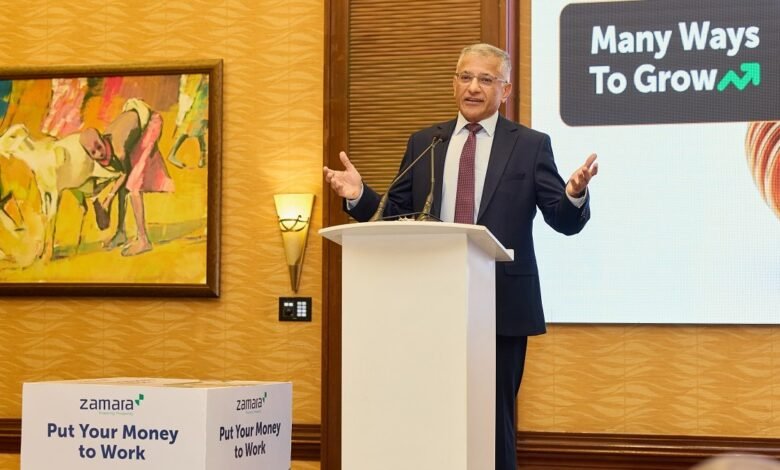
Zamara, the Kenyan group best known for running pension schemes and broking insurance, has gone into investments. On Thursday 26th November 2026 it publicly launched Zamara Investments and four unit trust funds, which you buy through MyZamara, its digital platform. The new business has already taken in KES 2.2 billion since it started accepting money in May, Zamara says.
A unit trust pools many people’s money for a licensed manager to invest. So when you put money in, you buy units, and their price moves with what the fund holds. Zamara’s four funds make up the Zamara Unit Trust Scheme, which is listed on the Capital Markets Authority’s (CMA) register. Standard Chartered Bank Kenya is the trustee and custodian, the bank that holds the funds’ assets apart from Zamara. Group CEO Sundeep Raichura calls the move “a natural evolution” of more than three decades in pensions, actuarial work and insurance broking, work that included the Fahari Retirement Plan we covered in 2021.
Every yield below is Zamara’s own figure from its promotional material, undated and not guaranteed, and each moves daily. All are effective annual yields, what you’d earn in a year if each day’s interest stayed in and earned interest too.
Money you might need soon
For emergency cash, look at the shilling money market fund. A money market fund can only hold short-term, interest-earning instruments, such as Treasury bills and bank deposits, with an average term of 18 months or less. Zamara calls it low risk, and it starts at KES 1,000, with top-ups from KES 100. There’s no lock-in, so you can ask for your money any time and get it within two working days.
It quotes 9.46%. So if you put KES 10,000 in for a year, you’d earn KES 946, and once the 15% withholding tax on interest comes off, you keep KES 804. That’s a little below Old Mutual’s shilling fund, which was at 10.26% on 25th November 2026, against Zamara’s undated figure. If you already have a money market fund elsewhere, the rate alone isn’t a reason to move.
For dollar savings, or money sent home from abroad, the dollar money market fund works the same way in dollars. It starts at USD 100 (about KES 13,000), with top-ups from USD 50 (about KES 6,500), no fixed term and payouts within two working days. Its 6.01% is above Old Mutual’s dollar fund, at 5.39% on the same date.
Money you can leave alone
The fixed income fund, pitched at medium-term goals, quotes 13.72%. That’s well above Old Mutual’s special fixed income fund, at 11.37%. A fixed income fund keeps at least 60% in bonds and similar securities, and since there’s no limit on how long those run, it can hold long government bonds. November’s government bond auctions paid 12.62% to 14.13%, which is how a fund can quote that much. The fund’s value moves with bond prices, though, and those fall when interest rates rise. Zamara puts its risk at low to moderate. It starts at KES 1,000, and your money is locked in for the first three months. Top-ups, from KES 1,000, also wait until then.
The Global Balanced Special Fund is for long-term money you want spread across world markets. A special fund follows a strategy the CMA approves case by case, and every investor has to put in at least KES 100,000, which this fund’s USD 1,000 (about KES 130,000) minimum clears. Last week we explained why a fund that invests abroad takes this route. Your money is locked in for six months, and top-ups after that start at USD 500 (about KES 65,000). Zamara calls it moderate to high risk. It doesn’t name the markets it buys into. The fund’s unit price is USD 10.70 (about KES 1,400), but without a starting price there’s no way to tell what the fund has returned.
Zamara hasn’t published its fees, fact sheets or the funds’ rulebooks, and doesn’t say whether its yields are after fees. The KES 2.2 billion can’t be checked against the CMA’s latest quarterly report either. That report runs to 30th June, and Zamara isn’t in it.
If you want to try Zamara, the shilling money market fund is the easy start, since it takes KES 1,000 and has no lock-in. For the other three, ask Zamara for the current rate, the fees and the fund rules in writing first.






Join the discussion