
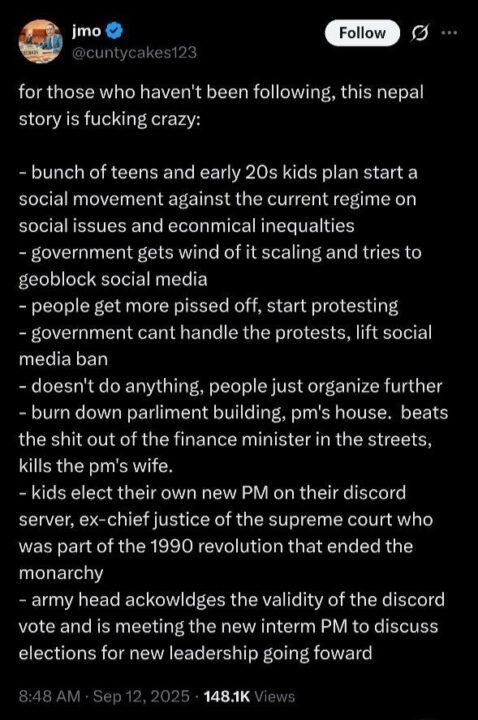
What happens when you ban social media in a country where young people already don’t trust the politicians flaunting their lavish lives while the rest struggle? Nepal just gave us the answer: you don’t kill dissent. You fuel it. And in the most 2025 plot twist yet, the country’s next political leader might have been elected on Discord. Yes, the gamer chat app.
It started like this: Nepal’s leaders, weighed down by corruption scandals and a widening wealth gap, thought pulling the plug on social platforms would silence their critics. After all, social media was where the dissent brewed, where young Nepalis vented about politicians’ kids posting luxury car selfies while the average youth struggled with unemployment and high prices.
But take away Gen Z’s coping mechanism? You only pour petrol on the fire. The ban backfired spectacularly, sparking street protests, a burned-down parliament, and even the Prime Minister’s resignation. More than 30 people were killed in clashes with police, and the capital, Kathmandu, found itself under curfew.
Here’s where things turned… surreal. With social media down, Nepalis migrated en masse to Discord. Yes, the platform better known for gaming servers and meme communities became the de facto parliament of Nepal. According to The New York Times, over 145,000 people joined a channel run by civic activists, holding raucous voice chats, polls, and digital “elections” to nominate an interim leader.

“The Parliament of Nepal right now is Discord,” Sid Ghimiri, 23, a content creator from Kathmandu, quipped. And they weren’t wrong. Discussions got so heated and chaotic that moderators begged members to stop trolling and “decide on a representative right now.” Out of the noise, one name emerged: Sushila Karki, the country’s former Chief Justice. By Thursday, she was in actual meetings with Nepal’s President and Army chief.
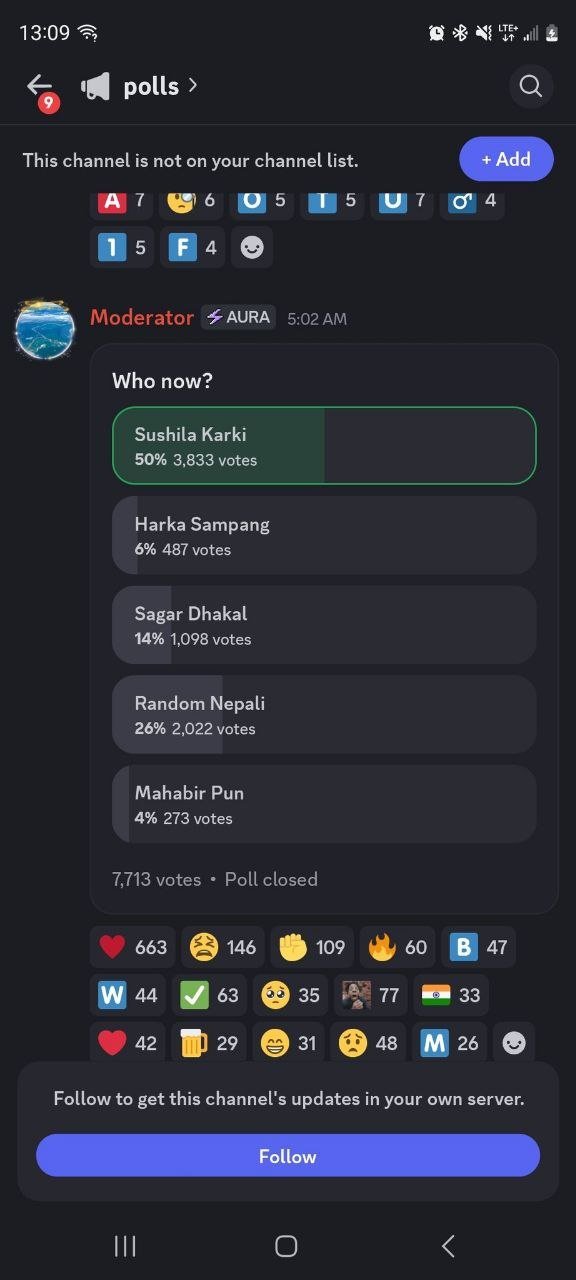
Think about that. A global first: an ex-Chief Justice potentially returning as interim Prime Minister, because tens of thousands of young people coalesced around her on a chat app. And the military acknowledged it. This might sound familiar for Kenyans, where retired Chief Justice David Maraga has quietly been positioning himself as a viable presidential option, and I can’t help but imagine what it would look like if, say, our Gen Z protests escalated to the point where Discord or X/Twitter Spaces became the venue to draft him into State House.
Of course, Discord democracy has its flaws. Trolls, disorganization, the ever-present risk of manipulation, and even unplanned outages. But the fact that an entire generation trusted an app over their traditional institutions tells you everything about how broken politics in Nepal had become.
And here’s why this story hits close to home for us in Kenya. We’ve had our own Gen Z–led protests since June 2024, shaking the state to its core. Our government responded with tear gas, bullets, and recently, a compensation panel for victims, one the High Court just declared unconstitutional. The distrust runs deep, and like Nepal, it’s fueled by young people watching politicians’ lavish lives while their own futures feel uncertain.
While politicians have floated the idea, Kenya hasn’t tried banning social media (yet). But imagine if it did. Where would we go? WhatsApp groups? Telegram? The South Sudan way? Or maybe, like Nepal, we’d find ourselves in a Discord server with moderators shouting “PLEASE DECIDE NOW” as tens of thousands argue about who should run the country.
It’s both funny and dead serious. Funny, because it’s wild to imagine politics decided the same way you might decide who raids in Fortnite. Dead serious, because it shows just how far people will go when formal systems fail.
Nepal’s Gen Z are proving that when politicians stop listening, technology becomes the loudest megaphone. Whether it’s X spaces, TikTok Lives, or now Discord parliaments, it’s clear that the future of protest and politics belongs online. And governments who try to ban it? They’ll only end up accelerating the very revolutions they fear.







Join the discussion