
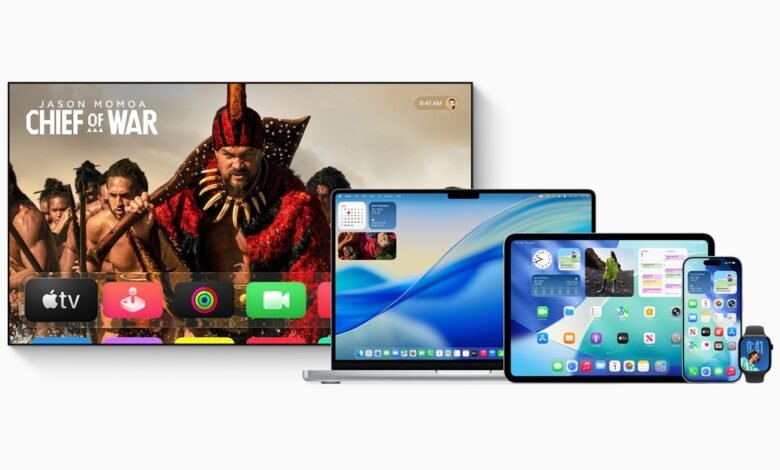
Apple has always been the master of spectacle, and last week’s iPhone 17 launch event was no exception. The company rolled out its latest crown jewel, the iPhone 17 lineup, including the much-hyped iPhone Air, a slimmer take on the world’s most popular smartphone. The stage lights, the polished demos, the applause – it all had the familiar Apple magic.
But when the lights dimmed and investors had time to process, the shine dulled. Apple’s stock tumbled, shedding $112 billion in market value almost overnight. Fans and analysts alike walked away with mixed feelings, calling the show more evolution than revolution.
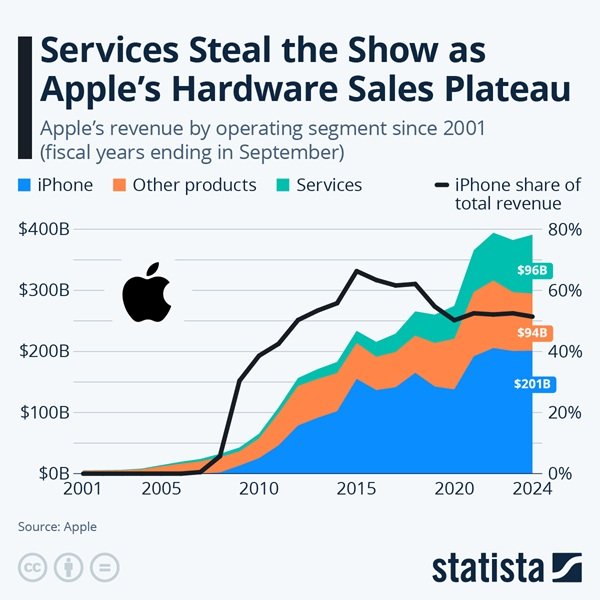
And the numbers don’t lie. According to Apple’s latest fiscal reports, hardware sales are flattening. The iPhone, once the juggernaut that carried Apple to near-trillion-dollar dominance, brought in $201 billion last year, a staggering sum, but one that has barely moved in years. Meanwhile, sales of “other products” ranging from iPads to Macs have slumped to $94 billion. Contrast that with Apple’s services, which hit $96 billion in 2024, outgrowing every other category.
Think about it: Apple now makes more money from services like iCloud, Apple Music, Apple Pay, and Apple TV+ than it does from all its non-iPhone gadgets combined. And while the iPhone still accounts for about half of Apple’s total revenue, its share has slipped from a 66% peak in 2015 to just 51% in 2024. The black line on the Statista chart below tracking iPhone dominance? It’s slowly but surely bending downward.

That doesn’t mean Apple has lost its sparkle. In fact, some areas are booming. The Apple Watch recently crossed $100 billion in lifetime sales, cementing itself as a quiet success story. And the broader premium smartphone market, where Apple reigns supreme, is having a record-breaking year.
Still, the elephant in the room is AI. Apple’s reluctance – or slowness – to stake its ground in the AI arms race has left investors twitchy. Reports that Apple may borrow Google’s Gemini model to power the next generation of Siri (despite going with ChatGPT) have only deepened questions over whether the Cupertino giant can innovate on its own. As the BBC put it, Apple is at a crossroads, caught between its past as a hardware innovator and its present as a service-driven ecosystem.
The truth is, Apple no longer needs to reinvent the wheel every September. Its ecosystem is sticky enough that once you’re in, you’re not leaving anytime soon. Your iPhone links to your Watch, your AirPods, your iCloud, Apple Music, and the App Store – and that’s exactly why services are becoming Apple’s silent engine of growth.
So yes, the iPhone 17 is here, sleeker and shinier than ever. But the real star of Apple’s story isn’t sitting in your pocket anymore. It’s humming quietly in the cloud, charging you $9.99 a month.







Join the discussion