

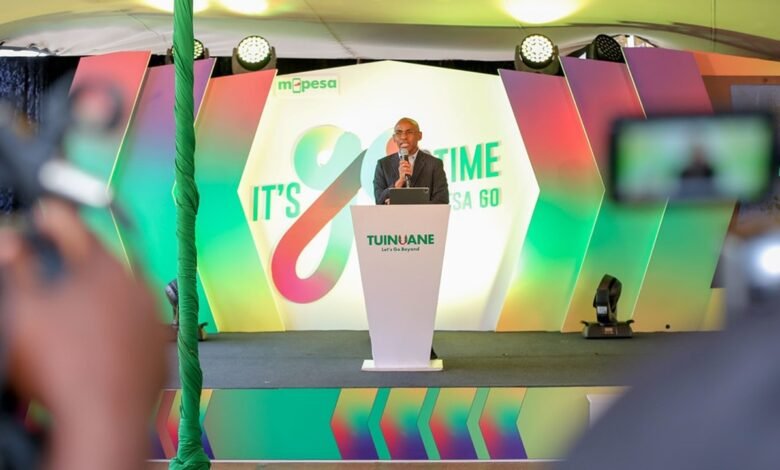
This headline is generous. Safaricom will pay out KES 80.13 billion to its shareholders for FY26, including a final proposed dividend of KES 1.15 per share that takes the full-year payout to KES 2.00. That is a 66.7% increase on last year. It is the highest dividend per share in the company’s history and one of the largest payouts ever made by a single Kenyan listed company.
For investors who have stayed patient through five years of flat or near-flat dividends, this is the year the wait paid off. For everyone else, the more interesting question is what this dividend actually means in the broader context of how Safaricom is being restructured.
How we got to KES 2.00
To understand why this number matters, it helps to look at the trajectory. Distributable profits have grown steadily, from KES 73.7 billion in FY20 to KES 99.7 billion in FY26. But the dividend per share did not move with profits.
For four straight years between FY23 and FY25, Safaricom held the dividend flat at KES 1.20. This was deliberate. The company was absorbing heavy losses in Ethiopia, and management chose to preserve capital rather than reward shareholders. This is the year that calculus changed. Ethiopia losses halved. Group capex fell 18.4%. Operating cash flow grew. The board judged that the company could finally afford to be generous.
The dividend is structured in two parts. The interim of KES 0.85 was paid in October 2025, returning KES 34.06 billion to shareholders. The final KES 1.15 is proposed and subject to AGM approval. Together they will distribute KES 80.13 billion across the share register.
Where the money was supposed to go
Until very recently, the answer to “who gets this money” was straightforward. Vodafone Kenya owned 39.9% of Safaricom, the Government of Kenya owned 35%, and public shareholders owned the remaining 25.1%. On the FY26 dividend, the rough split was about KES 32 billion to Vodafone Kenya, KES 28 billion to Treasury, and KES 20 billion to the Kenyan public.
That arithmetic is no longer accurate. On the last day of FY26, Parliament approved the partial divestiture of the government’s Safaricom stake to Vodacom, restructuring the share register before the final FY26 dividend has even been paid.
Under the deal, Vodacom buys 15% from Treasury for KES 204.3 billion, plus 5% from Vodafone Group for KES 68.1 billion. Post-deal: Vodacom 55%, government 20%, public 25%. Effective 1 April 2026, pending final approvals from the Central Bank of Kenya and the Competition Authority.
This means the FY26 dividend is being paid in transition. The interim dividend was distributed under the old register. The final dividend may not be.
The KES 40.2 billion twist
There is one more layer worth understanding. Beyond the share-sale price, Vodacom is paying the Kenyan government an upfront KES 40.2 billion “in lieu of future dividends” on the government’s residual 20% stake. In plain terms, Vodacom is pre-paying for several years of Safaricom dividends that would have flowed to Treasury.
The total cash to Treasury from this transaction is roughly KES 244.5 billion. According to the Kenyan Wallstreet’s reporting on the parliamentary report, the KES 40.2 billion advance is calculated as a present-value buyout of a future dividend stream estimated at KES 55.7 billion in undiscounted terms.
This is materially different from a normal dividend year. The government is monetising its long-term claim on Safaricom’s profits in exchange for cash today. That cash is earmarked for the National Infrastructure Fund, which President Ruto signed into law on 9 March 2026, and a Sovereign Wealth Fund.
What does not change
While the share register is being rewritten, one part of Safaricom’s contribution to Kenya does not move. The company paid KES 163 billion in taxes and levies during FY26 alone. Total taxes paid since the company’s inception in 2000 now exceed KES 1.54 trillion. These payments do not depend on who owns the equity. As long as Safaricom keeps generating profits in Kenya, it keeps generating tax revenue.
For context, KES 163 billion is substantially more than the KES 80 billion being distributed as dividend this year. Safaricom remains a fiscal pillar regardless of its shareholder mix. The same applies to the company’s foundations. Citizens of the Future, Wezesha Vijana TVET, Uzazi Salama maternal health, the Kakamega Forest conservation projects — these are funded out of Safaricom’s operations, and Parliament’s approval conditions for the Vodacom deal explicitly require Vodacom to continue supporting the Safaricom Foundation.
The questions worth asking
Three things are worth tracking from here.
The first is dividend sustainability. Safaricom’s net debt grew during FY26, and FY27 capex guidance has been revised slightly upwards. If Ethiopia underperforms or the Kenyan regulatory environment tightens, this KES 2.00 may be a high-water mark rather than a new floor.
The second is whether the divestiture delivers the promised public value. The KES 244.5 billion is being routed into the National Infrastructure Fund and a Sovereign Wealth Fund, both still in their early operational stages. Opposition MPs have argued that the share price secured (KES 34) understated Safaricom’s long-run value, and that selling a productive cash-generating asset to fund infrastructure is a one-time trade. Whether that trade ends well depends on execution.
The third is the 2027 election. Both the dividend payout and the divestiture proceeds land in the financial year before a national vote. Whether the proceeds get spent on visible infrastructure projects, ringfenced for the long term, or quietly redirected, will say a lot about how seriously the Sovereign Wealth Fund framework is taken in practice.
The end of a chapter
The KES 80.13 billion dividend is the largest in Safaricom’s history. It rewards investors who have been patient. But it is also the last dividend declared under a shareholder structure that has defined Safaricom for two decades. By next year, the question of who Safaricom is paying, and on whose behalf, will look meaningfully different.
The real story of FY26 is not just how much was earned, but how the architecture underneath the earnings is quietly changing.
This concludes the four-part series on Safaricom’s FY26 results. Read Part 1: M-PESA’s KES 183 billion year, Part 2: Safaricom Ethiopia, and Part 3: The connectivity inversion.




Join the discussion