

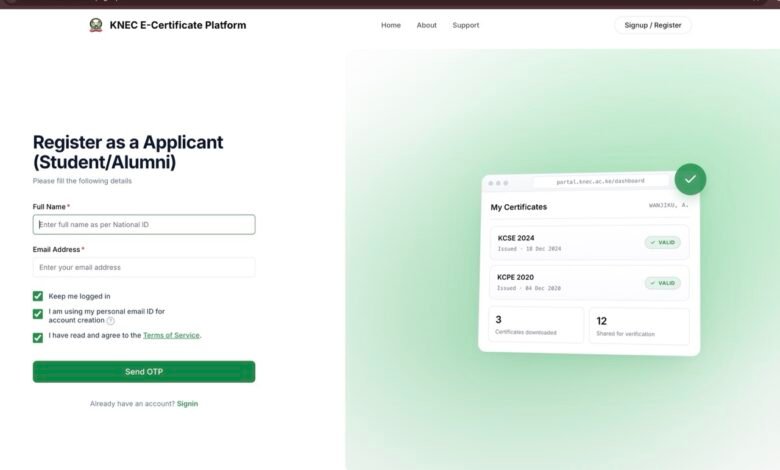
If you sat KCSE or KCPE any year from 1989, you can now download your certificate online. The Kenya National Examinations Council (KNEC) has launched an e-Certificate platform at ecertificate.knec.ac.ke. You pay a fee, verify your identity, and get a digitally signed PDF of your certificate. No school visits. No queues at Mtihani House.
This matters for a simple reason. For decades, KNEC did not issue duplicate certificates. If you lost yours, the only option was a “certification of examination results” letter. That process cost KES 5,220, required a police abstract, and involved physical visits. The new e-certificate costs about KES 1,450 in total and takes minutes.
What the platform does
The platform generates an official digital copy of your KCSE or KCPE certificate. Each certificate carries a digital signature and a blockchain verification hash. That hash lets employers and institutions confirm the document is real. KNEC has also built a separate verification portal for institutions, which can check up to 1,000 records at once through a CSV upload.
The service covers KCSE certificates from 1989 to 2025, and KCPE certificates from 1989 to 2023, when the exam was last sat. That range is wider than KNEC first promised. When Education Cabinet Secretary Julius Ogamba announced the e-certificate plan in February 2026, it was meant to cover certificates from 2023 onwards. The final product goes back 37 years.

How much it costs
The official fee is KES 1,200 per certificate. Add 16% VAT, and it comes to KES 1,392. eCitizen then adds its convenience charge on top, which brings the total to roughly KES 1,450. The exact final amount shows on the payment screen before you commit, according to KNEC’s official user guide.
One detail you should note: your certificate stays in your account under “My Certificates” for six months. After that window closes, you pay again to regenerate it. So download your PDF and back it up the moment you get it.
Step-by-step: how to get your certificate
- Create an account. Go to ecertificate.knec.ac.ke and sign up as an Applicant (Student/Alumni). Enter your name and email address. KNEC sends a one-time password (OTP) to your email. The OTP is valid for 10 minutes. You will log in with your email and an OTP each time.
- Complete your profile. Enter your citizenship, your name as it appears on your National ID, your date of birth, and your phone number. The system checks your identity automatically against the Integrated Population Registration Services (IPRS) database using your ID number.
- Request the certificate. Enter your index number, the exam type (KCSE or KCPE), and the year you sat the exam. The system verifies that the certificate record matches your identity.
- Pay through eCitizen. You can pay via an M-Pesa STK push or by card. Payment confirmation takes about 10 to 30 seconds.
- Download your PDF. The certificate lands in your dashboard, complete with its verification hash. Save it. Print copies if you need them.
Why this is a big deal
Lost certificates have locked Kenyans out of jobs, further studies, and visa applications for years. The old certification letter was slow, expensive, and was still not a certificate. This platform changes that for anyone who sat national exams in the last four decades. It also fits a wider pattern of government services moving online, from NTSA’s electronic logbooks to results portals. We already covered KNEC’s push towards paperless exams by 2027, and this platform is part of the same digitisation drive. It also follows the KNEC portal systems used for KCSE results, which we have walked readers through before.
A few things remain unclear. KNEC has not stated whether the e-certificate is legally equal to the paper certificate for all official uses, such as immigration. The February announcement suggested physical certificates would still matter for some purposes. If an employer or embassy insists on the original paper document, the e-certificate may serve as strong supporting proof rather than a full replacement.
The practical takeaway: if you have lost your KCSE or KCPE certificate, or you need a verifiable copy fast, this platform solves your problem for about KES 1,450. Download it within six months of paying, and keep your own backup.








What if I can\’t remember my index number