

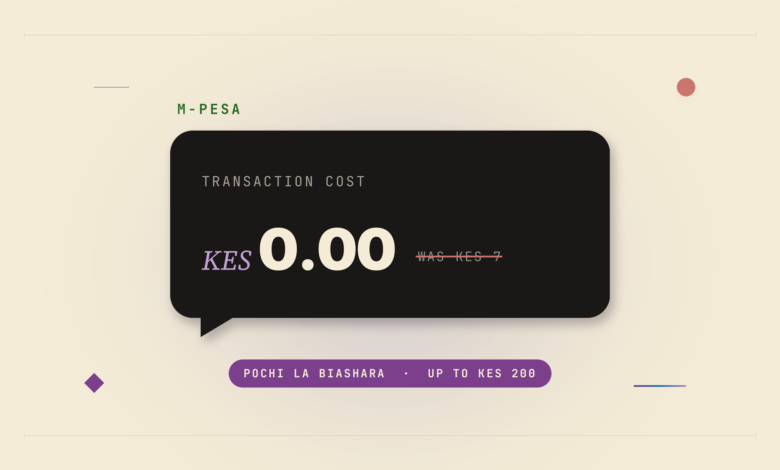
Safaricom has published a notice setting out new M-PESA tariffs on three services built around small businesses: Pochi la Biashara, Lipa na M-PESA Buy Goods, and M-PESA Business Till transfers. The Pochi part was already trailed on 31 July, when Safaricom launched PATA MORE, a campaign that also raised data bundle allocations and fibre speeds. The notice is the formal pricing document behind it, and it adds two changes the campaign did not lead with.
One of the three cuts is a three-month promotion aimed at customers. The other two are open-ended changes to what merchants pay, and they start a week later.
1. Pochi la Biashara: free up to KES 200, max charge at KES 50, for three months
Pochi la Biashara is the business wallet that sits on a trader’s existing M-PESA line, so customer payments land somewhere separate from personal money. There is no new till number and no paperwork. We already explained how Pochi works and who it suits in our M-PESA business tools series, and it has been running since its launch in late 2020.
Until now, paying into a Pochi cost the customer the same as sending money to any registered M-PESA number: free up to KES 100, then a rising fee that stops at KES 108 for anything above KES 20,000. From 1 August to 31 October 2026, payments to Pochi merchants use this reduced table instead:

| Amount (KES) | Charge (KES) |
|---|---|
| 1 – 200 | Free |
| 201 – 500 | 7 |
| 501 – 1,000 | 13 |
| 1,001 – 1,500 | 23 |
| 1,501 – 2,500 | 33 |
| 2,501 – 250,000 | 50 |
Two things changed. The free band doubled from KES 100 to KES 200, which covers a large share of everyday purchases at a mama mboga, a boda rider, or a kiosk. And everything above KES 2,500 now costs a flat KES 50 instead of climbing to KES 108. A customer paying KES 10,000 to a Pochi merchant paid KES 90 before and pays KES 50 now. The bands in between are unchanged.
The charge falls on the person paying, not the trader. The trader gains because the reason many small customers insist on cash is the fee they see on screen before they confirm.
The notice says the tariff is valid from 1 August to 31 October 2026, which Safaricom describes as 90 days. Nothing in the notice says what happens on 1 November.
2. Lipa na M-PESA Buy Goods: free merchant collections rise to KES 500
This change is on the merchant’s side. Paying at a Buy Goods till has always been free for the customer (except for certain Till Numbers especially in Fuel Stations). The fee sits with the business: 0.55% of each collection, capped at KES 200, with collections of KES 200 and below free.
Effective 7 August 2026, the free band rises from KES 200 to KES 500:
| Collection (KES) | Old fee | New fee |
|---|---|---|
| 0 – 200 | Free | Free |
| 201 – 500 | 0.55% | Free |
| 501 – 36,363 | 0.55% | 0.55% |
| Above 36,363 | KES 200 | KES 200 |
If you’re wondering why KES 36,363? Well, that’s just where the percentage hits the cap. At 0.55%, a collection of KES 36,363 costs KES 200, so every larger sale costs the same KES 200 and no more.
A shopkeeper collecting KES 450 on a sale previously paid about KES 2.48 in fees. They now pay nothing. The saving per transaction is small, and it applies to every low-value sale, which is most of what a duka or food vendor does in a day. Safaricom’s own numbers show how much of M-PESA lives down there: free small-value transactions, which Safaricom brands M-PESA Kadogo, reached 17.1 billion in the year to March 2026, 36.8% of all M-PESA volumes. Raising the merchant-side free line from KES 200 to KES 500 pulls a larger share of ordinary shop sales into that zero-fee zone.
Unlike the Pochi cut, the notice gives no end date for this one.
3. Business Till transfers: fees drop by close to half
The third change covers what a business pays to move money out of its M-PESA Business Till, either to a phone number or to a PayBill. Both routes get cheaper from 7 August 2026. Transfers of KES 100 and below stay free on both.
Pay to Mobile, which is how a business pays wages or settles with an individual:
| Band (KES) | Old fee | New fee |
|---|---|---|
| 0 – 100 | Free | Free |
| 101 – 500 | 7 | 4 |
| 501 – 1,000 | 13 | 7 |
| 1,001 – 1,500 | 23 | 12 |
| 1,501 – 2,500 | 33 | 17 |
| 2,501 – 3,500 | 53 | 27 |
| 3,501 – 5,000 | 57 | 29 |
| 5,001 – 7,500 | 78 | 39 |
| 7,501 – 10,000 | 90 | 45 |
| 10,001 – 15,000 | 100 | 50 |
| 15,001 – 20,000 | 105 | 53 |
| 20,001 – 250,000 | 108 | 54 |
The notice prints that last row as six separate bands, all at the same charge. So on this route, anything above KES 20,000 costs KES 54 from 7 August, down from KES 108.
Pay to PayBill, which is how a business pays suppliers, rent, taxes and utility bills:
| Band (KES) | Old fee | New fee |
|---|---|---|
| 0 – 100 | Free | Free |
| 101 – 500 | 5 | 3 |
| 501 – 1,000 | 10 | 5 |
| 1,001 – 1,500 | 15 | 8 |
| 1,501 – 2,500 | 20 | 10 |
| 2,501 – 3,500 | 25 | 13 |
| 3,501 – 5,000 | 34 | 17 |
| 5,001 – 7,500 | 42 | 21 |
| 7,501 – 10,000 | 48 | 24 |
| 10,001 – 15,000 | 57 | 29 |
| 15,001 – 20,000 | 62 | 31 |
| 20,001 – 25,000 | 67 | 34 |
| 25,001 – 30,000 | 72 | 36 |
| 30,001 – 35,000 | 83 | 42 |
| 35,001 – 40,000 | 99 | 50 |
| 40,001 – 45,000 | 103 | 52 |
| 45,001 – 250,000 | 108 | 54 |
Read across the bands and the cut is between 40% and 50%, with most bands close to half. Moving KES 10,000 from a till to a phone number falls from KES 90 to KES 45. The same amount to a PayBill falls from KES 48 to KES 24. This is money businesses move constantly, so the cut lowers a running cost rather than a one-off.
Why Safaricom is doing this
Safaricom says the changes make digital payments more affordable, and cites the Central Bank of Kenya’s pricing principles on customer centricity, transparency, fairness, competition and affordability.
Its results give the commercial reason. Pochi is the fastest-growing thing on M-PESA. Active Pochi tills grew 81.5% to 2.1 million in the year to March 2026, ahead of the 1 million Lipa na M-PESA till merchants, and Pochi revenue rose 86% to KES 4 billion, from KES 2.2 billion the year before, which was itself triple the year before that. Free rails bring transactions, and transaction histories feed the credit products Safaricom does charge for, including the Fuliza Biashara and Taasi loans priced off merchant activity.
For context on how rare price movement is here: Safaricom last cut consumer send money charges broadly in January 2021, by up to 45%, and cut PayBill and business-to-customer tariffs from January 2023. The standard send money table has not changed since 29 July 2023, when it went up to absorb the Finance Act 2023 rise in excise duty on transfer fees. We have many times argued the case for restoring free transfers below KES 1,000, which Kenya had during the pandemic, and the Kadogo numbers show free small transactions growing usage rather than draining it.
What to actually do with this
If you run a Pochi, tell your customers that payments up to KES 200 are free until 31 October, and that anything above KES 2,500 now costs them a flat KES 50. If you run a Buy Goods till, nothing is required of you: from 7 August, collections up to KES 500 stop attracting the 0.55% fee. If you move money out of a Business Till regularly, from 7 August it costs close to half what it did, on both the phone number and the PayBill route.
Our guess is that come 31st October, Safaricom will say the new rates are permanent. The current offer is just a way of getting people interested, and using the service more.




Join the discussion