

When Safaricom launched the B-LIVE data bundles in August 2025, the promise was clear: affordable, time-based internet access tailored for high-bandwidth users who needed dedicated hourly access without worrying about volume caps. One year later, that promise has curdled into a frustrating game of digital moving goalposts.
What started as a straightforward product has devolved into an unpredictable, algorithmically manipulated experience. Between hidden dynamic pricing tiers, forced financial cross-selling, speed throttling, and widespread technical outages, Safaricom is burning consumer trust under the guise of personalized offers.
The paper tiers vs. the dynamic trap
On paper and across official pages, Safaricom advertises a transparent 5-tier menu for B-LIVE:
| Price | Duration |
| KES 20 | 1 Hour |
| KES 30 | 1.5 Hours |
| KES 50 | 3 Hours |
| KES 75 | 4.5 Hours |
| KES 150 | 6 Hours |
Yet, ask almost any daily B-LIVE subscriber, and they will tell you a completely different story. The moment you begin relying on a specific tier — say, the KES 50 or KES 150 options — Safaricom’s backend algorithms seem to note your pattern and systematically strip that option from your USSD menu.

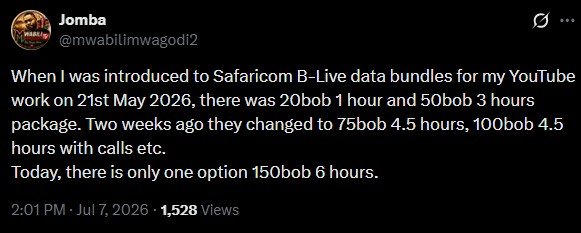
When customers reach out to customer care, the official response is always the same copy-paste template: these offers are dynamic and based on customer usage patterns.
However, the problem is that nowhere in Safaricom’s official FAQs, promotional banners, or product web pages does the telco state that B-LIVE menu choices are dynamically restricted. You only discover this hidden rule when support admits it on social media after you complain.
Punishing loyal users by removing their preferred bundle choices simply because they buy them frequently isn’t personalization. It’s algorithmic manipulation designed to force users into higher spending brackets.
The Ziidi push and the KES 25 monopoly
If dynamic removal wasn’t annoying enough, Safaricom recently escalated things. After quietly revamping B-LIVE to incorporate voice calls in June, the telco has now pushed the boundary even further. Dialing the B-LIVE menu this week is met with a baffling sight of only a single option available.
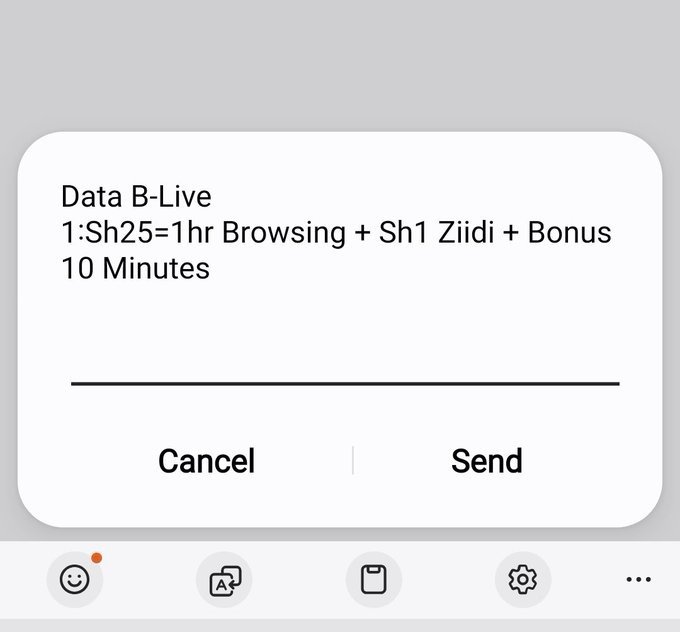
Not only is this KES 25 tier completely absent from Safaricom’s official product page, but it also aggressively hitches a data purchase to Safaricom’s Ziidi investment product. Forcing users into a financial product just to buy an hour of internet access is outright absurd.
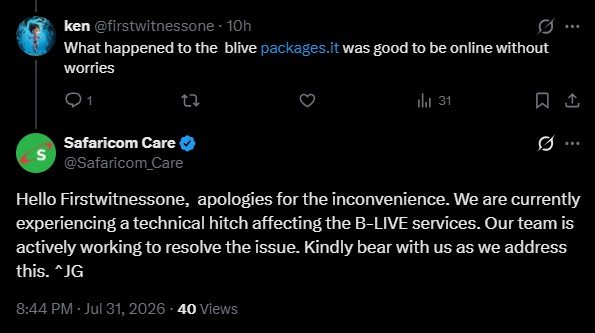
Predictably, social media has recently exploded with consumer anger. Safaricom support has acknowledged the situation as a technical issue, posting on X:
“We are currently experiencing a technical hitch affecting the B-LIVE services. Our team is actively working to resolve the issue. Kindly bear with us as we address this.”
Glitches aside, Safaricom’s B-LIVE strategy is broken
While Safaricom blames a “technical hitch” for collapsing the menu into a single KES 25 option, a temporary system outage does not excuse the broader structural decay of B-LIVE over the past year.
Users consistently report severe speed throttling kicking in shortly after purchasing these hourly packages, rendering high-bandwidth tasks like video uploads or streaming nearly impossible long before the allotted time expires. Combined with erratic pricing structures, the product feels increasingly unreliable for professionals and casual users alike.
Safaricom needs to abandon these stealthy tactics. Dynamic offering shouldn’t mean hiding standard options behind algorithmic paywalls or forcing financial product add-ons into data bundles.
The solution is simple: Publish all official B-LIVE options openly on the USSD and app menus, leave them there, and let subscribers freely choose the package that fits their needs and budget. Playing hide-and-seek with basic service menus isn’t innovation — it’s bad business.







Keep the insights rolling. At the backstage we keep wondering, but pap here I see it.
Great insight. I was wondering why I was not seeing the offers now I understand it is based on usage patterns and can be withdrawn anytime