

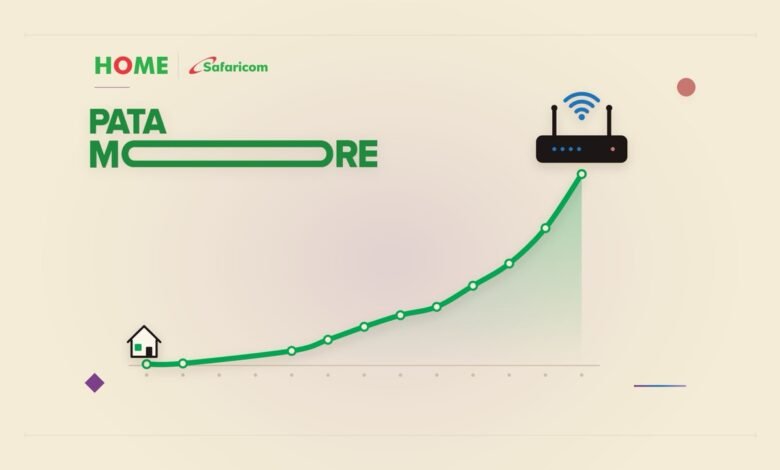
Safaricom had 1,024,950 fixed internet subscriptions on 30 June 2026. No internet provider in Kenya has ever had a million before. The figure is in the Communications Authority of Kenya’s sector statistics report for April to June 2026.
That’s more than Faiba (541,003) and Zuku (294,375), the second and third biggest providers, have between them. Safaricom holds 36.1% of the 2,838,656 fixed internet subscriptions in the country.
Fixed internet is internet delivered to a building, a home or an office, rather than to your phone. It comes in by fibre-optic cable, by a wireless link to a router in the house such as Safaricom’s 5G for Home, by satellite, or by cable.
Twelve years ago, Safaricom was fifth
Safaricom started selling fibre to homes in July 2014, in one estate, Nyayo Embakasi in Nairobi. The service was called Vuma@Home, and it gave you 5 Mbps for KES 2,999 a month. It started where Zuku and Faiba had little presence, away from their strongholds in Parklands and Westlands.

The fixed internet market then belonged to Zuku. In June 2014 the Wananchi Group, which owns Zuku, had 44,254 subscriptions. Liquid Telecom, Telkom Kenya and Access Kenya came next. Safaricom was fifth, with 7,222, about 7% of the market (CA, July to September 2014). A year later, Wananchi alone had 53.6% of all fixed subscriptions in Kenya.
Safaricom kept building. By September 2017 it was second, with 40,015. By December 2018 it had passed 100,000.
Overtaking Zuku
In the three months to September 2019, Safaricom went to number one for the first time. It had 154,603 subscriptions to Wananchi’s 151,548 (CA, July to September 2019). Zuku won the top spot back for the next two quarters. In June 2020 Safaricom passed it again, 207,398 to 201,605 (CA, April to June 2020), and it has stayed first ever since.
Six years on, it isn’t close. Safaricom has almost three and a half times Zuku’s subscriptions.
| June | Safaricom fixed subscriptions | Market share | Position |
|---|---|---|---|
| 2014 | 7,222 | 7.3% | Fifth |
| 2015 | 10,965 | 9.2% | Third |
| 2018 | 78,104 | 21.2% | Second |
| 2019 | 137,824 | 32.7% | Second |
| 2020 | 207,398 | 33.5% | First |
| 2021 | 269,397 | 36.7% | First |
| 2022 | 314,120 | 34.3% | First |
| 2023 | 427,003 | 36.2% | First |
| 2024 | 545,812 | 36.4% | First |
| 2025 | 735,749 | 34.3% | First |
| 2026 | 1,024,950 | 36.1% | First |
The CA’s reports for 2016 and 2017 don’t break fixed internet down by provider, so those years are missing.
Half a million to a million in 27 months
The growth is speeding up. Safaricom went from 100,000 subscriptions in December 2018 to 522,217 in March 2024, which took just over five years. It doubled that to 1,024,950 in the 27 months after.
In the year to June 2026 alone, Safaricom added 289,201 fixed subscriptions, up 39.3%. More than half of those, 166,556, came in the last six months. Across Kenya, 693,943 fixed subscriptions were added in the year, and 41.7% of them went to Safaricom. Its base is now 142 times what it was in June 2014.
What’s behind it
Start with the network. Safaricom’s annual report for the year to March 2026 puts its fibre footprint at 21,000 km, up from 18,300 km a year earlier. That fibre now passes 807,016 homes, 16.2% more than a year before, and 739,380 of those homes are connected.
Then there’s 5G. Safaricom launched 5G WiFi for homes in October 2022 at KES 3,499 a month for 10 Mbps and a 300 GB allowance, and the router cost KES 25,000. Today 5G for Home starts at KES 4,000 for 50 Mbps with a 1.5 TB allowance, and it doesn’t need a cable run to the house. Safaricom’s 5G fixed wireless customers grew 53.0% in the year to March, and 5G made up 52.3% of its new fixed connections. We reviewed Safaricom’s Baicells 5G router last October.
And there’s price. Safaricom now has plans below its main Home Fibre range. Fibre Lite starts at KES 1,500 for 15 Mbps. Wi-Fi Bamba, for high-density estates, starts at KES 1,600 for 15 Mbps. Wi-Fi Bamba Boma Yangu costs KES 800 a month for 10 Mbps in the government’s Affordable Housing projects.
Safaricom’s fixed business, counted together with its internet-of-things unit, earned KES 20.2 billion in the year to March, up 12.2%. Consumer fixed revenue grew faster, up 19.5% to KES 9.03 billion.
What KES 2,999 gets you now
In 2014, KES 2,999 bought 5 Mbps. On 29 April 2026 Safaricom raised the speed on every Home Fibre plan and left the prices alone. So KES 2,999 now buys Bronze at 40 Mbps, eight times what Vuma@Home gave you for the same money.
| Plan | Speed before 29 April | Speed now | Monthly price | Monthly fair usage allowance |
|---|---|---|---|---|
| Bronze | 15 Mbps | 40 Mbps | KES 2,999 | 1.5 TB |
| Silver | 30 Mbps | 60 Mbps | KES 4,100 | 2 TB |
| Gold | 80 Mbps | 150 Mbps | KES 6,299 | 5 TB |
| Diamond | 500 Mbps | 500 Mbps | KES 12,499 | 7 TB |
| Platinum | 1 Gbps | 1 Gbps | KES 20,000 | 7 TB |
At the end of July Safaricom added Pata More, which brings Family Share to Home Fibre. For a small extra amount on your fibre bill, you get a pot of mobile data or minutes to share across up to five Safaricom numbers. On Bronze it’s KES 750 more, KES 3,749 in total, for 14 GB or 750 minutes. So your family’s phones stay online when they leave the house, all on one bill.
The market Safaricom leads
Kenya’s fixed internet market grew 32.4% in the year to June, and 15.3% in the last six months alone. Safaricom is out front at 36.1%. Behind it are Faiba at 19.1%, Zuku at 10.4%, Ahadi Wireless at 9.5% and Poa Internet at 8.8%.
If you’re already on Bronze, Silver or Gold, the faster speed is already on your line. To check whether your building is covered, sign up, or add Family Share, go to Home Internet in My OneApp, or dial *400#.



Join the discussion