

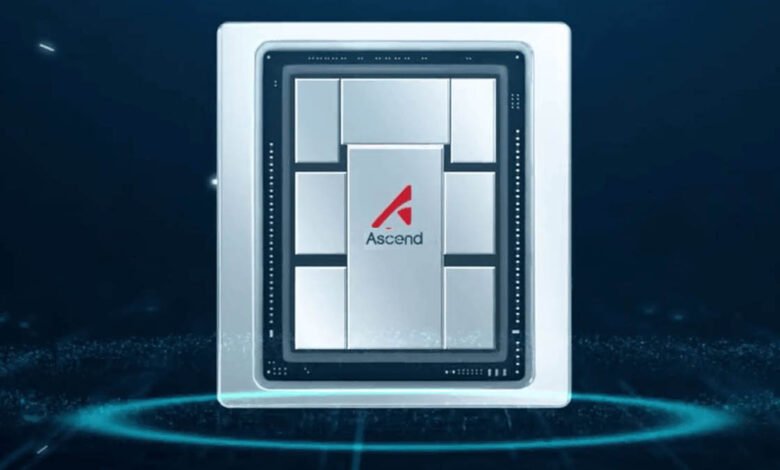
DeepSeek is preparing to install at least 160,000 of Huawei’s Ascend 950DT chips at a new gigawatt-scale data centre in Ulanqab, Inner Mongolia, according to people familiar with the plan. Scheduled to partially come online by late 2027 or early 2028, this facility will form one of the largest known clusters of Chinese-made AI chips. Neither company has commented.
To understand this move, it helps to view AI computing through a simple analogy. Training is like a student studying a vast library of books for years, requiring immense, specialised brainpower. Inference is that same student taking an exam, answering questions efficiently based on what they learned.
Because of ongoing trade restrictions, DeepSeek is splitting these tasks. The heavy lifting of training new models remains on whatever Nvidia hardware the company can secure. Inference, running the models for everyday users, will move to the new Huawei 950DT chips. Huawei designed the Ascend 950DT for training, and DeepSeek is not using it for that.
The facility and the hardware
Located 350km north-west of Beijing, Ulanqab has cheap wind and solar energy, coupled with an average temperature of 4.3°C for natural cooling. At full load, the one-gigawatt site will consume enough power for 750,000 homes. Historically reliant on rented computing, DeepSeek raised over $7 billion in June 2026 to fund this physical infrastructure.

Huawei plans to launch the Ascend 950DT in the fourth quarter of 2026 with its own high-bandwidth memory. Shortages of that memory will hold output to the low hundreds of thousands this year, so fulfilling DeepSeek’s order could take over a year. Huawei still expects its AI chip revenue to jump from $7.5 billion in 2025 to approximately $12 billion, roughly KES 1.55 trillion, in 2026.
The geopolitical timeline
The US and China have been trading restrictions for four years, and each round has changed what Chinese developers can buy:
| Date | Event |
|---|---|
| Oct 2022 to Oct 2023 | US mandates licences for Nvidia A100 and H100 sales to China; later rules block the slower, China-specific H800s. |
| Jan 2025 | DeepSeek launches R1, wiping $589 billion off Nvidia’s market cap, following V3’s training on 2,048 rented H800s for $5.6 million. We explained who DeepSeek is at the time. |
| Apr to Aug 2025 | US blocks Nvidia’s H20 and Nvidia writes off $4.5 billion; Huawei responds with CloudMatrix 384. US allows the H20 back for a 15% cut of revenue. DeepSeek fails to train R2 on Ascend, returning to Nvidia. |
| Sep to Nov 2025 | Beijing tells ByteDance and Alibaba to halt Nvidia testing; Jensen Huang says Nvidia went from 95% share to 0%; state-funded data centres must use Chinese chips. |
| Jan to Aug 2026 | US conditionally allows H200 sales; Beijing bottlenecks imports. A US official claims DeepSeek trained on smuggled Blackwells. DeepSeek V4 (1.6T parameters) arrives. ByteDance and Tencent secure 10,000 H200s each, and Nvidia plans for zero China revenue. |
Doing more with less
With Washington restricting access to Nvidia’s flagship Blackwell chips and Beijing throttling the permitted alternatives, China has developed three distinct workarounds:
- Architectural efficiency. DeepSeek V3 has 671 billion parameters, but only 37 billion activate per word, and its attention design cuts memory use. Together they squeeze maximum utility from cut-down chips, keeping V3’s final training run under $6 million, whereas OpenAI’s GPT-4 cost over $100 million.
- Brute-force scale. Huawei’s CloudMatrix 384 achieves 1.7 times the compute of Nvidia’s GB200 NVL72 by grouping five times as many weaker chips and using four times the power. The Ulanqab gigawatt site is this concept scaled to the extreme.
- Open weights. By giving models away, Chinese open-weight models took 41% of Hugging Face downloads this spring and 61% of tokens on OpenRouter in May. They drastically undercut Western pricing: DeepSeek V4 Pro costs $1.74 per million input tokens compared to $5 for GPT-5.5.
Where things stand now
The global AI industry has split in two. The US frontier (Anthropic’s Fable 5.1, OpenAI’s GPT-6 Astra) is built on closed weights and, at OpenAI, more than 100,000 Nvidia GPUs, driving Nvidia to a $96.2 billion quarter. China’s frontier (Moonshot’s Kimi K3, Alibaba’s Qwen3.8-Max, Zhipu’s GLM-5.3) runs on a hybrid model: Nvidia for training where possible, Huawei for inference, and open weights for global distribution.
The thing to watch is Huawei’s Q4 950DT launch. Any delay will directly stall DeepSeek’s 160,000-chip plan.






Join the discussion