
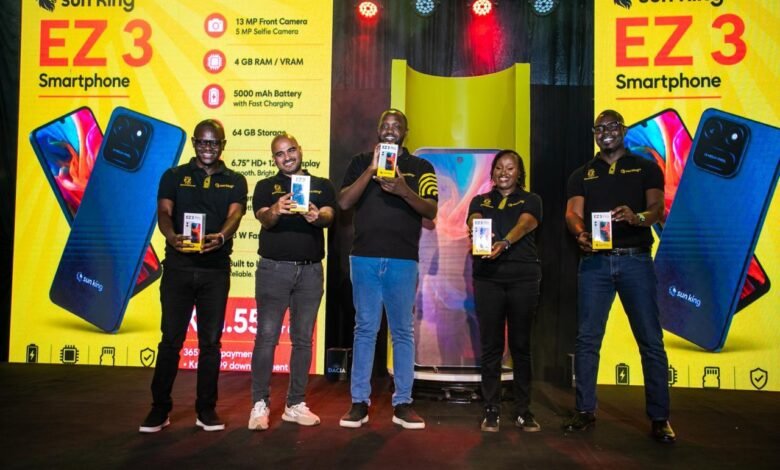
Sun King expanded its footprint in Kenya’s smartphone market on 3 September 2026, quietly replacing its debut handset with the newly launched EZ 3 and EZ 3 Pro. Assembled locally, these devices target the demographic already familiar with the company’s pay-as-you-go (PAYG) solar hardware. However, a rigorous analysis of the hardware, conflicting marketing claims, and the opaque financing model reveals a stark reality: financial accessibility at this tier comes at a punitive premium.
Big business meets local manufacturing
To contextualise this launch, one must understand Sun King’s scale. The company operates across 11 African countries and had extended a staggering USD 1.4 billion in customer credit as of November 2025. Catherine Mudachi, the global vice president for marketing, noted that one in five Kenyan households currently has access to a Sun King product.
The EZ 3 series is assembled at the manufacturing facility Sun King opened in Tatu City, Kiambu, in October 2025. This plant boasts the capacity to build up to 700,000 phones and televisions annually, signalling a deliberate pivot to full-scale regional hardware assembly.
The hardware breakdown
| Feature | EZ 3 (Base Model) | EZ 3 Pro |
|---|---|---|
| Display | 6.75″ HD+ 120Hz (Notch) | 6.67″ HD+ 120Hz (Punch-hole) |
| Processor | Unisoc T7250 (1.8GHz) | MediaTek Helio G81 (2.0GHz) |
| Memory | 4GB RAM (+4GB Virtual) / 64GB Storage | 6GB RAM / 128GB Storage |
| Cameras | 13MP Rear / 5MP Front | 50MP Rear (+ depth) / 8MP Front |
| Battery & Charging | 5,000mAh (10W Charge) | 6,000mAh (18W Charge) |
| Durability | IP54 Splash/Dust Resistance | IP64 Splash/Dust Resistance |
| Deposit | KES 2,299 | KES 3,099 |
| Daily Rate | KES 55 | KES 65 |
Both chips are strictly 4G only and built on a 12nm architecture. While neither device will feel incredibly quick, they are properly optimised for the Kenyan digital economy: WhatsApp, M-Pesa USSD menus, and some light 720p streaming. Generously, both ship with a comprehensive accessory bundle and a 12-month warranty that surprisingly covers loss and theft.

When auditing the EZ 3 Pro’s specifications, one claim falls apart under basic scientific scrutiny. The product page claims the 6,000mAh battery goes from empty to full in exactly 30 minutes using the included 18W charger. You cannot fit 22.8 Watt-hours of energy using a 9 Watt-hour supply limit. Ignoring thermal throttling, a 30-minute charge will likely only fill the battery to around 35-40%. Buyers should expect a zero-to-hundred charge to take closer to two hours.
The PAYG tax: affordability or exploitation?
The most critical aspect of the EZ 3 series is its financing. Sun King only sells these phones on contracts; there is no outright cash price. To make matters confusing, product pages state the plan requires 365 daily payments, while its general listing page calculates the total based on 364 payments.
- EZ 3 Total Cost: Roughly KES 22,259 to KES 22,374.
- EZ 3 Pro Total Cost: Roughly KES 26,759 to KES 26,824.
To truly understand this “PAYG Tax”, look at the open market. The Tecno Pop 10 features the exact same Unisoc T7250 processor, screen layout, and 5,000mAh battery. A cash purchase of the Tecno Pop 10 sits at about KES 10,699.
Ironically, Sun King finances this same Tecno Pop 10 on its own platform at KES 2,799 down and KES 55 a day, totalling roughly KES 22,819. In plain terms: The financed EZ 3 costs roughly twice what a comparable phone costs in cash.
The regulatory void
Sun King utilises aggressive enforcement mechanisms. If you miss a payment, the device locks entirely. While Victor Agandi, VP for PAYG, defends the model arguing good phones shouldn’t require a lump sum, the financing mechanics remain frustratingly opaque.
In September 2025, Embakasi East MP Babu Owino threatened to introduce a bill to explicitly cap markups, calling out device financing giants for predatory practices. No legislative action has materialised, leaving consumers exposed.
The EZ 3 is a vital bridge to the digital economy for those lacking liquidity. However, mathematical impossibilities on the spec sheet and the 100% premium over equivalent cash devices make it a bitter pill to swallow. If you can gather KES 10,700 at once, a smartphone with the exact same processing power costs half as much.








Join the discussion