

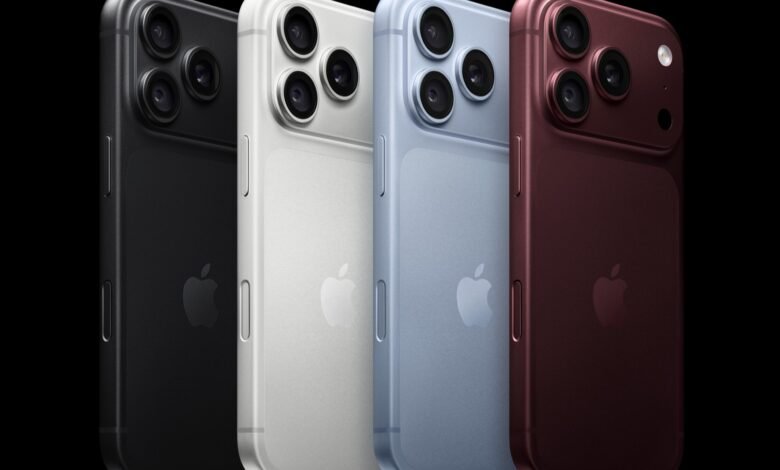
The 1TB and 2TB versions of the iPhone 18 Pro and Pro Max use QLC flash storage, while the 256GB and 512GB versions stay on the faster TLC type. HOMOLAB, a Chinese storage testing channel, published the finding on Bilibili on 20th September 2026 after benchmarking a 1TB iPhone 18 Pro Max against a 512GB one. The 512GB phone won the random read and write tests by up to 38%.
That’s the cheaper phone. In the US the 1TB Pro Max costs $1,899, or about KES 246,000. The same phone with 512GB costs $1,499, or about KES 194,000. So the extra $400, about KES 52,000, buys twice the space on slower storage.
Apple launched both phones on 9th September 2026 and doesn’t say which kind of flash each model gets. Its iPhone 18 Pro spec page lists the capacities and nothing else about the storage.
What QLC and TLC mean
Your phone’s storage is a flash chip made of billions of tiny cells, and each cell holds data as a level of electrical charge. A TLC (triple-level cell) cell stores 3 bits by telling apart 8 charge levels. A QLC (quad-level cell) cell stores 4 bits, so it has to tell apart 16.

The extra bit is why QLC exists. The same chip holds a third more data, so a 1TB or 2TB phone needs less flash, and that makes each gigabyte cheaper to build. The catch is that 16 levels sit much closer together than 8. The phone has to write each cell slowly and carefully to land on the right level, and QLC cells wear out after fewer rewrites.
Apple has not said why it made the switch.
How Apple hides the slow part
Apple doesn’t write straight to the QLC cells. The 1TB phone uses part of its empty space as a cache in SLC mode, one bit per cell, which is the fastest way to write flash. New data lands there first, and the phone moves it into QLC later, when it’s idle.
On a nearly empty phone, HOMOLAB measured the SLC cache at about 250GB, writing at more than 3,000 MB/s. That’s roughly a minute and a half of writing flat out before the cache fills. After that the phone drops to a second buffer that writes in TLC mode at about 578 MB/s.
When both are full, data goes straight into QLC. HOMOLAB measured that at an average of 79.4 MB/s, falling as low as 25.6 MB/s. For comparison, an ordinary UHS-I memory card tops out at 104 MB/s. So a $1,899 phone, pushed hard enough, writes at memory card speed.
It gets worse as the phone fills up
The cache lives in free space, so it shrinks as you fill the phone. With the 1TB phone 60% full, HOMOLAB found the SLC cache down to about 58GB. The TLC buffer after it wrote at 396 MB/s. Direct QLC writes averaged 45 MB/s and dipped to 1.1 MB/s at the worst point. That 1.1 MB/s is the worst moment in a long run of writing, not a steady rate.
The everyday speed gap
HOMOLAB also ran random tests, which read and write small 4K chunks of data scattered across the chip. That’s closer to what a phone does when it opens an app or loads a photo library than one long file copy.
At a queue depth of one, meaning one request at a time, the 512GB phone scored 11,285 against the 1TB phone’s 8,168. That’s the 38% gap. With four requests at once, the gap closed to 12%, at 35,992 against 32,219.
Will you notice?
For most people, no. Taking photos, installing apps and sending messages write small amounts in short bursts, and those fit inside the cache with room to spare. The cache then empties itself in the background.
Long, heavy writes are where it shows. Think copying a big video library onto the phone, restoring a full backup, or shooting long ProRes video, Apple’s large, lightly compressed video format. Apple itself asks for an external drive that writes at least 220 MB/s before it will record 4K ProRes at 60 frames per second to it. On paper, at that rate, the 250GB cache on an empty 1TB phone lasts about 19 minutes. At 60% full, the 58GB cache lasts about four and a half. The TLC buffer comes next and is still fast enough. Past that, the QLC layer’s 45 to 79 MB/s is well short of 220.
So if you’re buying a 1TB or 2TB model for room to store photos and apps, you won’t feel this. If you’re buying it to shoot and move hours of ProRes, the 512GB model with a fast external SSD is the better buy, and it’s $400 cheaper.
iPhone 18 Pro prices and storage type
Prices are US Apple Store prices before tax, and they include the $100 rise Apple put on every iPhone this month.
| Model | Price | About | Storage type |
|---|---|---|---|
| iPhone 18 Pro 256GB | $1,199 | KES 155,000 | TLC |
| iPhone 18 Pro 512GB | $1,399 | KES 181,000 | TLC |
| iPhone 18 Pro 1TB | $1,799 | KES 233,000 | QLC |
| iPhone 18 Pro 2TB | $2,399 | KES 311,000 | QLC |
| iPhone 18 Pro Max 256GB | $1,299 | KES 168,000 | TLC |
| iPhone 18 Pro Max 512GB | $1,499 | KES 194,000 | TLC |
| iPhone 18 Pro Max 1TB | $1,899 | KES 246,000 | QLC |
| iPhone 18 Pro Max 2TB | $2,499 | KES 324,000 | QLC |
HOMOLAB benchmarked the 1TB Pro Max. Its report puts the 2TB models on QLC too, though it didn’t publish results for a 2TB phone. Apple has not commented publicly on the findings.





Join the discussion