

If you grew up in Africa in the early 2000s, chances are your first real taste of the internet came through a humming Windows desktop in a dimly lit cybercafé. Back then, the Windows logo was practically the gatekeeper to the web. Whether you wanted to check your brand-new Facebook account, fire off a Yahoo email, download a form, or even type out your first CV, you’d probably be doing it on a beige or black Windows box running XP or Windows 7.
Fast-forward to 2025, and the picture couldn’t be more different.
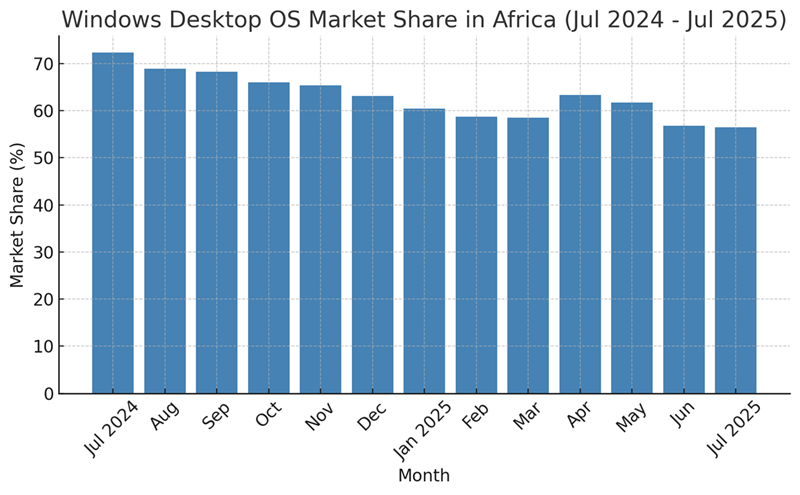
According to StatCounter’s Desktop Operating System Market Share in Africa (July 2025), Windows is still the top dog with 56.46%, but it’s limping a little. That’s down from a whopping 72.28% just a year ago. It dipped ever since to 68.86% in August, 66.03% in October, 60.41% by January 2025, and now sitting at 56.46%. That’s a massive 15.82% drop in just twelve months.
What’s eating into Windows’ lunch? It’s not just Macs. It’s the smartphone.

Today, the tasks that once sent you sprinting to a cybercafé, be it sending an email, applying for a job, downloading movies and songs, or even editing photos, can be done from the palm of your hand. And with affordable Androids and increasingly powerful iPhones flooding the market, the cybercafés (and their Windows desktops) have quietly vanished from most towns and cities.
macOS: From Invisible to Suddenly Everywhere
Here’s where it gets interesting. For eight straight months from July 2024 to February 2025, macOS held an official 0% market share in Africa according to StatCounter. Then, like a plot twist in a good drama, March 2025 happened: macOS popped up at 0.98%. By April, it was 2.88%. May? 3.6%. June? 5.18%. And now, July 2025? 5.2%.
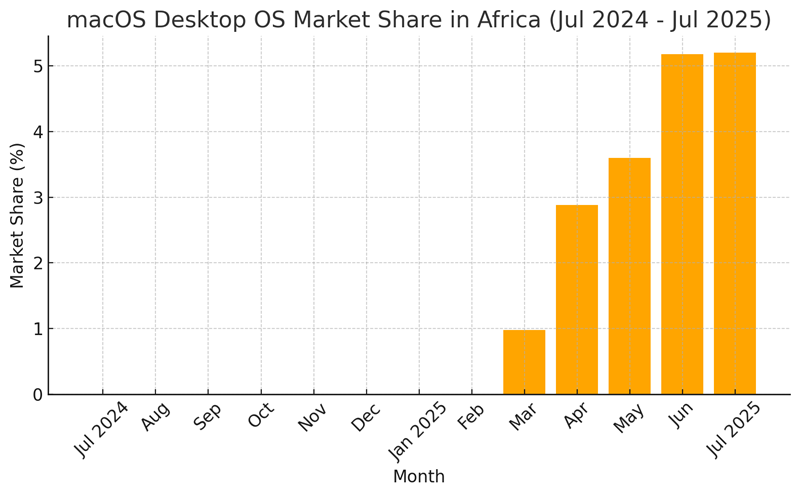
That’s a meteoric climb for a platform that has always been seen as premium and pricey on the continent. The growth hints at a new wave of African users that include young professionals, designers, DJs, coders, content creators, and freelancers who are now investing in MacBooks, perhaps for the design appeal, the performance, great battery life, or just the Apple logo clout.
And the timing? Perfect. Apple is rumoured to be cooking up a $599 MacBook powered by the iPhone 16 Pro’s A18 Pro chip with an aim to expand market share into developing markets. If Apple brings that to Africa, it might just ride this momentum wave straight into more living rooms, offices, and coffee shops.
Linux, OS X, and Chrome OS are Still Smaller Players
Linux in Africa nudged up slightly from 2.77% in July 2024 to 3.08% in July 2025, showing steady growth from a loyal but very much niche user base. OS X (yes, the older Mac operating system branding) slipped a bit from 4.62% to 3.98%. And Chrome OS? It’s in trouble, down from 0.59% to just 0.34%.
The Mystery Giant: “Unknown” at 30.92%
StatCounter lists an “Unknown” OS category at 30.92% market share in July 2025, up from 19.71% last year. That’s nearly a third of Africa’s desktop OS usage going into the mystery box. Are these obscure Linux distros? Pirated Windows copies? Niche operating systems for specific industries? It’s anyone’s guess.
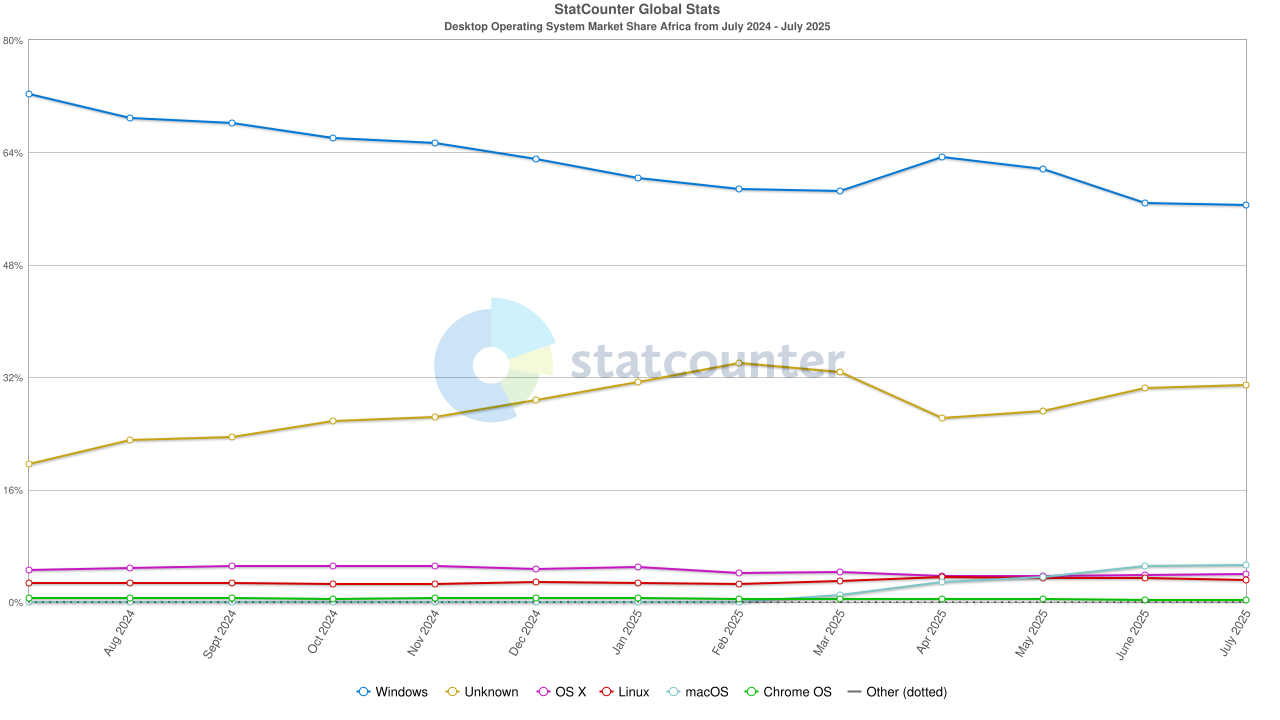
But from where I’m sitting, Africa’s desktop OS story is in the middle of a shake-up. Windows still rules, but it’s losing ground fast. macOS is making an unlikely sprint, Linux is holding the fort, Chrome OS is fading, and “Unknown” is… well, quietly massive.
If Apple actually delivers that affordable MacBook here, we might be looking at one of the most interesting PC market shifts the continent has seen in decades.







Join the discussion