

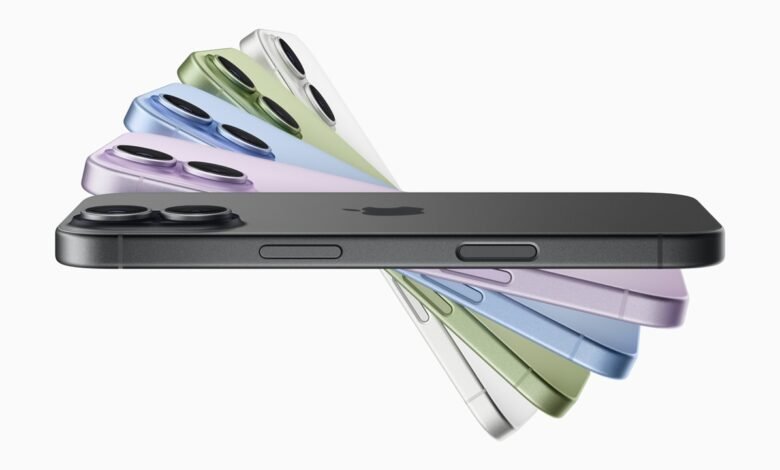
Counterpoint Research has published three separate reports on the Q1 2026 smartphone market across April and May 2026, and the figures only make sense when read together. The first, on 10 April, showed global smartphone shipments fell 6% year-on-year as the memory crunch hit, with Apple becoming the world’s number-one vendor in a first quarter for the first time ever. The second, on 4 May, ranked the iPhone 17 as the world’s best-selling phone with a 6% share and noted the top 10 models took a record 25% of all sales. A third tracker, released in February, locked down the cause: mobile RAM prices climbed 50% quarter-on-quarter and NAND storage climbed over 90% QoQ in Q1 2026.
We covered the top 10 rankings themselves earlier. What follows is the business read on what the three datasets show together, and what it means for Kenyan buyers.
The smartphone market just split in two
Counterpoint’s three Q1 2026 reports show Apple leading global shipments in a first quarter for the first time ever, Xiaomi collapsing, and memory prices at record highs. Read them together, not separately.
Five facts now firmly established
One. The iPhone 17 captured 6% of all global smartphone sales in Q1 2026. The previous three quarters of 2025 were each led by the iPhone 16 at around 4%. The iPhone 17 Pro Max led Q4 2025 at 5%. So the single-model leader share has moved 4% → 4% → 4% → 5% → 6% over five quarters. Apple is widening its lead sequentially.

Two. The top 10 best-selling phones combined took 25% of all global sales, the highest first-quarter concentration Counterpoint has ever recorded. Full-year 2022 was 19%. Full-year 2023 was 20%. Q3 2025 was 20%. Q4 2025 jumped to 23%. The figure sat in the 19-20% band for years before the Q4 2025 to Q1 2026 step change.
Three. Apple finished as the world’s number-one smartphone vendor by shipments at 21% market share, the first time it has led the market in a Q1 in the company’s history. Samsung was second at 20%. Apple was the only top-5 brand to grow shipments year-on-year. Samsung fell 6%, OPPO fell 4%, Vivo fell 2%, and other vendors collectively fell 10%.
Four. Xiaomi’s shipments fell 19% year-on-year, the largest decline among the top 5, dropping its share from 14% in Q1 2025 to 12% in Q1 2026. Counterpoint attributed this directly to Xiaomi’s heavy reliance on budget hardware, which has been hit hardest by the memory crunch.
Five. Per Counterpoint’s February 2026 Memory Price Tracker, mobile RAM prices rose 50% QoQ and NAND storage rose over 90% QoQ in Q1 2026. For a sub-$200 phone with 6GB of LPDDR4X RAM and 128GB of eMMC storage, memory now eats 43% of the total bill of materials, up 25 points in one quarter. Counterpoint senior analyst Shenghao Bai put it directly: “Those who rely heavily on entry-level models to drive market share will face a significant risk of short-term losses.”
How the five facts tell one story
The memory crunch is the upstream cause. Samsung, SK Hynix, and Micron have shifted wafer capacity from standard DRAM and NAND toward high-bandwidth memory for AI data centres, as I explained in The End of Cheap Phones. That crushes budget OEMs disproportionately because memory is a bigger share of their bill of materials.
Xiaomi’s 19% decline is the upstream cause at the brand level. The Redmi A5 holding the #10 spot in the rankings is a marketing positive, but the volume collapse across Xiaomi’s full portfolio is the bigger data point. Apple’s first-ever Q1 vendor crown is the mirror image. Apple is the most premium-skewed top-5 vendor and is vertically integrated, with its own A-series chips. Counterpoint’s separate SoC tracker confirmed Apple grew chip shipments while Qualcomm and MediaTek saw double-digit declines.
The 25% concentration is the structural outcome. When the market contracts and budget OEMs lose volume, the same fixed group of premium devices ends up representing a bigger share of what is left. The iPhone 17’s 6% record is the most extreme expression of this.
The Kenyan read
Three things follow directly for Kenyan buyers.
First, the Galaxy A07 4G holding the #4 spot globally is doing real work locally. It pairs with the Lipa Mdogo Mdogo financing model, and Samsung’s six-year update commitment turns it into a multi-year purchase. Without that financing layer, the budget squeeze playing out at Xiaomi’s global scale would already be sharper here.
Second, Counterpoint estimates retail prices will rise roughly $30 on low-end phones and $150 to $200 on flagships in 2026. At about KES 129 to the dollar, that is around KES 3,900 added at the bottom and KES 19,000 to KES 26,000 at the top. We have already seen the top-end version play out, with the Galaxy A57 5G and A37 5G landing in Nairobi at prices well above historical mid-range norms. The sub-KES 20,000 phone landscape has narrowed since February.
Third, expect fewer fresh budget options through 2026. Counterpoint expects the memory shortage to last into late 2027. That is not a one-quarter pressure. It is the new operating environment.
What to watch
Whether the Galaxy S26 Ultra makes the Q2 2026 top 10 will tell us if Samsung’s premium tier can recover ground from Apple. Whether Xiaomi’s shipment decline narrows or worsens will indicate whether the budget squeeze is stabilising. Whether memory prices follow Counterpoint’s projection of moderating in the second half of 2026 will determine retail prices on devices launching in Kenya through Q4. The Q1 data is the most coherent quarterly picture yet of a smartphone market being reshaped upstream by AI data centres, and showing up downstream in what a Galaxy A37 costs in Nairobi.





Join the discussion