
If you’ve been closely watching the home internet wars in Kenya recently, you know the pressure is mounting. Local giants like Safaricom and Zuku have been forced to continually rethink their value propositions as Starlink beams down highly competitive packages from low Earth orbit.
But there’s a quiet global shift happening in Starlink’s pricing tiers that hasn’t officially touched down on African soil yet.
Late last year, Starlink launched a cheaper plan in the US, effectively splitting its popular Residential Lite offering into two distinct tiers: 100Mbps and 200Mbps. While the rebrand itself flew somewhat under the radar, I’ve been tracking its market availability, and the footprint is expanding fast. As of this writing, the new tier system has rolled out to 39 markets, including the US, UK, Australia, New Zealand, Canada, and a massive chunk of Europe from Albania to Switzerland.
Available countries:

Albania, Australia, Belgium, Canada, Czech Republic, Denmark, Estonia, Faroe Islands, Finland, France, Germany, Greece, Guernsey, Iceland, Ireland, Isle of Man, Italy, Jersey, Kosovo, Latvia, Liechtenstein, Lithuania, Luxembourg, Malta, Netherlands, New Zealand, North Macedonia, Norway, Öland Islands, Poland, Portugal, Romania, Slovakia, Slovenia, Spain, Sweden, Switzerland, United Kingdom, and United States
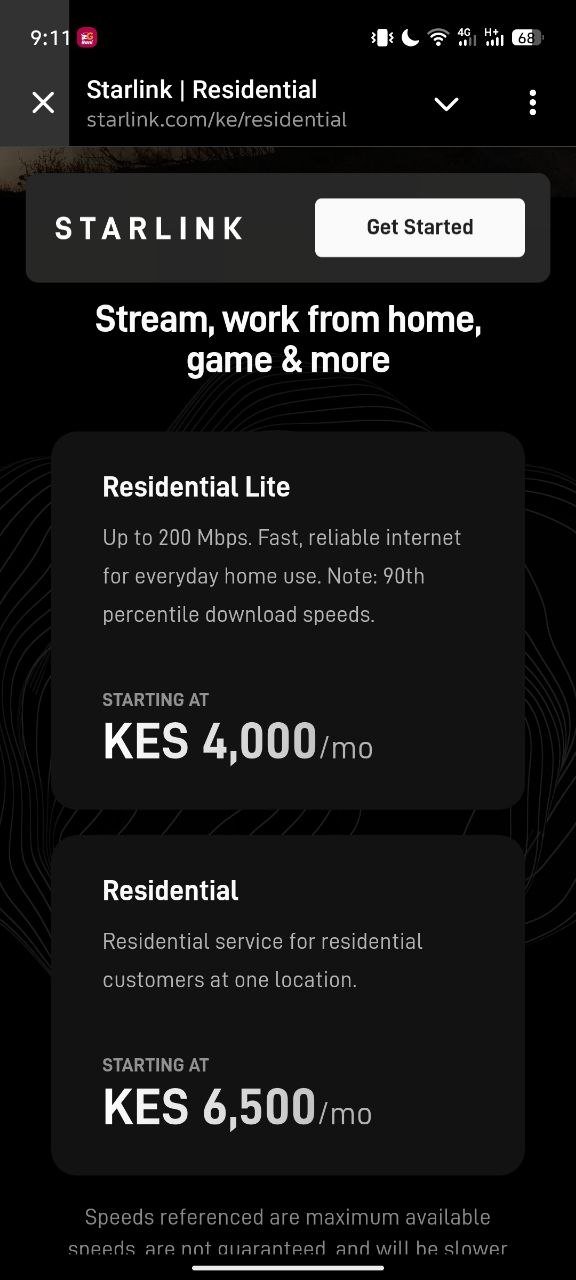
Here in Kenya, we are still waiting. We currently operate on the older naming convention, where our entry-level KES 4,000/month plan is the equivalent of the new Residential 200Mbps, and our KES 6,500/month premium plan mirrors the Residential Max.
When you look at the economics, a 100Mbps tier specifically tailored for the Kenyan market isn’t just a possibility, but an absolute necessity.
The global tiers vs. the Kenyan reality
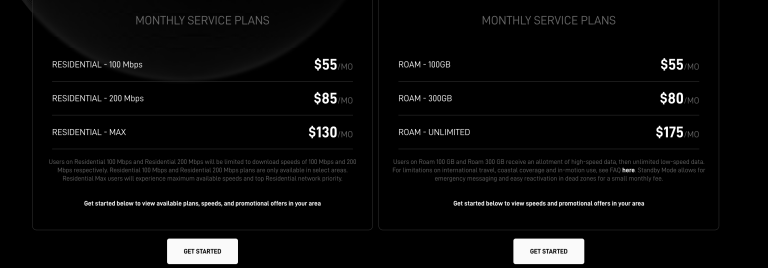
To understand where we are going, we have to look at what Starlink is currently charging in markets where the rebrand is fully active. In the United States, the entry-level 100Mbps plan started at $40/month but recently bumped up to $55/month. The 200Mbps tier sits at $85/month, while the Residential Max plan commands $130/month.
Contrast that with Kenya’s current pricing. Our KES 6,500 premium tier (Max) is roughly $50, less than half the US equivalent. Our KES 4,000 tier (200Mbps) sits at around $30. The economic adjustments are obvious, but it leaves a massive, unexploited gap at the bottom of the market. Starlink hasn’t confirmed when—or if—they will bring the 100Mbps plan to Kenya, but I fully expect them to make the move. If they apply the same regional pricing logic, a 100Mbps plan should land right at the KES 2,000 per month mark.
At KES 2,000 for a 100Mbps uncapped connection, Safaricom, Zuku, and Airtel would face an existential threat in the home internet space.
Why 100Mbps is the sweet spot
Under the new global branding, Starlink describes the Residential 100Mbps plan as an option for households with 1 to 3 people with basic needs like web browsing, video calls, and streaming. It offers download speeds capped at 100Mbps, upload speeds of 15–35 Mbps, and unlimited data (though speeds may be deprioritized during peak hours).
In Western markets, 100Mbps might be considered basic. But in Kenya, where 10Mbps to 15Mbps is still the standard for entry-level fixed internet, a 100Mbps connection is blazing fast. I see a situation where this plan instantly becomes the most popular among Starlink’s offerings.
Here is how the restructured lineup would shape up side-by-side:
| Tier | Download / Upload Caps | Best Used For | Estimated/Current Kenya Price |
| Residential 100Mbps | 100 Mbps / 15–35 Mbps | 1-3 people, web browsing, HD streaming | KES 2,000 / month (Projected) |
| Residential 200Mbps | 200 Mbps / 15–35 Mbps | Medium households, moderate heavy usage | KES 4,000 / month (Current) |
| Residential Max | 400+ Mbps / 20–40 Mbps | Large households, gaming, heavy concurrent downloads | KES 6,500 / month (Current) |
The hardware elephant in the room
So, what is stopping Starlink from dropping the KES 2,000/month 100Mbps bomb on the Kenyan market tomorrow?
Finding the right price for the subscription is the easy part. Getting the hardware into the hands of the demographic that needs a KES 2,000 plan is the real headache.
For someone targeting a budget-friendly monthly subscription, buying the Starlink hardware upfront is a massive, often insurmountable barrier. Even with the introduction of the Starlink Mini, the entry cost is aggressively high. As I argued recently, the Starlink Mini’s ridiculous activation fees and overall hardware costs are actively holding back mass adoption in Kenya.
You cannot sell a budget-friendly KES 2,000 monthly plan if the user has to drain their savings just to get the dish.
The Lipa Mdogo Mdogo solution
If Starlink genuinely wants to capture the massive demographic currently reliant on lower-tier fibre or limited 4G/5G home routers, they need to rethink hardware financing. A Lipa Mdogo Mdogo (pay-as-you-go) model is the most logical step. However, Starlink must carefully control this ecosystem to ensure Kenyan financing platforms don’t slap exorbitant markups on the devices, which would defeat the entire purpose of an accessible tier.
The 100Mbps plan is already proving successful across 39 global markets. Bringing it to Kenya at KES 2,000/month wouldn’t just be a win for the consumer; it’s the exact aggressive play Starlink needs to completely corner the African home internet market. Now, they just need to figure out how to get the hardware on our roofs without breaking the bank.





Join the discussion