

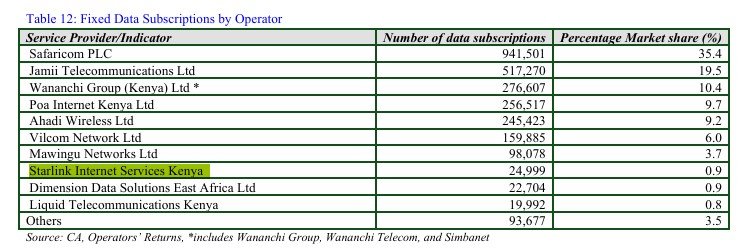
The fixed broadband market in Kenya is undergoing a fascinating transformation, driven largely by the disruptive entry of satellite internet providers. The Communications Authority of Kenya (CA) has just released its Third Quarter Sector Statistics Report for the Financial Year 2025/2026, covering the period from January 1st to March 31st, 2026. According to the industry data, Starlink Internet Services Kenya has reached a new milestone, officially recording 24,999 active subscribers in the country.
This figure marks a steady increase from the 22,282 satellite users recorded in the preceding quarter between September and December 2025. The growth solidifies Starlink’s grip on the satellite connectivity segment, pushing overall satellite internet subscriptions in the country up by 11.4 percent to 25,088 connections. This represents the highest growth rate among all fixed internet technologies during the quarter.
While traditional players continue to lead the broader fixed internet landscape with Safaricom maintaining the top spot at 941,501 subscriptions (35.4 percent market share) and Jamii Telecommunications trailing at 19.5 percent, Starlink’s 0.9 percent market share demonstrates impressive inroads for a relatively new, premium-priced technology.
However, this rapid subscriber acquisition has not come without its technical caveats. The surge in Starlink’s user base is creating visible pressure on the company’s network capacity in the region. There’s a concerning trend of slowing speeds for local users as the network becomes more crowded.

According to data from the network intelligence firm Ookla, Starlink’s average download speeds in Kenya dropped by 26 percent compared to last year, hitting a median of 34.55 Mbps in March 2026. This slowdown is largely attributed to localized network congestion, as the satellite bandwidth gets shared across a rapidly expanding pool of users in densely populated hubs like Nairobi.
To manage user expectations and address various consumer needs, the SpaceX-backed firm has been diversifying its service tiers. The recent introduction of Starlink’s 100Mbps residential plan was seen as a strategic move to offer more affordable, speed-capped alternatives for standard households that do not require maximum, unrestricted bandwidth. But this plan is still limited in availability.
On the hardware front, the company introduced compact dish variants to lower the barrier to entry, although Starlink Mini’s ridiculous activation fee is holding back adoption in Kenya. High upfront hardware and activation costs remain the primary friction points for low-to-middle-income households looking to transition to low-earth-orbit (LEO) internet.
Despite these hurdles, enterprise and institutional uptake of the service remains robust. Starlink is increasingly being viewed as a highly reliable primary and secondary connection for the education sector, backed by a recent study showing Starlink replacing mobile data and fibre in Kenyan schools. The ability to completely bypass complex terrestrial infrastructure rollouts makes these satellite dishes a game-changer for educational facilities situated outside major fibre optic grids.

In response to its scaling user base, Starlink has also had to tighten its local regulatory and compliance frameworks to operate smoothly. The company recently enforced ID verification, ensuring all local subscribers fully conform to the national Know Your Customer (KYC) requirements mandated by the CA.
Looking ahead, Starlink’s honeymoon phase as the sole high-speed LEO broadband provider in Kenya might soon end. The competitive landscape is gearing up for a major shift with Amazon applying for a satellite internet licence in Kenya. Amazon’s Project Kuiper aims to deploy a rival constellation that will aggressively compete for the same rural and enterprise demographic, and we know Safaricom’s parent company, Vodafone, wants a piece of Amazon’s satellite technology.
As of Q3 2025/26, the data remains clear: Kenyans are hungry for reliable broadband, driving total fixed data subscriptions up 7.9 percent to reach 2,656,653. In the same period, fibre optic connections maintained steady growth, jumping 7.0 percent to 1,474,201 users. For Starlink to maintain its impressive momentum amidst this growth, the company will need to strike a delicate balance between expanding its subscriber base and urgently upgrading its ground and space infrastructure to reverse the current trend of declining speeds and lower the minimum entry barrier.









Join the discussion