


- WhatsApp will finally let you chat without sharing your number.
- Just not yet. Right now you can only reserve the name.
- It's a land grab, and the first person to claim a name keeps it.
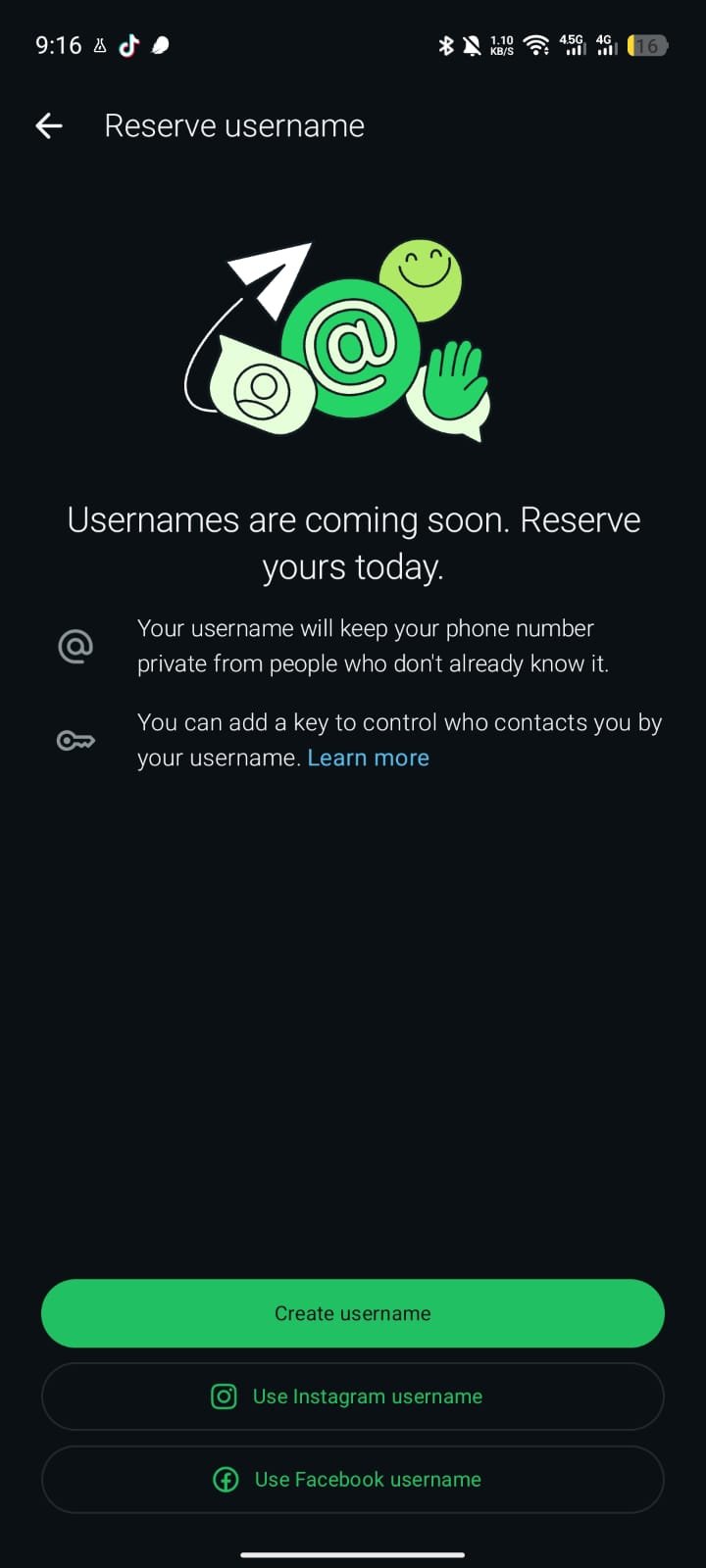
- Some Kenyans already have the screen. We've got the screenshot.
- The catch nobody's flagging: a username won't hide a business's number.
Update for Kenya: This is already reaching local accounts. Some Kenyans are now getting the in-app prompt to reserve and claim a username. The rollout is gradual, so not everyone will see it at the same time. One thing to keep clear: what is arriving now is the reservation, not the finished feature. The usernames themselves still will not work in chats until WhatsApp’s wider launch later this year.
On Monday, 29 June 2026, WhatsApp announced that it is opening username reservations to its users worldwide. The reservation window is rolling out this week and over the coming months. The full username feature, the part that actually lets you use the name in chats, is due to launch later in 2026.
If you have followed this story with us, the groundwork will be familiar. We covered it when WhatsApp first signalled that usernames were coming, and again in April when usernames began rolling out to a limited number of beta users on Android and iOS. Today’s announcement is the next step: the public reservation phase.
What a WhatsApp username actually does
Right now, to start a conversation on WhatsApp, someone needs your phone number. That number is personal. It is tied to your bank, your M-PESA, your two-factor codes, and much of the rest of your life. Handing it to a stranger, a new acquaintance, or a group of parents you have never met can feel like a lot.

A username changes that. Once the feature is live, you will be able to message new people and businesses, or join group chats, using a name instead of your digits. According to WhatsApp’s official announcement, when you message someone for the first time using your username, they will no longer see your phone number, provided you have turned the feature on.
This is optional. Nothing changes if you do nothing, and you will still need a phone number to register for WhatsApp in the first place. The username simply becomes the thing you can share publicly instead of your number. The idea is not new. Telegram, Signal, Instagram, and X have let people connect by handle for years. WhatsApp is the last of the giants to add it, and given its scale, the one that matters most for how billions of people swap contacts.
Why reserve a name now, before the feature even works
The reservation phase exists because of sheer numbers. WhatsApp says it has more than three billion users, and with a base that large, a lot of names overlap. In practice this is a land grab. The first person to reserve a name gets it, which is why WhatsApp is letting you claim one months before you can use it.
How to reserve your username
The steps are simple, once the option reaches your account:
- Update WhatsApp to the latest version from the Play Store or App Store.
- Open Settings > Account > Username.
- Type the username you want, or use the built-in generator if you need suggestions.
- Reserve it, as long as it is still available.
WhatsApp will notify you in the app when the option becomes available in your country. In Kenya, that has started: some users are already seeing the prompt, though the rollout is still gradual and has not reached everyone.
On the screen itself, titled “Reserve username,” you get three choices. You can create a brand new username, or claim the one you already use on Instagram or Facebook. As the screenshot above shows, the screen still reads “Usernames are coming soon,” a plain reminder that you are reserving a name now, not switching the feature on yet.
The rules for picking a name
There are limits, mostly to stop scams and impersonation. Based on details documented by WABetaInfo, which has tracked the feature through testing, a username:
- Must be between 3 and 35 characters.
- Must include at least one letter, and that letter has to be the first character. Numbers or symbols alone are not enough.
- Can use lowercase letters, numbers, periods, and underscores.
- Cannot start with “www.” or end with a domain extension like .com, so no one can dress a username up to look like an official website.
- Cannot contain two periods in a row.
The extra lock: a “username key”
WhatsApp has also built an optional username key. This is a code that someone must know before they can message you for the first time. Without it switched on, anyone who knows your exact username can start a chat. With it on, your username alone is not enough, though people who already have your phone number are unaffected. WhatsApp suggests turning it on if you are claiming a well-known handle or already have a public following, since a public name is easy for strangers to find.
Creators and businesses: claim your handle, but read the fine print
WhatsApp is letting creators, small businesses, and organisations claim the same username they already use on Instagram or Facebook, so their presence stays consistent across apps. You cannot simply type in a famous handle, though. You have to prove you own it by linking your WhatsApp account to Meta’s Accounts Center, the same hub that ties your Instagram and Facebook together. That linking is itself a privacy trade-off worth weighing.
There is one detail almost every report has glossed over. According to Meta’s own developer documentation, business usernames are not designed for privacy. If a business adopts a username, its phone number will still be visible in the app. The number-hiding benefit is built for ordinary users, not business accounts. If you run a business on WhatsApp, do not assume a username keeps your line private.
No directory, by design
One thing WhatsApp is deliberately not building is a search directory. There is no way to browse usernames and no recommendation system. People need to know your exact username to contact you for the first time. That is a privacy choice, and it stops usernames from becoming a tool for strangers to find and spam you, a real risk on platforms that do let you search for people.
Why this matters for Kenya
WhatsApp is not just popular here, it is close to universal. Industry figures have repeatedly put WhatsApp usage at around 97% of Kenya’s internet users aged 16 to 64, among the highest rates anywhere in the world. With roughly 27 million Kenyans online according to DataReportal, that points to somewhere between 22 and 25 million people who treat the app as their default way to communicate. We explored that dependence in detail when WhatsApp ads arrived in Kenya.
For a country that runs Chamas, side hustles, customer service, and family life through WhatsApp, a way to share a contact without exposing a personal number could change how strangers connect. With some Kenyan accounts already seeing the reservation prompt, this is not a distant feature to watch from afar. It is reaching one of WhatsApp’s most dependent markets right at the start. It also fits a longer pattern of Meta reshaping the app, from ads to a paid WhatsApp Plus tier.
The bottom line
Reservations are open globally and have started reaching Kenyan accounts, so you may already see the prompt. The usernames themselves still will not work in chats until WhatsApp’s wider launch later this year, so reserving a name now does not change how you message anyone today. If you have a public handle, a brand, or a business name you want to protect from being taken, claim it as soon as the option appears. For everyone else, there is no rush. This is a privacy upgrade to be aware of, not a race to win.






Join the discussion