

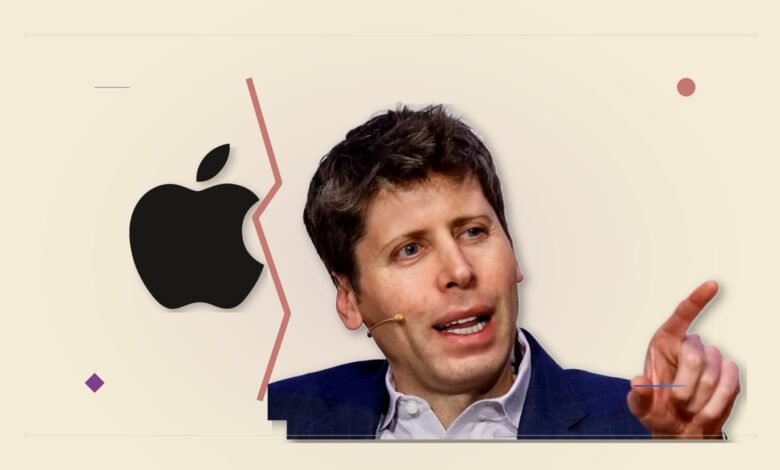
Apple has sued OpenAI in a US federal court, accusing the ChatGPT maker of running a coordinated campaign to steal Apple trade secrets and use them to build OpenAI’s upcoming AI hardware device.
The lawsuit was filed on Friday, 10th July 2026, in the US District Court for the Northern District of California. It names OpenAI, its hardware subsidiary io Products, and two former Apple employees who now work at OpenAI: Tang Tan, OpenAI’s Chief Hardware Officer, and Chang Liu, a former senior systems electrical engineer at Apple.
“This case is about Apple’s former employees stealing Apple’s trade secrets for the benefit of OpenAI. Apple brings this suit to put a stop to it,” the filing reads.
This is a dramatic collapse of what was once a headline partnership. In 2024, Apple and OpenAI announced that ChatGPT would be integrated into Siri and Apple Intelligence, with Sam Altman visiting Apple’s headquarters for the announcement. Two years later, the two companies are in court.

What Apple is alleging
The complaint centres on Tang Tan. Before joining OpenAI, Tan spent 24 years at Apple, most recently as Vice President of Product Design for the iPhone and Apple Watch. He co-founded io, the hardware startup started with famed former Apple design chief Jony Ive, which OpenAI acquired in 2025 for roughly USD 6.5 billion. We covered that acquisition, and what it signalled about Apple’s AI position, when the deal was announced.
According to Apple’s filing, Tan used his insider knowledge to extract confidential information during OpenAI’s recruitment of Apple staff. The allegations include:
- Using Apple’s internal project codenames during interviews to draw out more details from candidates still employed at Apple.
- Directing candidates to bring “actual parts” from Apple, including batteries, logic boards and SIPs (system-in-package chips), to interviews for “show and tell” sessions.
- Circulating an internal Apple managers’ document marked “Need to Know”, which describes Apple’s security procedures for departing employees, so new OpenAI hires could evade exit checks.
- Advising recruits not to tell Apple they were leaving for OpenAI, so they could stay inside Apple for as long as possible.
The second named defendant, Chang Liu, spent eight years at Apple before joining OpenAI in January 2026. Apple alleges he never returned a company-issued laptop, skipped his exit interview, and later exploited a bug that let him access Apple’s internal cloud storage after he had already left. The filing quotes a message Liu allegedly sent a former colleague: “LOL, I found out I can access the [network storage], so funny.” Apple says he downloaded dozens of confidential files, including over a thousand pages of technical documents covering unreleased products, engineering presentations and manufacturing details for circuit boards.
Apple also accuses OpenAI of taking stolen information to Apple’s own suppliers. In one instance, the filing says, OpenAI got a manufacturing partner to demonstrate a trade-secret metal-finishing technique for an OpenAI device by misleading the partner into believing Apple had given permission.
The scale claim is notable: Apple says more than 400 of its former employees now work at OpenAI, and that its investigation “uncovered a pattern of theft” that runs “at every level, from members of its Technical Staff to its Chief Hardware Officer”.
Apple says it raised these concerns with OpenAI directly in February 2026 and received no response.
What Apple wants
Apple is asking the court to stop OpenAI from possessing, using or disclosing its trade secrets, to order the return of confidential materials, to preserve evidence, and to award damages “in an amount to be determined at trial”. Tan and Liu are additionally sued for breach of their contracts with Apple.
A court order blocking OpenAI from using contested technology could complicate the company’s device plans. OpenAI has not publicly confirmed what its first device is, though reporting from The Information points to a camera-equipped smart speaker, and OpenAI executives have said a device would arrive soon. The legal discovery process also gives Apple a window into OpenAI’s hardware operation that it currently does not have.
What Jony Ive has to do with this
Jony Ive, Apple’s former Chief Design Officer and the designer behind the iPhone, iPod and Apple Watch, leads OpenAI’s device design. He co-founded io with Tan, Evans Hankey and Scott Cannon, all Apple veterans. Notably, Ive is not named as a defendant, and the filing does not accuse him of wrongdoing. The same goes for Hankey and Cannon.
The bigger fight
The relationship between the two companies had already soured before Friday. Bloomberg and The New York Times reported earlier this year that OpenAI was itself weighing legal action against Apple, claiming Apple had not sufficiently integrated and promoted ChatGPT under their partnership. Apple’s revamped Siri, expected later this year, is reportedly built on Google’s Gemini models rather than ChatGPT. Apple’s filing says the ChatGPT partnership agreement is not at issue in this case.
OpenAI had not responded to requests for comment from Reuters, CNN and other outlets at the time of writing. We will update this story if the company issues a statement.
OpenAI is no stranger to courtrooms. A California jury threw out Elon Musk’s lawsuit against OpenAI and Sam Altman in May, ruling he waited too long to sue. This case is different: it targets the hardware business OpenAI is betting on for its next phase of growth, and it lands as the company reportedly prepares for a massive IPO.
For readers here in Kenya, nothing changes immediately. ChatGPT still works on iPhones, and the cheaper ChatGPT plan OpenAI launched in Kenya is unaffected. What to watch is whether the court blocks any technology inside OpenAI’s device before launch, whether Apple quietly pulls ChatGPT out of Siri, and what OpenAI’s formal response says. Trade secret cases of this size usually take years or end in settlement, so treat this as the opening move, not the verdict.
Sources: Apple’s complaint as reported by Reuters, CNBC, TechCrunch, 9to5Mac, CNN, Axios.




Join the discussion