

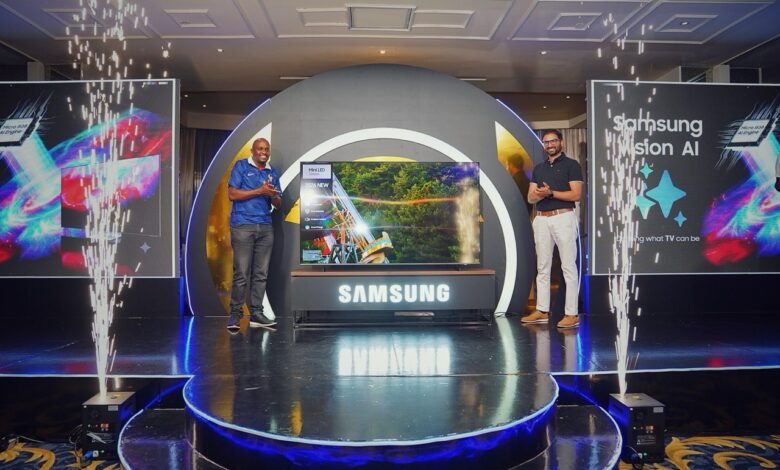
Samsung Electronics East Africa unveiled its 2026 television line-up in Kenya on 11 July. The headline product is a new Mini LED range, sold as two series, the M80H and the M70H. Samsung also confirmed that Micro RGB, the most advanced screen technology it makes, arrives in Kenya in September.
The main thing to know is that these new Mini LED sets are value offerings. They are the cheapest Mini LED televisions Samsung has ever made, and they sit one rung below Neo QLED, the range Samsung has been selling in Kenya since 2021.
First, what is a Mini LED TV?
Every LCD television needs a light source behind the screen. The picture you watch is that light shining through a layer of pixels.
An ordinary LED television uses a modest number of fairly large LEDs to make that light, grouped into a handful of zones. When a scene has a bright object against a dark background, say a torch in a night scene, the set cannot dim the area around the torch without dimming the torch too. Blacks turn grey.

Mini LED shrinks those LEDs so that thousands of them fit behind the same panel, split into many more zones. The television can hold one patch of the screen bright while keeping the patch next to it dark. Contrast improves, blacks look deeper, and the halo of light that spills around bright objects, called blooming, gets smaller.
Where the new sets fit in Samsung’s range
Samsung’s televisions come in tiers. At the bottom sit the basic Crystal UHD sets. At the top of its LCD range sits Neo QLED, which combines a Mini LED backlight with a layer of quantum dots. Quantum dots are microscopic crystals in a film in front of the backlight that convert its light into purer, more saturated red and green. They are what give a QLED its colour punch.
The new M80H and M70H take the Mini LED backlight and leave out the quantum dot layer. They are Samsung’s first Mini LED televisions built this way, replacing the mid-range QLED sets Samsung used to sell. The easiest way to think of them is Neo QLED’s backlight at a friendlier price. Samsung’s own pitch in the US is premium picture quality “at an unmatched value”, and that is a fair description of what these are for.
What Samsung announced
The launch leaned on three features. Vision AI Companion lets you ask the television questions using a dedicated button on the remote. AI Soccer Mode recognises a football match on screen and automatically tunes the picture and sound for it. Motion Xcelerator 144Hz smooths fast motion for sport and gaming.
“For 20 years, Samsung has led the global TV market by continuously innovating to meet the changing needs of consumers,” said Sam Odhiambo, Samsung’s Head of Consumer Electronics Business in Kenya, at the launch. That 20-year run checks out: research firm Omdia puts Samsung at 29.1% of global TV revenue in 2025, its 20th straight year on top.
Choosing between the M80H and the M70H
The two series look similar on a shelf but are quite different inside, so the model number matters.
The M80H is the one with the headline features. It has the 144Hz panel, variable refresh rate and AMD FreeSync for gaming, Samsung’s NQ4 AI Gen2 processor, and the full AI Soccer Mode. The M70H runs a standard 60Hz panel with a simpler processor, and gets a plain Soccer Mode rather than the AI version. It comes in smaller sizes too, from 43 inches, where the M80H starts at 55.
One useful thing to know about that 144Hz number: it is a gaming specification. Football broadcasts in Kenya arrive at 50 frames per second or below, so for DStv or free-to-air matches, both sets show the same feed equally well. The 144Hz panel earns its keep when you plug in a PlayStation, an Xbox or a gaming PC. If you game, buy the M80H. If you mainly watch broadcast TV and streaming, the M70H covers you. One naming note: the same football feature is branded AI Football Mode in some markets, so either label may appear in the menu.
What to expect from the picture
Coming from a basic LED television, either set should be a clear upgrade in contrast and black levels. That is what the Mini LED backlight is for.
If you compare them side by side with a Neo QLED in the shop, expect a visible gap. TechRadar measured the M80H against the QN80H, the entry Neo QLED in the same 2026 line-up, and recorded 269 nits of full-screen HDR brightness on the M80H against 634 on the QN80H. The tester found the M80H’s colours natural and true to life, but the set noticeably dimmer, and more prone to reflections in a bright room. Kenyan sitting rooms get a lot of daylight, so if your TV faces a window, that difference is worth checking in person. He also rated the AI Soccer Mode’s commentary clarity highly. We have not tested Kenyan units ourselves.
The software is a genuine strength
Both series run Samsung’s One UI Tizen with a promise of seven years of operating system updates, which few brands at this price match. We reported in April on Google Cast arriving on Samsung televisions, and in June on new Samsung sets in Kenya, Uganda and Tanzania shipping with the DStv Stream app pre-installed. Both series also carry Samsung’s Gaming Hub for cloud gaming and Q-Symphony for pairing with a Samsung soundbar.
One thing to confirm in the shop
Vision AI Companion is the conversational side of the TV: an upgraded Bixby assistant, plus Microsoft Copilot and Perplexity as apps, plus Live Translate. Samsung rolls these features out region by region, and its product pages note that availability varies by country and model. Kenya’s launch did not spell out which features are live on local units, and Bixby’s supported languages do not yet include Swahili. If the AI features are part of why you are buying, ask for a demonstration on the actual unit before you pay. We have asked Samsung Kenya for the full local feature list and will update this article.
What they cost
Retailers have started listing. The 75-inch M80H, model UA75M80HAUXKE, is going for around KES 165,000 against a KES 174,500 recommended price, and the 85-inch for roughly KES 240,000.
For scale, the 100-inch Neo QLED Samsung brought here last September launched at KES 699,000. An 85-inch Samsung for KES 240,000 is a very different proposition, and it shows how much this launch is about reach rather than the high end.
It also lands in a competitive spot. A 65-inch TCL C6K QD-Mini LED sells in Kenya for about KES 88,000, and a 75-inch Hisense U7N Mini LED for roughly KES 133,000, both with quantum dots included. TCL and Hisense have grown fast in Africa on exactly this kind of affordable Mini LED, with TCL’s global shipments up 20% last year while Samsung’s dipped. When we reviewed the TCL 43-inch V6C, dealers told us it was the best-selling TV in the country. The M80H and M70H are Samsung’s answer to that pressure, which is good news for buyers: it means real competition in the middle of the market, from a brand that until now saved Mini LED for its expensive sets.
What to take from this
If you want a big, modern Samsung with better contrast than a basic LED set, backed by seven years of updates, the M80H at around KES 165,000 for 75 inches is a genuinely strong offer. Just know what you are choosing: the M80H and M70H differ a lot, so check the model number; the gaming and AI football features live on the M80H; and if you want the brightest, most colourful Samsung, that is still Neo QLED, at Neo QLED money.
And keep September in mind. Micro RGB, the range Samsung is bringing next, is the one that moves its picture technology forward. We will cover it when it lands.


Join the discussion